
Inquire Now
Key strategic points
X band radar is a high‑frequency radar system operating in the 8–12 GHz frequency range of the electromagnetic spectrum. It is used for detecting, tracking, and imaging objects with high resolution, offering fine target discrimination.
The market encompasses the design, development, manufacturing, and integration of X band radar systems and components. It includes applications such as missile tracking, weather monitoring, air traffic control, and maritime navigation.
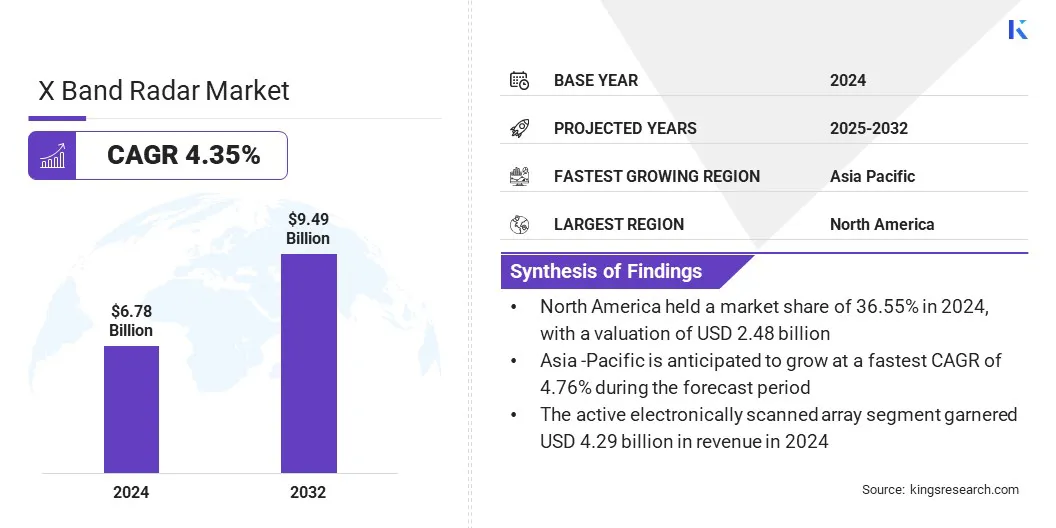
The global X band radar market size was valued at USD 6.78 billion in 2024 and is projected to grow from USD 7.04 billion in 2025 to USD 9.49 billion by 2032, exhibiting a CAGR of 4.35% over the forecast period.
Market growth is driven by the rising demand for high‑resolution imaging in military surveillance and missile defense systems. The increasing use of X band radar in weather monitoring and disaster management is further supporting its integration across defense, navigation, and environmental monitoring applications.
Major companies operating in the X band radar market are Northrop Grumman, RTX Corporation, Reutech Radar Systems, ProSensing, Detect Inc, Saab AB, Thales Group, Leonardo S.p.A, Hensoldt AG, Terma Group, GEM ELETTRONICA srl, Japan Radio Co., Ltd, FURUNO ELECTRIC CO., LTD, Mitsubishi Electric Corporation, and Bharat Electronics Limited.
Growing need for accurate and timely detection of aerial, maritime, and ground threats is driving the adoption of advanced X-band radar systems. Manufacturers are responding by developing next-generation radar platforms with enhanced detection precision, extended range, and improved target tracking capabilities.
Additionally, key players are investing in comprehensive lifecycle services including upgrades, maintenance, and technical support to ensure consistent performance and reliability, thereby strengthening market demand.
In June 2025, the U.S. Navy (USN) awarded RTX’s Raytheon a contract valued at USD 536 million to provide continued support for the SPY-6 family of radars for the United States Navy. The AN/SPY-6 radar system features an X-band radar engineered for horizon monitoring, missile communication, precise target tracking, and terminal guidance support. The contract covers training, engineering services, ship installation, and integration and testing, as well as software upgrades aimed at enhancing radar performance and operational capabilities.
Increasing Global Defense Budgets
A key factor propelling the growth of the X band radar market is the increasing global defense budgets, which are enabling nations to enhance surveillance and missile defense capabilities. Rising defense spending is allowing militaries to adopt advanced radar technologies that improve operational readiness, situational awareness, and threat response.
Governments and defense agencies are prioritizing high‑resolution, reliable radar systems to strengthen national security and support strategic defense initiatives to address evolving threats and maintain technological superiority in modern warfare.
High Development and Maintenance Costs of Advanced Radar Systems
A key challenge impeding the growth of the X band radar market is the high development and maintenance cost of advanced radar systems. The design and production of next-generation solid-state radars require expensive components, specialized engineering, and significant R&D investments. Moreover, ongoing expenses related to calibration, software upgrades, and skilled technical support further increase operational costs.
To address this challenge, market players are focusing on innovating cost-efficient radar designs and leveraging advanced technology that reduces lifecycle expenses compared to traditional magnetron-based systems. Companies are investing in modular architectures that simplify upgrades and lower integration costs for vessel operators, defense agencies, and weather monitoring authorities.
Development of Compact Radar Systems Designed for Tactical Operations
A key trend shaping the X band radar market is the development of compact radar systems designed for tactical operations. These systems offer enhanced portability, rapid deployment, and adaptability across diverse operational environments, including naval, airborne, and land-based missions.
Advances in solid‑state technology, miniaturized components, and efficient power management are enabling smaller, lighter, and lower-maintenance designs without compromising performance.
|
Segmentation |
Details |
|
By Platform |
Space-Based, Sea-Based, Ground-Based, Airborne |
|
By Technology |
Active Electronically Scanned Array, Passive Electronically Scanned Array |
|
By Application |
Defense & Military, Aviation & Air Traffic Control, Weather Monitoring, Space & Satellite, Others |
|
By Region |
North America: U.S., Canada, Mexico |
|
Europe: France, UK, Spain, Germany, Italy, Russia, Rest of Europe |
|
|
Asia-Pacific: China, Japan, India, Australia, ASEAN, South Korea, Rest of Asia-Pacific |
|
|
Middle East & Africa: Turkey, U.A.E., Saudi Arabia, South Africa, Rest of Middle East & Africa |
|
|
South America: Brazil, Argentina, Rest of South America |
Based on region, market has been classified into North America, Europe, Asia Pacific, Middle East & Africa, and South America.
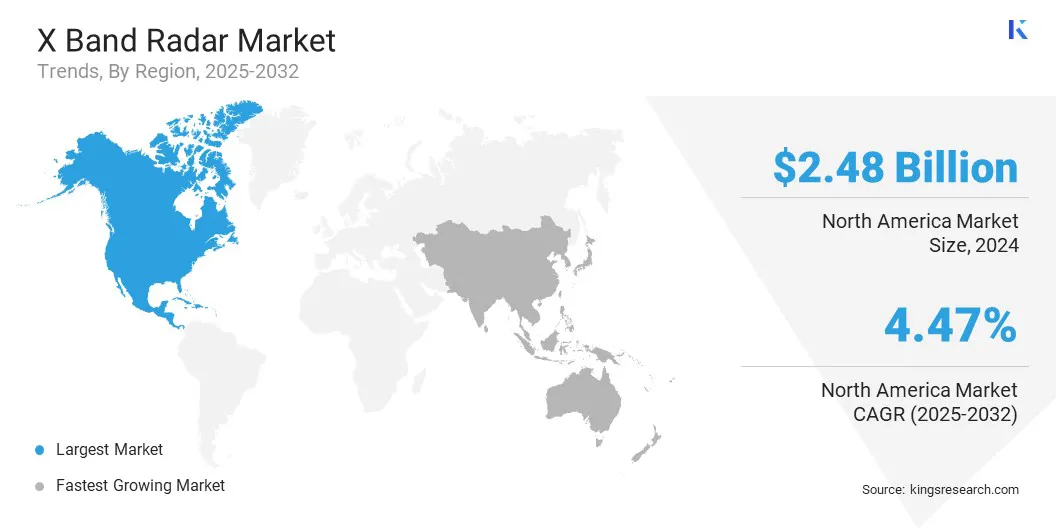
North America X band radar market share stood at 36.55% in 2024 in the global market, valued at USD 2.48 billion. This is driven by rising defense budgets that enable significant investments in advanced radar systems for surveillance, target tracking, and missile defense.
Increasing investments by governments and defense agencies in solid‑state radar technology is enhancing operational efficiency and reliability. Moreover, regional market players are strengthening indigenous radar production through long‑term procurement programs and strategic collaborations, thereby driving market growth in this region.
Asia Pacific is set to grow at a CAGR of 4.76% over the forecast period. This growth is driven by rising maritime security concerns and defense modernization initiatives that enhance naval fleets and coastal surveillance capabilities.
Rapid growth in port infrastructure and shipping traffic is driving the adoption of X band radars for enhanced navigation safety. Moreover, increasing government focus on disaster preparedness and climate resilience is encouraging the deployment of advanced radar systems for weather monitoring and environmental observation across the region.
Major players in the X band radar industry are focusing on developing advanced solid‑state radar systems to enhance detection accuracy, reliability, and operational efficiency. They are expanding production capabilities and delivering high‑performance radar units to strengthen their technology portfolios and meet growing defense and surveillance demands.
Additionally, they are investing in research and innovation to integrate cutting‑edge materials and architectures, improving radar sensitivity and range while reducing lifecycle costs.
Frequently Asked Questions

Swati is a committed research analyst with a passion for optimizing systems and processes across industries, specializing in healthcare but also bringing valuable expertise to sectors such as consumer goods, life sciences, and more. Her cross-domain research approach allows her to generate clear, actionable reports that inform strategic decisions in a variety of fields. Swati is committed to staying ahead of evolving trends, leveraging her broad understanding of different sectors to provide insights that are relevant to a range of industries. In her personal time, she enjoys music and spending quality time with her family, which inspires her creativity and enriches her professional approach. Her systematic methodology ensures that every report is both thorough and practical. Swati's ability to bridge regulatory frameworks with market realities gives her recommendations a distinct edge. She collaborates seamlessly with cross-functional teams, distilling complex data into straightforward narratives. Her proactive monitoring of policy and technological shifts keeps her analysis forward-looking.

With over a decade of research leadership across global markets, Ganapathy brings sharp judgment, strategic clarity, and deep industry expertise. Known for precision and an unwavering commitment to quality, he guides teams and clients with insights that consistently drive impactful business outcomes.