
Inquire Now
Key Strategic Points
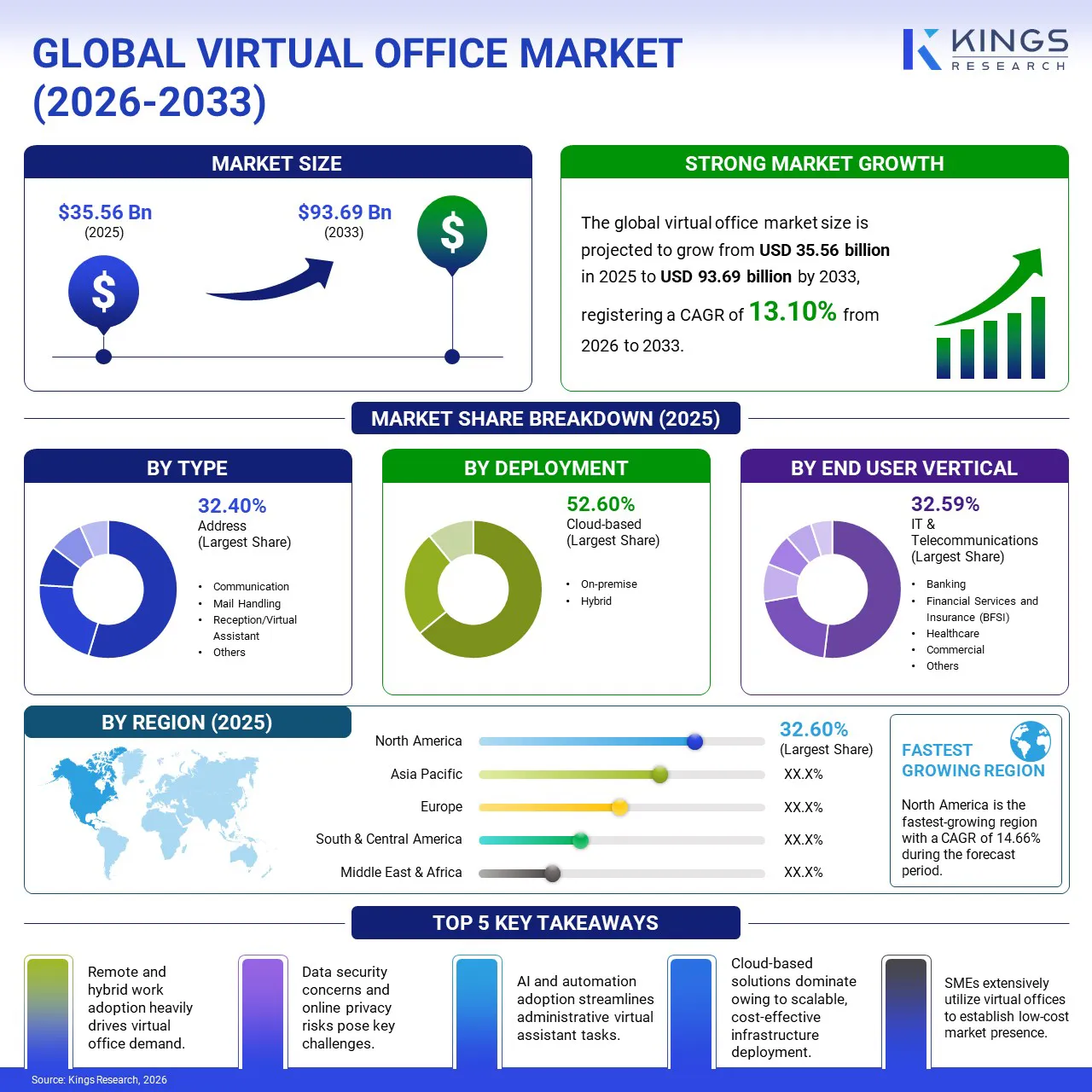
The global virtual office market size was valued at USD 35.56 billion in 2025 and is projected to grow from USD 39.59 billion in 2026 to USD 93.69 billion by 2033, exhibiting a CAGR of 13.10% during the forecast period. This robust growth is supported by the rising use of remote and hybrid work systems, along with cost-saving benefits for businesses and advancements in digital collaboration technologies.
Major companies operating in the global virtual office industry are International Workplace Group plc, WeWork Companies Inc., Servcorp, The Executive Centre, Industrious, Davinci virtual office, alliancevirtualoffices.com, Opus Virtual Offices, iPostal1, Awfis Space Solutions Limited, instaspaces.in, The Instant Group, Mindspace, Venture X, and Vast Coworking.
The growth of the market is also boosted by the increased demand for flexible business solutions, international business growth, and the necessity of a professional business address without any significant overhead expenses. The market is expected to record long-term growth and innovation in the next few years as organizations continue to concentrate on flexibility and operational efficiency.
The growth of remote and hybrid work models is a major driver of the virtual office market. With the rising adoption of flexible working arrangements by businesses, there has been a decline in the demand for traditional offices. Companies are seeking ways for employees to work effectively from any place while still representing the company professionally. Virtual offices offer essential services such as business addresses, mail handling, and access to meeting rooms without the costs or commitments of physical offices.
According to the Australian Bureau of Statistics (ABS), as of August 2025, 36% of employed people regularly worked from home, reflecting the sustained shift toward remote work arrangements. This adaptability allows companies to attract and retain talent from a wider geographic area and respond quickly to changing business environments. With remote work and hybrid work becoming the new norm, the market is growing as demand for virtual office solutions continues to rise.
Businesses are becoming increasingly dependent on online platforms to handle sensitive information and communication. Cyberattacks, data breaches, and unauthorized access are likely to jeopardize client confidentiality and the reputation of organizations. Since virtual offices usually involve accessing important business records and personal information over the Internet, it is important to ensure that robust security measures are in place.
Regulatory compliance, such as adhering to the GDPR or other data protection laws, adds further complexity for providers operating across multiple jurisdictions.
To address these challenges, businesses are investing in advanced cybersecurity solutions, including end-to-end encryption, multi-factor authentication, and secure cloud storage. Furthermore, periodic training for staff on best practices in data protection can enhance organizational security against possible attacks.
The growing use of advanced technology is one of the most important trends in the virtual office industry. Virtual office providers are adopting artificial intelligence and automation to streamline administrative processes such as virtual reception, call handling, and digital mail management. The use of cloud-based collaboration tools and secure virtual meeting rooms has become standard, enabling teams to communicate and share documents efficiently from anywhere.
Additionally, AI-driven workspace apps and assistants are being introduced by industry leaders to provide an enhanced user experience, improve productivity, and strengthen operational control.
On January 3, 2026, SoWork reported that remote work is being transformed by AI-driven virtual offices that can simulate face-to-face collaboration through avatars, spatial audio, and immersive digital workspaces. This has resulted in an 83% increase in productivity, and a 41% reduction in meetings, with technologies such as meeting summaries, action items extraction, and team analytics saving teams an average of 3.5 hours per week.
With more companies demanding efficient and flexible solutions, the continued adoption of advanced technology is likely to become the new standard for service quality, fueling market growth.
|
Segmentation |
Details |
|
By Type |
Address, Communication, Mail Handling, Reception/Virtual Assistant, and Others |
|
By Deployment |
On-premise, Cloud-based, and Hybrid |
|
By Organization Size |
Small and Medium-sized Enterprise (SME), and Large Enterprise |
|
By End User Vertical |
Banking, Financial Services, and Insurance (BFSI), Healthcare, IT & Telecommunications, Commercial, and Others |
|
By Region |
North America: U.S., Canada, Mexico |
|
Europe: France, UK, Spain, Germany, Italy, Russia, Rest of Europe |
|
|
Asia-Pacific: China, Japan, India, Australia, ASEAN, South Korea, Rest of Asia-Pacific |
|
|
Middle East & Africa: Turkey, U.A.E., Saudi Arabia, South Africa, Rest of Middle East & Africa |
|
|
South America: Brazil, Argentina, Rest of South America |
Based on region, the global market has been classified into North America, Europe, Asia Pacific, Middle East & Africa, and South America.
North America virtual office market share stood at 32.60% in 2025, valued at USD 11.59 billion. This strong market presence is largely attributed to the region’s highly developed digital infrastructure and the early adoption of cutting-edge communication technologies. The presence of a strong business environment, extensive broadband availability, and robust demand for affordable business solutions has helped the region to gain prominence in the market.
The use of virtual offices is propelled by the evolution of remote work, particularly among technology companies, startups, and professional service providers. Moreover, increased funding in cloud services and collaboration applications is highlighting the need for service providers. As innovation continues and the regulatory climate is favorable, North America will continue to be a major player in the market.
The Europe virtual office market is set to grow at a CAGR of 13.47% over the forecast period. This growth is supported by the increasing interest in sustainability, flexible working, and cross-border expansion of business in the region. Many European countries are seeing a surge in remote work adoption, facilitated by evolving labor regulations and a highly skilled workforce.
Moreover, the increase in the number of startups and SMEs that seek to increase their presence in new markets is fueling the demand for virtual office services. The rise in connectivity in the continent, along with investment in digital infrastructure and smart-city projects, is also contributing to the adoption of virtual office solutions in Europe.
The competitive landscape of the virtual office market is highly dynamic and marked by both global and regional providers offering a wide range of services. The competition revolves around issues like pricing, technological strengths, customization of services, and geographical coverage. Providers offer differentiated features such as mail handling, call management, access to meeting spaces, and integration of enhanced digital tools to facilitate remote collaboration.
Remote and hybrid work have intensified competition in the market, which has stimulated constant innovation and service portfolio growth. Strategic partnerships, investments in technology, and a focus on customer experience are key strategies as companies strive to enhance their offerings and secure a larger share of the growing market.
How We Gather This Information
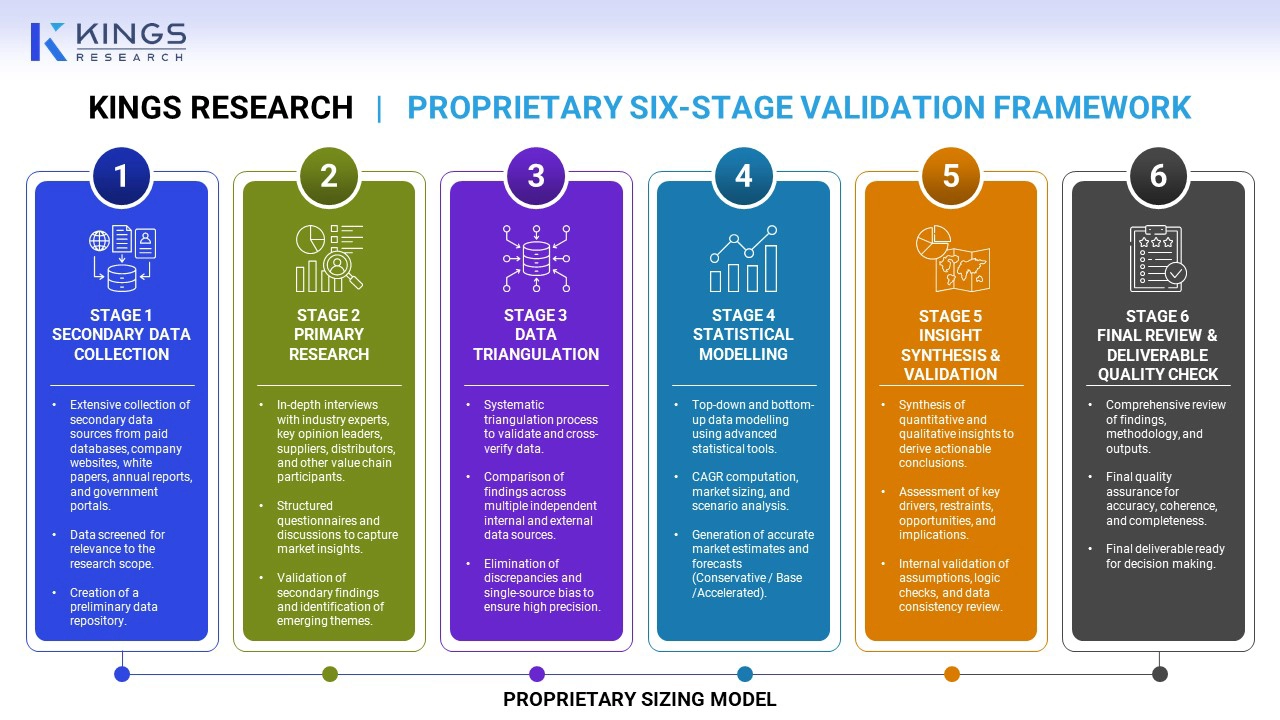
Our methodology triangulates insights from multiple independent and publicly available research databases and is further validated against regulatory filings and public company disclosures. All estimates are cross-verified; no single-source data is presented without validation.
 Why Kings Research?
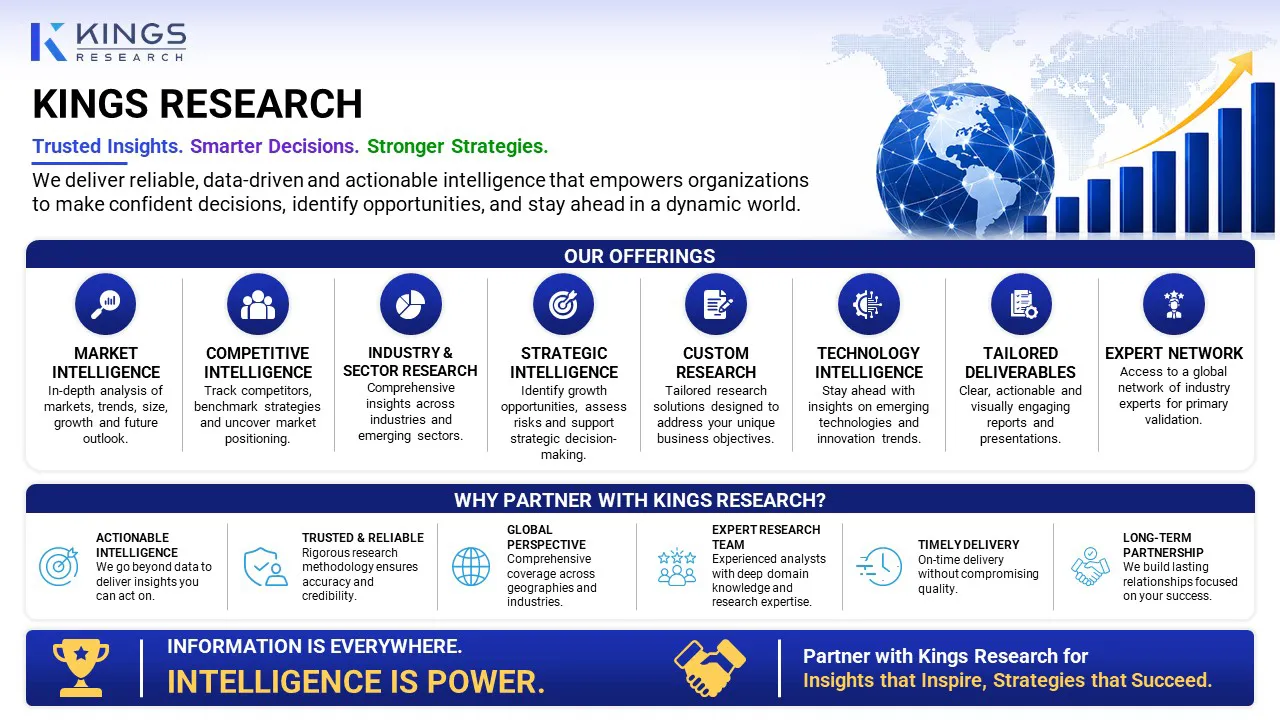
Our custom offerings deliver tailored, data-driven intelligence and strategic guidance to help organizations identify, evaluate, and capitalize on key market opportunities.
Frequently Asked Questions

Aswathi holds cross-domain expertise, translating market trends and competitive intelligence into decision-ready insights. Her work helps clients interpret evolving market conditions and identify growth opportunities. She brings a focused, insight-led approach to research execution. She translates these findings into clear, prioritized action plans that align with client capabilities. Her research often includes scenario modeling to test growth strategies under varying economic conditions. She maintains a rigorous validation process, cross-checking primary and secondary sources to ensure reliability. Clients value her ability to synthesize noisy data into concise executive summaries that drive board-level discussions. Her sector-specific lens, combined with a pragmatic focus on execution, consistently delivers high-impact, commercially sound recommendations. Her structured yet flexible research frameworks adapt to client timelines without compromising depth. She is known for distilling complex trade-offs into straightforward, defensible positions that facilitate confident decision-making.
With many years of consulting experience across global pharma, biotech, and MedTech markets, Minaz brings deep domain expertise, strategic clarity, and analytical rigor to every engagement. She has led 130+ consulting assignments spanning market entry, competitive landscaping, and portfolio prioritization, helping clients navigate complex, high-stakes decisions with confidence. Known for her ability to synthesize primary and secondary research into executive-ready recommendations, Minaz has built forecasting models and market sizing frameworks that have informed multi-million dollar investment decisions in oncology, diagnostics, and peptide therapeutics. Beyond her analytical strength, Minaz is a trusted client partner, translating complex datasets into clear, actionable insights for senior stakeholders. She currently leads a team of research analysts, driving business expansion, and shaping client engagement strategy.