
Inquire Now
Key Strategic Points
The spatial biology market covers technologies, instruments, reagents, software, and services used to study the spatial organization of cells and molecules within intact tissue. It includes techniques such as spatial transcriptomics, spatial proteomics, and multiplexed imaging, which help preserve tissue architecture unlike traditional sequencing methods. Applications span oncology, neuroscience, and immunology research, with end users including pharmaceutical companies, biotech firms, and academic institutions.
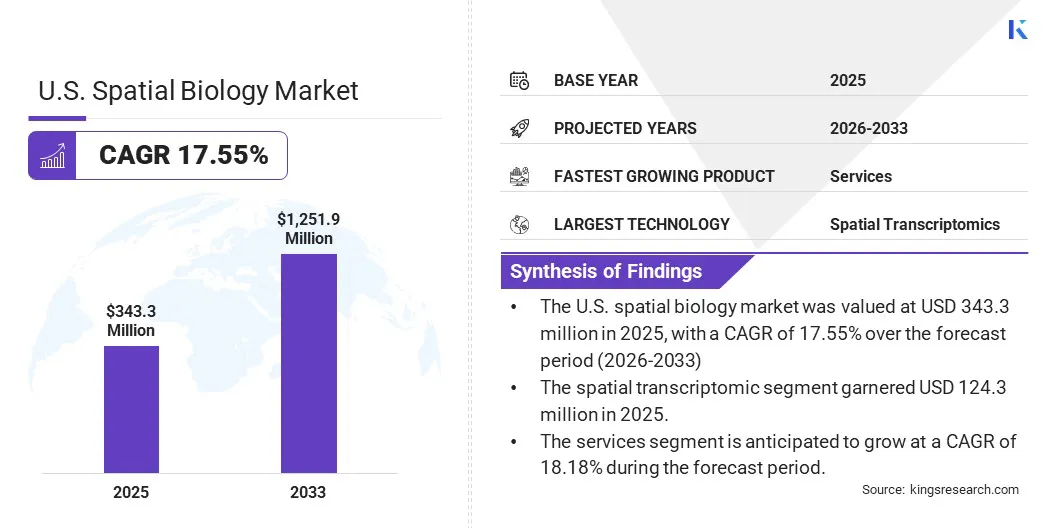
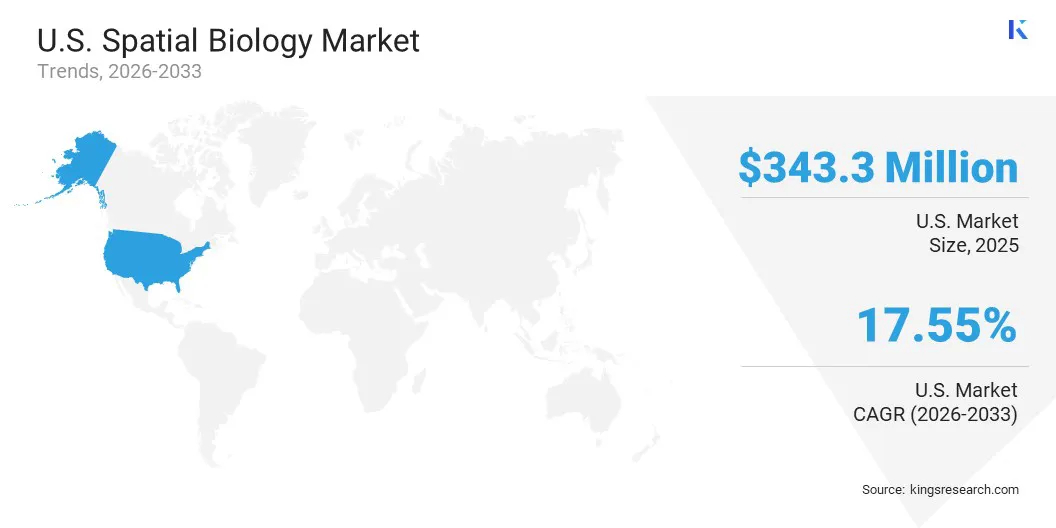
The U.S. spatial biology industry size was valued at USD 343.3 million in 2025 and is projected to reach USD 1,251.9 million by 2033, exhibiting a CAGR of 17.55% during the forecast period. This growth is driven by the adoption of spatial biology platforms across oncology, neuroscience, and immunology research.
Major companies operating in the U.S. spatial biology market are 10x Genomics, Vizgen Corp, Quanterix, Bruker Spatial Biology, Inc., Standard BioTools, Illumina, Inc., RareCyte, Bio-Techne, Nucleai, Inc., Latch Bio, Inc., Spatial Genomics, Takara Bio USA, Inc., Resolve Biosciences, Stellaromics, and Singular Genomics Systems, Inc.
Expanding R&D investments, technological advancements, and the integration of AI for data analysis are accelerating market expansion. The emergence of new industry players and strategic collaborations among leading companies are further increasing competition and driving innovation in the U.S. spatial biology landscape.
A rise in R&D funding is accelerating the adoption of spatial biology platforms, especially in cancer and immune-related research. As tumor microenvironment profiling and immune cell mapping become central to cancer research, spatial platforms are being adopted by pharmaceutical companies, academic cancer centers, and CROs for translational studies. This momentum is reinforced by sustained federal funding for cancer research.
According to the National Cancer Institute (NCI), the Consolidated Appropriations Act, 2026 provided NCI with a total appropriation of USD 7.35 billion, an increase of USD 128 million compared to the FY25 enacted level. This continued growth supports expanded use of spatial transcriptomics and proteomics tools in oncology-focused research, strengthening market demand across the country.
Substantial upfront costs for advanced instruments and ongoing expenses for specialized reagents pose significant barriers to wider adoption. Platforms capable of high-resolution, multiplexed tissue analysis require significant capital investment along with expensive per-sample reagents. This limits the adoption largely to well-funded pharmaceutical companies and top-tier research institutions, while smaller academic labs frequently lack the resources to invest in such technologies.
The New York Genome Center recently received a USD 2.68 million NIH grant from the National Human Genome Research Institute specifically to develop a more cost-accessible platform for spatial multi-omic profiling, addressing this financial bottleneck in tissue biology research. To address affordability, companies are developing scaled-down, user-friendly instruments, pursuing federal grant partnerships, and offering shared-service or core-facility models that let multiple research groups access spatial platforms without individual capital investment.
AI and machine learning integration is emerging as a defining trend in the U.S. spatial biology industry, as researchers rely on automated tools to interpret complex, high-plex tissue datasets. AI-powered digital pathology is gaining regulatory traction alongside this shift. Beyond pathology, spatial biology companies are embedding AI-driven image segmentation and pattern recognition into their platforms to accelerate biomarker discovery. This growing regulatory acceptance signals that AI-assisted spatial data interpretation is moving toward broader clinical and translational applications.
|
Segmentation |
Details |
|
By Technology |
Spatial Transcriptomics, Spatial Proteomics, Spatial Genomics, Spatial Metabolomics, Spatial Multi-omics, Multiplex Imaging, Image Analysis Software, and Others |
|
By Product |
Instruments/Platforms, Consumables, and Services |
|
By Sample Type |
FFPE tissue, Fresh frozen tissue, Fixed frozen tissue, and Others |
|
By Application |
Oncology, Immunology and infectious diseases, Neuroscience, Developmental biology, Regenerative Medicine, and Others |
|
By End Users |
Pharma & Biotech, Academic & Research, Hospitals & Diagnostics, CROs, and Others |
|
By Region |
U.S. |
The U.S. spatial biology space is transitioning from an early-adoption research tool into a more established component of translational and clinical workflows. Academic institutions and pharmaceutical companies remain the primary users, though hospital systems and diagnostic labs are exploring its potential for patient-level tissue analysis. Venture capital and strategic investment continue to flow into the space, supporting new platform development and expanding commercial applications into areas like autoimmune and neurological disease research.
In 2023, the NIH (National Institutes of Health) launched its USD 150 million BRAIN Initiative Connectivity Across Scales (BRAIN CONNECTS) program, funding 11 projects over five years to develop tools for brain-wide connectivity mapping, reflecting this broadening application base. Regulatory pathways for spatial biology-based diagnostics are still developing, with early clearances in adjacent fields like digital pathology signaling gradual movement toward clinical validation. Overall, the space reflects a technology maturing from a specialized research niche toward broader, more mainstream scientific and clinical adoption.
The U.S. spatial biology market remains moderately consolidated, with a small number of established life sciences companies holding a significant share, while numerous smaller and mid-sized players continue to expand their presence. Competitive dynamics are being shaped through acquisitions, as larger companies absorb smaller spatial genomics and proteomics firms to build more comprehensive, multi-omic platforms.
Strategic partnerships between instrument manufacturers and larger diagnostics or life sciences companies are also common, combining complementary technologies such as RNA and protein profiling into unified workflows. At the same time, well-funded startups continue to enter the space with novel, higher-resolution platforms, drawing strong venture investment. This mix of consolidation, partnership-driven expansion, and continued innovation from newer entrants is increasing competition across the market.
Frequently Asked Questions

Aswathi holds cross-domain expertise, translating market trends and competitive intelligence into decision-ready insights. Her work helps clients interpret evolving market conditions and identify growth opportunities. She brings a focused, insight-led approach to research execution. She translates these findings into clear, prioritized action plans that align with client capabilities. Her research often includes scenario modeling to test growth strategies under varying economic conditions. She maintains a rigorous validation process, cross-checking primary and secondary sources to ensure reliability. Clients value her ability to synthesize noisy data into concise executive summaries that drive board-level discussions. Her sector-specific lens, combined with a pragmatic focus on execution, consistently delivers high-impact, commercially sound recommendations. Her structured yet flexible research frameworks adapt to client timelines without compromising depth. She is known for distilling complex trade-offs into straightforward, defensible positions that facilitate confident decision-making.
With many years of consulting experience across global pharma, biotech, and MedTech markets, Minaz brings deep domain expertise, strategic clarity, and analytical rigor to every engagement. She has led 130+ consulting assignments spanning market entry, competitive landscaping, and portfolio prioritization, helping clients navigate complex, high-stakes decisions with confidence. Known for her ability to synthesize primary and secondary research into executive-ready recommendations, Minaz has built forecasting models and market sizing frameworks that have informed multi-million dollar investment decisions in oncology, diagnostics, and peptide therapeutics. Beyond her analytical strength, Minaz is a trusted client partner, translating complex datasets into clear, actionable insights for senior stakeholders. She currently leads a team of research analysts, driving business expansion, and shaping client engagement strategy.