
Inquire Now
Key Strategic Points
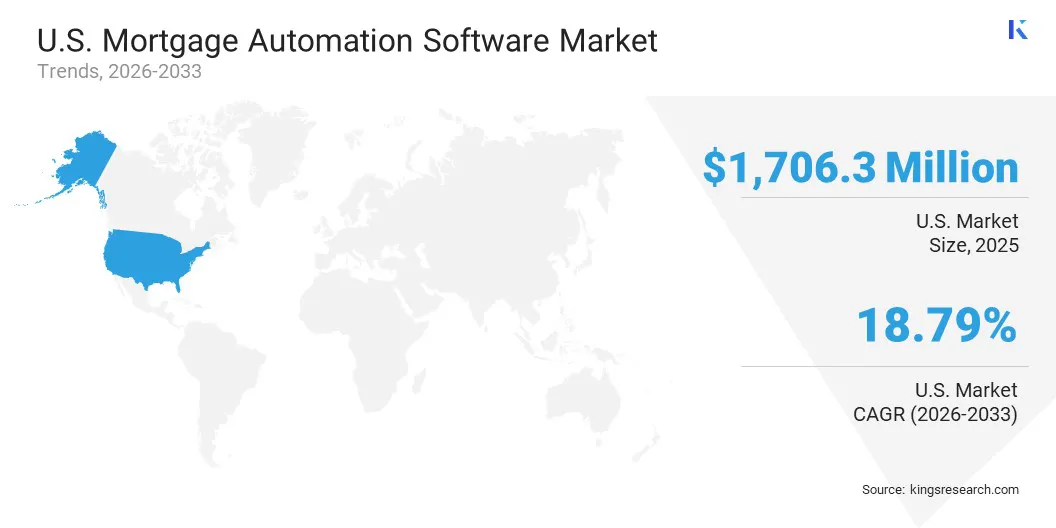
The U.S. mortgage automation software market size was valued at USD 1,706.3 million in 2025 and is projected to reach USD 6,766.2 million by 2033, exhibiting a CAGR of 18.79% during the forecast period. This growth is driven by rising mortgage origination volumes, greater adoption of AI-driven automation, and rising demand for operational efficiency among lenders.
Major companies operating in the U.S. mortgage automation software market include ICE Mortgage Technology, Blue Sage Solutions, Byte Software, nCino, Floify LLC, Ocrolus, TRUE AI, Tavant, Infrrd Inc., Finastra, Mortgage Automator, Backbase, Turnkey Lender, Capacity, and Shape Software Inc.
Enhanced regulatory compliance and a growing focus on improving borrower experiences are further accelerating market expansion. As financial institutions continue to modernize their processes, the mortgage automation software sector is expected to play a pivotal role in advancing mortgage lending in the U.S.
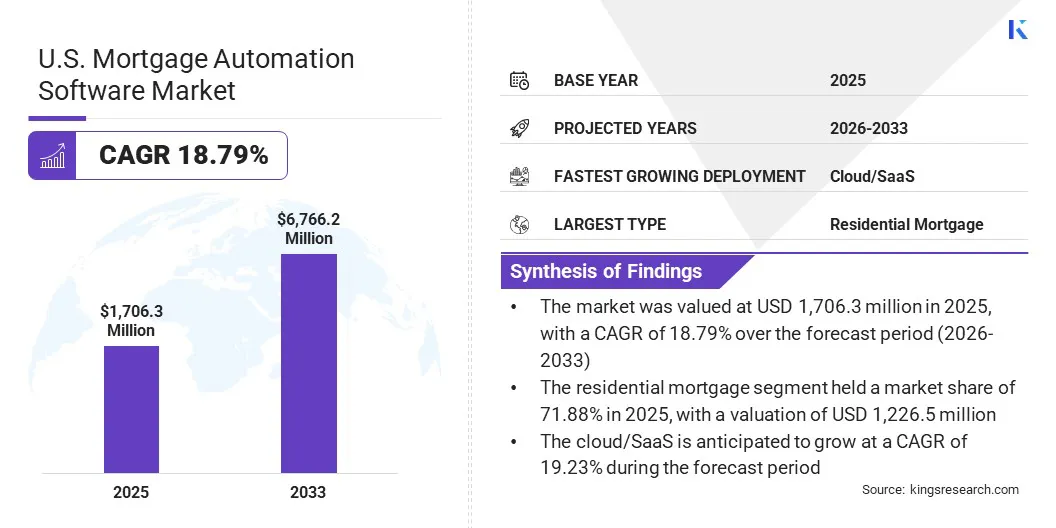
Increased mortgage origination volumes are contributing significantly to market expansion. Lenders are adopting automation software to efficiently manage higher loan counts, reduce manual work, and control operational costs as origination activity continues to grow. The Mortgage Bankers Association forecasts total single-family mortgage origination volume to increase by 8 percent to reach USD 2.2 trillion in 2026, up from an estimated USD 2.0 trillion in 2025. By loan count, total originations are expected to rise by 7.6 percent to 5.8 million loans in 2026, compared to 5.4 million in 2025. This sustained growth in transaction volume across the U.S. mortgage industry is placing pressure on lenders to process applications faster and more accurately without proportional workforce expansion.
This is creating a strong demand for mortgage automation software, as these platforms streamline application intake, document verification, and underwriting processes, enabling institutions to scale operations more efficiently. As origination activity increases, demand for automation tools that reduce per-loan processing time and operational costs is expected to grow significantly.
Mortgage automation platforms process highly sensitive borrower information, including income data, credit history, social security numbers, and property details, which makes them primary targets for cyberattacks. As U.S. lenders continue to digitize origination and underwriting processes, the volume of sensitive data within cloud-based systems grows correspondingly, heightening exposure to breaches and unauthorized access.
Financial institutions must comply with stringent federal data protection standards, and any compromise may lead to regulatory penalties, reputational damage, and loss of borrower trust. To address these risks, companies are investing in end-to-end encryption, multi-factor authentication, and continuous system monitoring to safeguard borrower data. Vendors are also obtaining SOC 2 and other third-party security certifications to enhance lender confidence and strengthen platform credibility.
A major trend transforming the mortgage automation software market is AI-driven end-to-end automation. By integrating artificial intelligence and machine learning throughout every stage of the mortgage lifecycle, from application and document verification to underwriting, approval, and servicing, lenders significantly improve operational efficiency and accuracy. AI automates complex decision-making, quickly identifies errors or missing information, and continuously improves outcomes through learning.
This approach reduces processing time and operational costs while delivering a more efficient and transparent borrower experience. As regulatory demands and customer expectations increase, AI-driven end-to-end automation has become a critical differentiator, enabling lenders to scale operations, ensure compliance, and remain competitive in a rapidly evolving market.
|
Segmentation |
Details |
|
By Type |
Residential Mortgage, Commercial Mortgage, Home Equity Loans (HELOC/Home Equity), and Others |
|
By Deployment |
Cloud/SaaS, On-Premise, and Hybrid |
|
By Enterprise Size |
Large Enterprises and Small & Medium Enterprises (SMEs) |
|
By Application |
Loan Origination, Underwriting, Risk Assessment, Compliance Management, Customer Service, and Others |
|
By End User |
Banks, Credit Unions, Mortgage Lenders, Brokers, and Others |
|
By Region |
U.S. |
The U.S. mortgage automation software market is driven by a mature digital infrastructure that supports end-to-end electronic mortgage transactions. According to the Mortgage Bankers Association, 45 states and the District of Columbia have enacted laws permitting remote online notarization specifically for real estate financial transactions, reflecting a regulatory environment that increasingly supports fully digital loan closings.
This expanding legal framework has enabled software providers to build comprehensive, closing-ready platforms rather than partial digital solutions limited to earlier-stage processes. As a result, the market is transitioning from fragmented, single-function tools to integrated platforms capable of managing origination, underwriting, and closing within unified digital workflows, positioning automation software as a core infrastructure layer that supports the broader modernization of U.S. mortgage lending.
The U.S. mortgage automation software market is moderately consolidated, with a small group of established full-suite providers holding significant share, alongside a broader base of specialized point-solution vendors. Larger players compete based on end-to-end platform integration, offering unified systems that cover loan origination, underwriting, closing, and servicing within a single ecosystem. In contrast, smaller vendors differentiate through targeted tools addressing specific mortgage workflow stages such as borrower-facing applications or document automation.
Competitive dynamics are increasingly driven by AI-driven capabilities, including automated income verification, fraud detection, and predictive underwriting. Strategic acquisitions and platform expansions remain common as vendors seek to broaden their service offerings and strengthen market position. Additionally, growing emphasis on API connectivity and interoperability is intensifying competition, as lenders increasingly favor flexible, integration-friendly platforms over closed, single-vendor systems.
Frequently Asked Questions

Aswathi holds cross-domain expertise, translating market trends and competitive intelligence into decision-ready insights. Her work helps clients interpret evolving market conditions and identify growth opportunities. She brings a focused, insight-led approach to research execution. She translates these findings into clear, prioritized action plans that align with client capabilities. Her research often includes scenario modeling to test growth strategies under varying economic conditions. She maintains a rigorous validation process, cross-checking primary and secondary sources to ensure reliability. Clients value her ability to synthesize noisy data into concise executive summaries that drive board-level discussions. Her sector-specific lens, combined with a pragmatic focus on execution, consistently delivers high-impact, commercially sound recommendations. Her structured yet flexible research frameworks adapt to client timelines without compromising depth. She is known for distilling complex trade-offs into straightforward, defensible positions that facilitate confident decision-making.
Habi is a seasoned research and consulting leader with renowned experience in guiding clients on strategic growth and transformation initiatives across global markets. He has led high-performing research teams that deliver actionable insights on market expansion, M&A strategies, opportunity assessment, new business development, and product launches. His project portfolio spans large petrochemical producers, electronic device manufacturers, lubricants companies, and other leading enterprises across diverse industrial and consumer sectors. He currently heads the research department at Kings Research, where he is responsible for setting the research agenda, mentoring analysts, and ensuring client-ready deliverables that support executive decision-making. With extensive experience in market intelligence, strategic research, and consulting, Habi brings a strong understanding of evolving industry dynamics, competitive landscapes, emerging opportunities, and business growth challenges. His expertise includes developing research frameworks, translating complex market data into actionable strategic recommendations, and working closely with senior stakeholders to address critical business questions. He has also contributed to building research capabilities, strengthening analytical methodologies, and driving a culture of quality and insight-led decision-making within research teams. His cross-industry exposure enables him to connect market trends with broader business implications and provide perspectives that help organizations identify opportunities, mitigate risks, and make informed strategic decisions.