
Inquire Now
Key Strategic Points
Transportation composites are advanced materials made by combining two or more substances to enhance strength, reduce weight, and improve durability in vehicles and infrastructure. The market is focused on the research, innovation and production of these materials.
The report explores key drivers of market development, offering detailed regional analysis and a comprehensive overview of the competitive landscape shaping future opportunities.
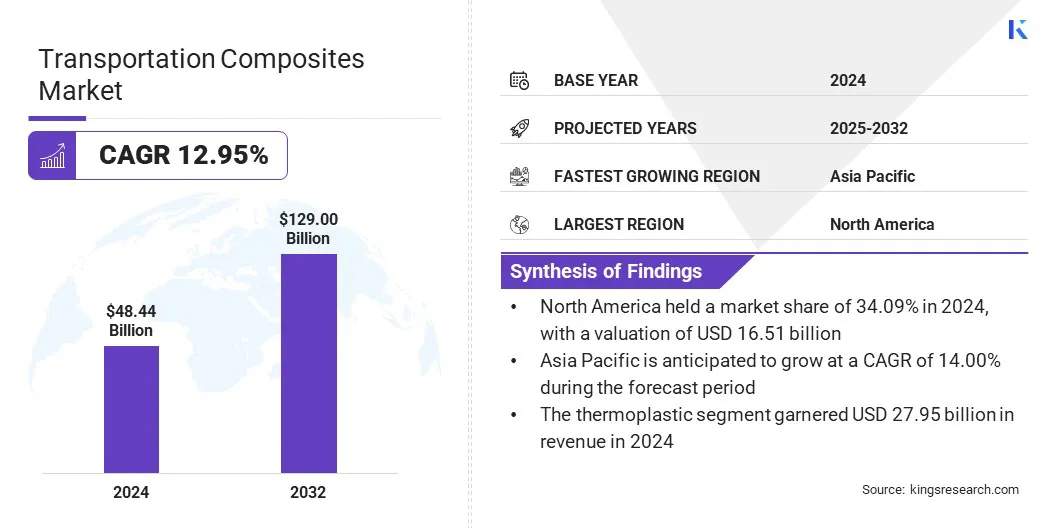
According to Kings Research, the global transportation composites market size was valued at USD 48.44 billion in 2024, which is estimated to be USD 54.56 billion in 2025 and reach USD 129.00 billion by 2032, growing at a CAGR of 12.95% from 2025 to 2032.
Market growth is driven by improved thermal management in vehicles, which enhances engine efficiency, component lifespan, and passenger comfort. This boosts demand for advanced composites with integrated thermoelectric materials in the automotive and aerospace sectors.
Major companies operating in the transportation composites market are Owens Corning, Mitsubishi Chemical Group Corporation, Syensqo, Toray Composite Materials Inc., Hexcel Corporation, TEIJIN LIMITED, SGL Carbon, PPG Industries, Inc., Huntsman International LLC, DuPont, Solvay, Kineco Limited, Schweiter Technologies, Exel Composites, and Microtex Composites s.r.l.
Market expansion is fueled by rising demand for lightweight and high-performance materials in the automotive, aerospace, marine, and rail industries. These composites help manufacturers meet stringent fuel efficiency, emission, and safety standards by reducing vehicle weight without compromising strength or durability.
Technological advancements, increased use of electric vehicles, and supportive government regulations are further boosting market expansion. Additionally, the growing emphasis on sustainable transportation and reduced carbon emissions is promoting the adoption of innovative composite solutions.
The growth of the market is propelled by the need for improved thermal management in vehicles. Advanced composites with thermoelectric materials enhance heat regulation, boost engine efficiency, extend component lifespan, and improve passenger comfort.
As the automotive and aerospace industries focus on performance and sustainability, the demand for these composites rises, making them crucial for future innovations and energy-efficient designs.
Material durability remains a key challenge in the transportation composites market, as these materials must withstand harsh environmental and mechanical stresses. Degradation can affect safety and performance, limiting broader adoption.
To address this, companies are investing in advanced testing protocols and developing enhanced composite formulations with improved resistance to fatigue, corrosion, and temperature extremes.
Additionally, protective coatings and reinforcing fibers are being used to extend service life while preserving the lightweight benefits critical for automotive and aerospace applications.
The rising adoption of closed-loop recycling systems is emerging as a key trend in the market. These systems focus on recovering and reprocessing composite materials from end-of-life vehicles and manufacturing waste to create new components.
By minimizing material loss and waste, closed-loop processes support circular economy models, reducing environmental impact and raw material dependency.
This trend is further supported by growing sustainability goals and regulatory pressures, prompting manufacturers to develop innovative recycling techniques that maintain material quality while promoting resource efficiency and cost savings across the transportation industry.
|
Segmentation |
Details |
|
By Resin |
Thermoplastic, Thermoset |
|
By Fiber |
Glass, Carbon, Natural |
|
By Mode of Transportation |
Airways, Railways, Waterways, Roadways |
|
By Region |
North America: U.S., Canada, Mexico |
|
Europe: France, UK, Spain, Germany, Italy, Russia, Rest of Europe |
|
|
Asia-Pacific: China, Japan, India, Australia, ASEAN, South Korea, Rest of Asia-Pacific |
|
|
Middle East & Africa: Turkey, U.A.E., Saudi Arabia, South Africa, Rest of Middle East & Africa |
|
|
South America: Brazil, Argentina, Rest of South America |
Based on region, the global market has been classified into North America, Europe, Asia Pacific, Middle East & Africa, and South America.
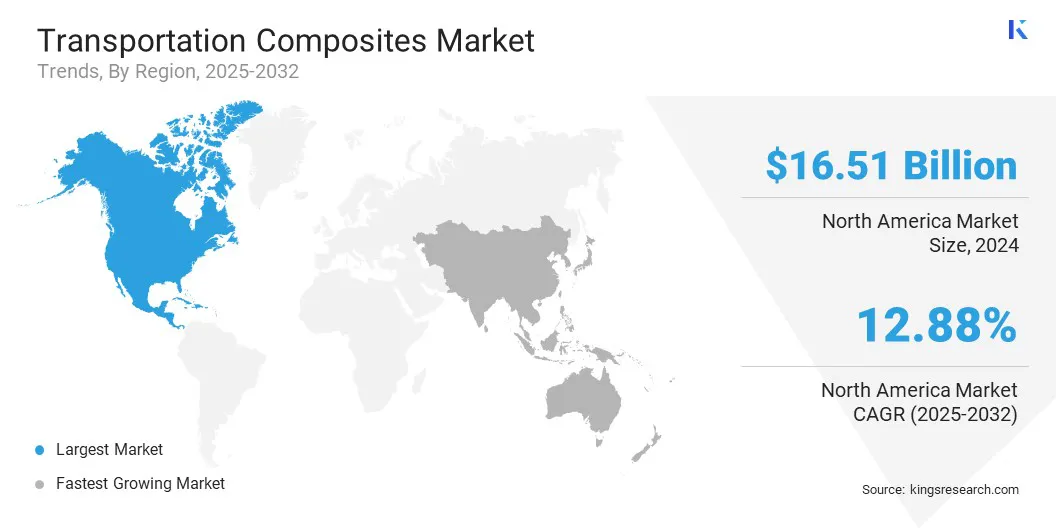
The North America transportation composites market share stood at around 34.09% in 2024, valued at USD 16.51 billion. This dominance is reinforced by the region's advanced manufacturing infrastructure, strong aerospace and automotive industries, and continuous innovation in lightweight, high-performance materials.
The region’s focus on sustainability and stringent regulations to reduce vehicle emissions further boost the adoption of composites.
Additionally, major companies and research institutions in the U.S. and Canada are actively developing and implementing cutting-edge composite technologies. Robust investments in R&D and recycling initiatives further contribute to regional market growth.
The Asia-Pacific transportation composites industry is set to grow at a robust CAGR of 14.00% over the forecast period. This expansion is stimulated by rapid industrialization, increasing infrastructure development, and growing demand for lightweight, durable materials in the automotive and aerospace sectors.
As per IBEF, the Indian composite materials industry is set to grow at a projected compound annual growth rate (CAGR) of 7.8%, reaching USD 2.8 billion by 2030, propelled by increasing demand across transportation, construction, and aerospace sectors.
Expanding manufacturing capabilities, government initiatives promoting sustainable transportation, and rising investments in research and development are further accelerating regional market growth. Additionally, the region’s focus on innovation and adoption of advanced composite technologies positions it as a key market for transportation composites.
Companies in the transportation composites market are increasingly focusing on innovation to enhance material performance, sustainability, and manufacturing efficiency.
They are investing in developing lightweight, high-strength composites that improve fuel efficiency and reduce emissions. Furthermore, there is a growing emphasis on integrating advanced adhesives and thermoelectric materials to optimize energy recovery and thermal management.
Additionally, firms are advancing recycling technologies and closed-loop systems to promote circular economy models, ensuring eco-friendly production practices and meeting stringent environmental regulations within the transportation sector.
Frequently Asked Questions

Sharmishtha is a budding research analyst with a strong commitment to achieving excellence in her field. She brings a meticulous approach to every project, delving deep into details to ensure comprehensive and insightful outcomes. Passionate about continuous learning, she strives to enhance her expertise and stay ahead in the dynamic world of market research. Beyond work, Sharmishtha enjoys reading books, spending quality time with friends and family, and engaging in activities that foster personal growth. Her dedication to precision ensures that no critical detail is overlooked, and her analytical rigor consistently produces reliable, evidence-based conclusions. Sharmishtha's proactive curiosity drives her to explore emerging research methodologies, which she readily applies to deliver fresh perspectives on complex market questions. Her collaborative nature and openness to constructive feedback make her a dependable team player. She balances technical accuracy with clear communication, ensuring her insights are actionable for clients and stakeholders alike.

Ganapathy Subramaniam Suresh
With over a decade of research leadership across global markets, Ganapathy brings sharp judgment, strategic clarity, and deep industry expertise. Known for precision and an unwavering commitment to quality, he guides teams and clients with insights that consistently drive impactful business outcomes.