
Inquire Now
Key strategic points
Tactical communications refer to specialized systems used by military, defense, emergency response, and security forces to exchange information securely, reliably, and in real time during missions or operations.
It includes voice, data, and video transmission over radios, satellite links, or networks designed to function in challenging environments, ensuring coordination, situational awareness, and mission success. The market encompasses hardware, software solutions, and services that enable voice, data, and video exchange for mission‑critical operations.
The global tactical communications market size was valued at USD 20.37 billion in 2024 and is projected to grow from USD 21.57 billion in 2025 to USD 34.10 billion by 2032, exhibiting a CAGR of 6.76% over the forecast period.
Market growth is driven by the rising adoption of advanced technologies such as software‑defined radios (SDR) and IP‑based communication. The growing need for secure, interoperable communication in military and emergency operations is further supporting the development and deployment of next‑generation tactical communication solutions.
Major companies operating in the tactical communications market are BAE Systems, Motorola Solutions, Inc, Bittium Corporation, CODAN Limited, EFJohnson Technologies, Elbit Systems Ltd, General Dynamics Mission Systems, Inc, Indra Sistemas S.A., Iridium Communications Inc, L3Harris Technologies, Inc, Leonardo DRS, Inc, Northrop Grumman Corporation, QinetiQ Group, Rohde & Schwarz GmbH & Co. KG, and Thales Defense & Security, Inc.
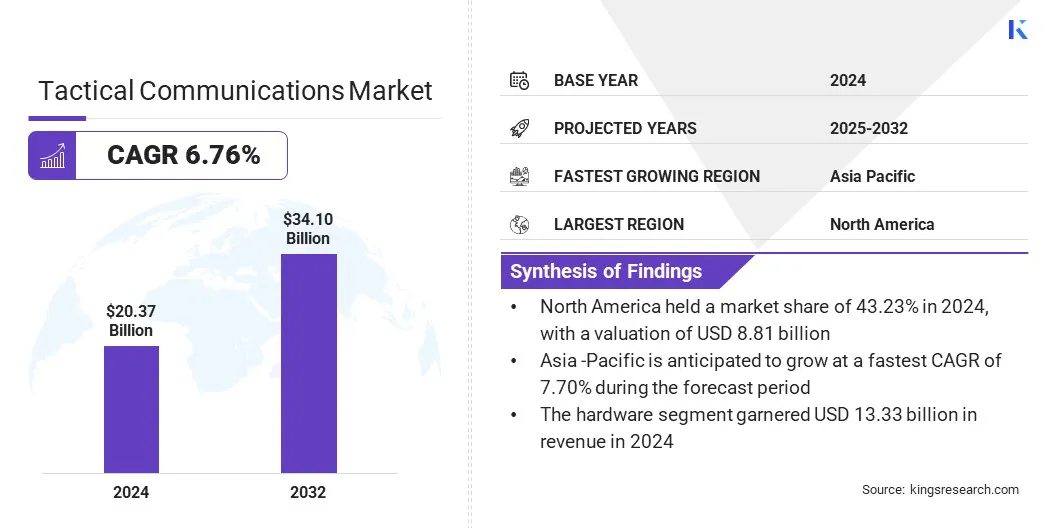
The growing focus of market players on developing deployable tactical defense networks is accelerating the adoption of advanced communication solutions. Additionally, integrating high-performance technologies with digitalization expertise is enhancing secure and resilient network capabilities.
Rising Global Defense Spending
Rising global defense spending is a major factor driving the growth of the tactical communications market. Increasing budgets are allowing governments to modernize command, control, and communication (C3) infrastructure and adopt next-generation systems that enhance battlefield connectivity.
Defense forces are prioritizing secure, real-time information exchange to support network-centric warfare, joint operations, and rapid decision-making. This growing investment is accelerating the deployment of software-defined radios, satellite-based communication links, and encrypted data networks across land, air, and naval platforms.
Rising Cybersecurity Threats in Tactical Networks
A key challenge impeding the growth of the tactical communications market is the rising cybersecurity threats targeting tactical communication networks. These networks transmit critical and sensitive data during military and emergency operations, making them vulnerable to hacking, jamming, interception, and malware attacks. Advanced persistent threats and electronic warfare tactics can disrupt communications and compromise mission success.
To address this challenge, market players are investing in advanced security solutions and resilient network architectures. They are integrating end‑to‑end encryption, multi‑factor authentication, and secure software‑defined radio (SDR) platforms. Companies are also developing AI‑driven threat detection systems and intrusion prevention tools to identify and mitigate attacks in real time.
Increasing Use of Mobile Ad‑Hoc Networks (MANET) for Resilient Communications
A key trend influencing the tactical communications market is the increasing use of mobile ad-hoc networks (MANET) for resilient connectivity. These decentralized systems enable secure, self-healing, and scalable communication that adapts to changing battlefield conditions.
MANET supports seamless real-time data exchange and interoperability across diverse platforms, ensuring reliable performance in infrastructure-limited and contested environments. These advancements are driving the adoption of advanced tactical communication solutions to strengthen military operations in modern defense.
|
Segmentation |
Details |
|
By Component |
Hardware (Radios, Antennas & Terminals, Ruggedized Devices), Software (Network management software, Secure communication platforms, Maintenance & support services) |
|
By Platform |
Land, Airborne, Naval, Space |
|
By Technology |
Radio Communication, Satellite Communication, Time-Division Multiplexing, Next-Generation Network |
|
By End-User |
Defense Forces, Homeland Security, Law Enforcement, Disaster Relief |
|
By Region |
North America: U.S., Canada, Mexico |
|
Europe: France, UK, Spain, Germany, Italy, Russia, Rest of Europe |
|
|
Asia-Pacific: China, Japan, India, Australia, ASEAN, South Korea, Rest of Asia-Pacific |
|
|
Middle East & Africa: Turkey, U.A.E., Saudi Arabia, South Africa, Rest of Middle East & Africa |
|
|
South America: Brazil, Argentina, Rest of South America |
Based on region, the market has been classified into North America, Europe, Asia Pacific, Middle East & Africa, and South America.
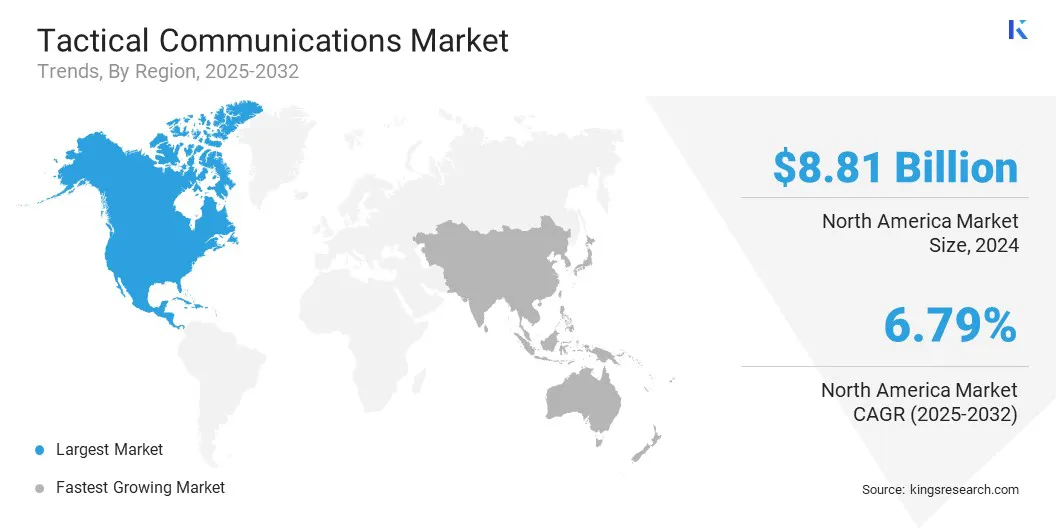
North America tactical communications market share stood at 43.23% in 2024 in the global market, with a valuation of USD 8.81 billion. This dominance is attributed to rising defense budgets that support the modernization of military infrastructure and the adoption of advanced communication systems.
Increasing demand for secure, reliable, and interoperable connectivity to enable mission-critical military and emergency operations is driving market growth. Moreover, the presence of regional market players that are actively expanding their portfolios and capabilities through strategic acquisitions is further driving the market growth across North America.
Asia Pacific is set to grow at a CAGR of 7.70% over the forecast period. This growth is due to the rising geopolitical tensions and defense modernization across the Asia Pacific.
Increasing investments by governments and defense organizations in indigenous defense manufacturing are reducing reliance on imports to develop tailored communication solutions. Additionally, rapid adoption of advanced communication technologies, including AI‑assisted networks and software‑defined radios, is driving innovation and growth in the region.
Companies operating in the tactical communications industry are expanding their portfolios by integrating advanced hardware and software solutions to offer secure and interoperable systems. They are investing in research and development to enhance capabilities in AI‑assisted networks, software‑defined radios, and resilient communication platforms.
Market players are also focusing on strategic partnerships and collaborations to accelerate innovation, improve deployment speed, and extend their reach in key regions. Additionally, they are enhancing product offerings to address evolving battlefield requirements, ensuring mission‑critical connectivity in urban and remote areas.
Frequently Asked Questions

Over the years, Versha brings over 15 years of experience managing consulting assignments across industries, including Food and Beverage, Consumer Goods, ICT, Aerospace, and more. Her work has spanned diverse sectors. Her cross-domain expertise and adaptability make her a versatile and dependable professional. She is known for her keen business insight and foresight. With sharp analytical skills and a curious mindset, Versha excels at transforming complex data into actionable insights. She has a proven track record of unraveling market dynamics, identifying trends, and delivering tailored solutions to meet client needs. As a skilled leader, Versha has successfully mentored research teams and directed projects with precision, ensuring high-quality outcomes. Her collaborative approach and strategic vision enable her to turn challenges into opportunities and consistently deliver impactful results. Whether analyzing markets, engaging stakeholders, or crafting strategies, Versha draws on her deep expertise and industry knowledge to drive innovation and deliver measurable value.

With over a decade of research leadership across global markets, Ganapathy brings sharp judgment, strategic clarity, and deep industry expertise. Known for precision and an unwavering commitment to quality, he guides teams and clients with insights that consistently drive impactful business outcomes.



.webp&w=128&q=75&dpl=dpl_3pUwJtNgpk6oXgXnK9PBcvvUhHi3)