
Inquire Now
Key strategic points
Sustainable food refers to products produced, processed, and distributed with minimal environmental impact, efficient resource use, and social and economic benefits. The market encompasses organic food, plant-based alternatives, sustainably sourced seafood, functional foods, and items produced using eco-friendly practices.
The market includes producers, processors, distributors, and retailers committed to environmentally responsible sourcing, ethical production methods, and transparent supply chains to meet growing consumer demand for sustainable consumption.
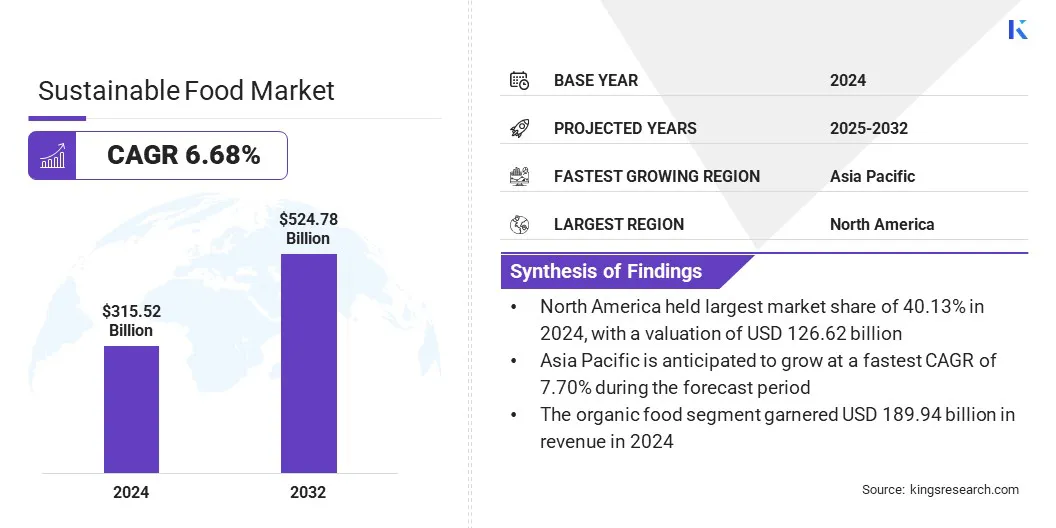
According to Kings Research, the global sustainable food market size was valued at USD 315.52 billion in 2024 and is projected to grow from USD 333.73 billion in 2025 to USD 524.78 billion by 2032, exhibiting a CAGR of 6.68% during the forecast period. The market grows steadily as consumers prioritize products that support health, environmental preservation, and social responsibility.
Rising awareness of carbon footprint, biodiversity impact, and sustainable agriculture practices is driving strong demand for organic, plant-based, and responsibly sourced foods.
In response, companies are leveraging innovations in functional ingredients, eco-friendly processing, and transparent supply chains to meet evolving consumer preferences and expand their global presence.
Major companies operating in the sustainable food market are Nestlé, Unilever, Danone, General Mills Inc., PepsiCo, Cargill, Incorporated, Mars, Incorporated, Tyson Foods, Inc., Arla Foods amba, McCormick & Company, Inc., Bunge, AB InBev, Kerry Group plc., FrieslandCampina, and Conagra Brands, Inc.
Companies are increasingly emphasizing the use of sustainably sourced ingredients to strengthen their supply chains and demonstrate environmental responsibility. They are investing in practices such as regenerative agriculture, reforestation, and climate-smart farming to reduce carbon emissions and improve soil health. These efforts support long-term resilience while aligning with consumer demand for ethical products.
The growth of the sustainable food market is driven by rising consumer demand for eco-friendly products and strong policy support. Growing awareness of environmental impacts and resource limitations is boosting preference for products with lower ecological footprints.
Governments and regulatory bodies are implementing policies to promote circular economy practices, reduce waste, and improve resource efficiency across the food value chain.
Aligned with the UN's Sustainable Development Goal 12, which targets halving global food waste and reducing supply chain losses by 2030, many countries have adopted supportive measures. This combination of policy support and changing consumer behavior is significantly propelling market growth.
A key challenge impeding the progress of the sustainable food market is its higher production and pricing compared to conventional products.
Organic, plant-based, and sustainably sourced foods often involve costly raw materials, labor-intensive practices, and stringent certifications. These costs are passed on to consumers, limiting adoption among price-sensitive groups and slowing overall market penetration.
Government incentives, subsidies, and supportive policies are helping reduce production and retail costs, making sustainable food more affordable and accessible. Additionally, awareness campaigns emphasizing long-term health and environmental benefits support consumer acceptance of premium pricing.
The sustainable food market is witnessing notable growth as consumers shift toward healthier and more environmentally responsible diets. Rising demand for vegan diets, supported by greater awareness of health benefits, ethical considerations, and reduced environmental impact, is further aiding this shift.
Consumers increasingly seek plant-based proteins, dairy alternatives, and clean-label products that align with their values. In response, manufacturers are expanding portfolios with innovative, nutritionally balanced offerings. The trend is expected to strengthen as plant-based diets gain broader acceptance globally.
|
Segmentation |
Details |
|
By Food Type |
Organic Food, Plant-Based Food, Sustainable Seafood, Sustainable Functional Food, Sustainable Processed Food, Others |
|
By Distribution Channel |
Supermarkets & Hypermarkets, Specialty Organic & Health Stores, Online Retail & E-commerce Platforms, Foodservice & Restaurants, Others |
|
By Region |
North America: U.S., Canada, Mexico |
|
Europe: France, UK, Spain, Germany, Italy, Russia, Rest of Europe |
|
|
Asia-Pacific: China, Japan, India, Australia, ASEAN, South Korea, Rest of Asia-Pacific |
|
|
Middle East & Africa: Turkey, U.A.E., Saudi Arabia, South Africa, Rest of Middle East & Africa |
|
|
South America: Brazil, Argentina, Rest of South America |
Based on region, the market has been classified into North America, Europe, Asia Pacific, Middle East & Africa, and South America.
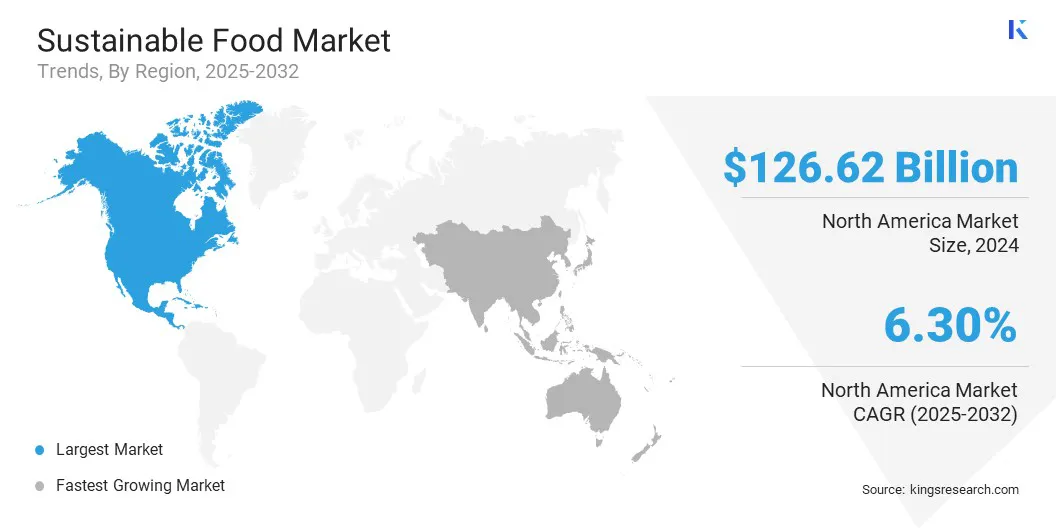
The North America sustainable food market accounted for a substantial share of 40.13% in 2024, valued at USD 126.62 billion. This dominance is reinforced by the rising adoption of advanced sustainable packaging technologies that enhance product safety, extend shelf life, and reduce environmental impact.
Companies across the region are investing in biodegradable materials, recyclable solutions, and smart packaging systems to track freshness and reduce waste. These innovations align with consumer demand for eco-friendly products and regulatory measures aimed at reducing plastic usage, strengthening North America’s position as a key market for sustainable food.
The Asia-Pacific sustainable food Industry is expected to register the fastest CAGR of 7.70% over the forecast period. This growth is propelled by increasing consumer demand for sustainable seafood, supported by rising awareness of health benefits, environmental impact, and ethical sourcing.
This region is a major producer of fish, shellfish, and aquaculture products and is attracting significant investments from seafood producers and agribusiness firms in disease management, climate-resilient farming, and digital traceability systems.
Government initiatives, such as India’s National Fisheries Development Board programs, China’s Sustainable Aquaculture Development Plans, and Vietnam’s Aquaculture Certification Schemes, further promote responsible production and export standards. Adoption of innovative farming techniques and enhanced supply chain practices is strengthening Asia Pacific’s position as a key region for sustainable seafood.
Key players in the sustainable food industry are implementing sustainability strategies, including climate-aligned targets, regenerative agriculture, and eco-friendly packaging, to enhance operational resilience and demonstrate strong ESG performance.
They are also focusing on product innovation, developing new plant-based, functional, and sustainably sourced food products to meet evolving consumer preferences and regulatory requirements.
Companies are investing in research and development to improve product quality and sustainability. These strategies are allowing companies to differentiate their offerings, build brand credibility, and maintain a competitive market position.
Frequently Asked Questions

Over the years, Versha brings over 15 years of experience managing consulting assignments across industries, including Food and Beverage, Consumer Goods, ICT, Aerospace, and more. Her work has spanned diverse sectors. Her cross-domain expertise and adaptability make her a versatile and dependable professional. She is known for her keen business insight and foresight. With sharp analytical skills and a curious mindset, Versha excels at transforming complex data into actionable insights. She has a proven track record of unraveling market dynamics, identifying trends, and delivering tailored solutions to meet client needs. As a skilled leader, Versha has successfully mentored research teams and directed projects with precision, ensuring high-quality outcomes. Her collaborative approach and strategic vision enable her to turn challenges into opportunities and consistently deliver impactful results. Whether analyzing markets, engaging stakeholders, or crafting strategies, Versha draws on her deep expertise and industry knowledge to drive innovation and deliver measurable value.

With over a decade of research leadership across global markets, Ganapathy brings sharp judgment, strategic clarity, and deep industry expertise. Known for precision and an unwavering commitment to quality, he guides teams and clients with insights that consistently drive impactful business outcomes.



.webp&w=128&q=75&dpl=dpl_3pUwJtNgpk6oXgXnK9PBcvvUhHi3)