
Inquire Now
Key Strategic Points
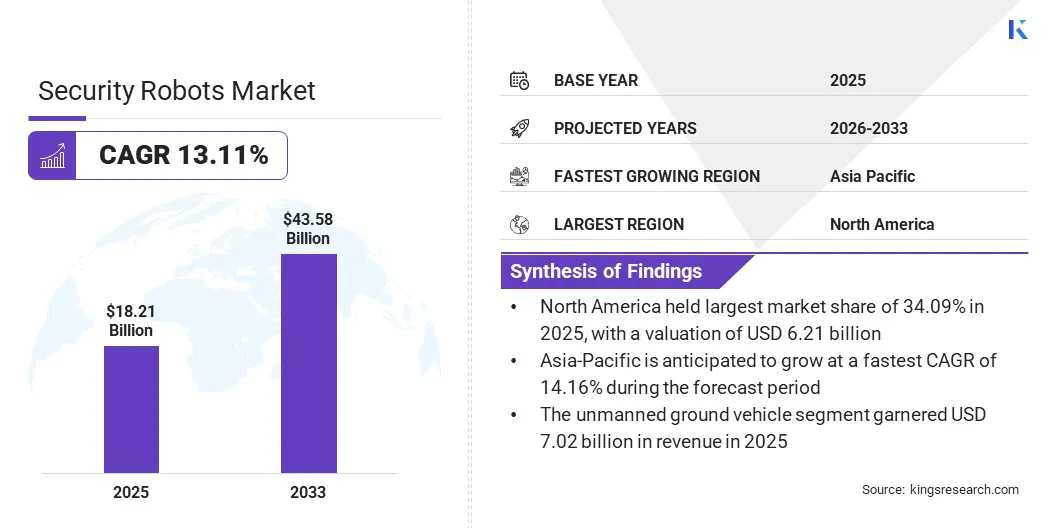
According to Kings Research, the global security robots market size was valued at USD 18.21 billion in 2025 and is projected to grow to USD 43.58 billion by 2033, exhibiting a CAGR of 13.11% during the forecast period.
The market growth is attributed to increasing demand for automated surveillance and advanced threat detection in critical infrastructure, commercial spaces, and defense installations. Increasing crime rates, labor shortages among security personnel, and growing concerns about public safety are some of the major factors driving the growth of the autonomous security robots market over the forecast period.
Major companies operating in the security robots industry are Knightscope, Inc., BAE Systems, Boston Dynamics, Northrop Grumman, Kabam Pte Ltd, Cobalt AI, Shark Robotics, QinetiQ, SMP Robotics, Thales, L3Harris Technologies, Inc., ReconRobotics, Inc., AeroVironment, Inc., Elbit Systems Ltd., and Teledyne FLIR LLC.
Advancements in artificial intelligence and sensor technologies are enhancing the ability of robots to operate in complex environments, analyze data in real-time and identify anomalies with greater precision.
Security robots are being used by airports, data centers, manufacturing plants and public spaces for perimeter surveillance, intrusion detection and hazardous material inspection. This is driving the adoption of products across government agencies, private enterprise and industrial operators worldwide.
 Key Market Highlights
The growing demand for security robots is fueled by the increasing need for 24/7 surveillance and fast response to incidents for enhanced safety and operational resilience. With rising concerns of crime and terrorism and security breaches, there is an increasing need for continuous and real-time monitoring solutions. Organizations are increasingly using autonomous robots to replace or augment human patrols to ensure consistent coverage and timely anomaly detection.
This trend is also driven by the growing reliance on automated systems to reduce human error, optimize resource allocation, and enable faster decision making during security incidents. Proactive threat management is driving investment in advanced robotic platforms that improve situational awareness and incident response capabilities, accelerating market growth.
The use of security robots in sensitive environments is hindered by major challenges, including concerns about data privacy and vulnerabilities associated with cybersecurity. The data includes video feeds, access credentials, and environmental analytics, and these robots are continuously collecting and sending the data, making them vulnerable to malicious cyber activities.
If this information is obtained by the wrong parties, it could jeopardize sensitive operations, result in regulatory penalties for organizations, and erode stakeholder trust. Furthermore, the use of security robots in larger enterprise networks puts the entire system at risk of being hacked or having data intercepted.
Regulatory systems such as the General Data Protection Regulation (GDPR) and national data protection laws are imposing ever tighter requirements on data storage, transmission and protection.
To reduce these risks, manufacturers are investing in sophisticated encryption technologies, secure cloud infrastructures and strong authentication protocols. Continuous software updates, network monitoring, and cybersecurity training for operators are also being emphasized to safeguard data integrity and ensure the safe operation of security robots in critical environments.
Advances in aerial robotics are revolutionizing the security robots market through improved wide-area surveillance, operational efficiency and response accuracy. Advances in drone design including increased flight endurance, advanced stabilization, and multi-sensor payloads allow for continuous surveillance of large perimeters that are difficult to secure by ground-based systems alone. These aerial platforms are equipped with high-resolution optical, thermal and infrared imaging to provide real-time situational awareness across complex environments.
Autonomous navigation technologies such as obstacle avoidance and intelligent flight path optimization may improve the consistency of coverage and reduce the need for manual intervention. Centralized command platform integration allows seamless coordination with ground units to assist with rapid incident assessment and coordinated response.
The changes are making perimeter security operations more efficient, reducing long-term monitoring costs and increasing the use of drones in critical infrastructure, defense facilities, industrial sites and public spaces.
|
Segmentation |
Details |
|
By Type |
Unmanned Aerial Vehicle, Unmanned Ground Vehicle, and Unmanned Underwater Vehicle |
|
By Application |
Spying, Patrolling, Explosive detection, Rescue operations, Firefighting, and Others |
|
By End User |
Military & Defense, Residential, and Commercial |
|
By Region |
North America: U.S., Canada, Mexico |
|
Europe: France, UK, Spain, Germany, Italy, Russia, Rest of Europe |
|
|
Asia-Pacific: China, Japan, India, Australia, ASEAN, South Korea, Rest of Asia-Pacific |
|
|
Middle East & Africa: Turkey, U.A.E., Saudi Arabia, South Africa, Rest of Middle East & Africa |
|
|
South America: Brazil, Argentina, Rest of South America |
Based on region, the market has been classified into North America, Europe, Asia Pacific, Middle East & Africa, and South America.
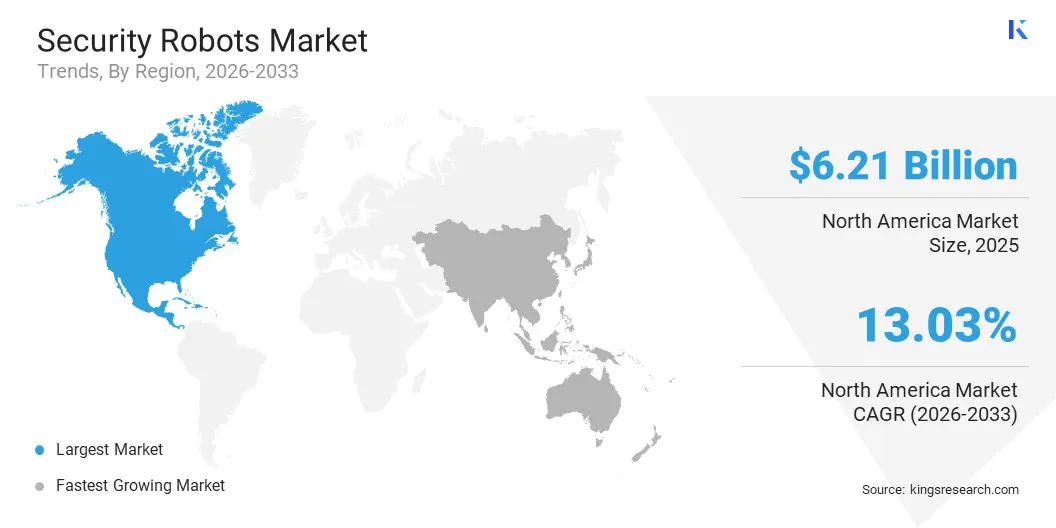
North America security robots market share stood at 34.09% in 2025, valued at USD 6.21 billion. This dominance is reinforced by the region’s strong defense budget, advanced technological capabilities, and the presence of leading security robot manufacturers.
Also, rising investments in artificial intelligence, robotics research and homeland security programs are accelerating the implementation of autonomous security systems across military, government and commercial sectors. The region’s focus on improving border security, critical infrastructure protection and public safety will further strengthen its market leadership.
Rising security threats, increasing use of unmanned systems in defense operations and ongoing innovations in autonomous navigation, sensor integration and real-time data processing are further fueling the regional market expansion.
The Asia-Pacific security robots industry is set to grow at a CAGR of 14.16% over the forecast period. This growth is propelled by increasing geopolitical tensions and rising investments in defense modernization. The region’s expanding industrial infrastructure and growing emphasis on critical infrastructure protection are contributing to the rising demand for autonomous security solutions.
Government initiatives to improve border control, urban safety and public surveillance further boost the domestic market. In addition, rising focus on the integration of artificial intelligence and development of advanced robotics technologies are driving the adoption of security robots in the Asia-Pacific region.
The security robots industry has several established defense contractors and emerging technology companies competing on innovation, autonomous capabilities, and multi-domain integration. The key players in the market are focusing on the developments in the areas of artificial intelligence, sensor fusion and autonomous navigation to improve real-time threat detection, operational efficiency and situational awareness.
Companies are investing in research and development to develop modular, scalable multi-sensor robotic platforms that address complex security challenges across the defense, commercial and public safety sectors.
Moreover, strategic alliances with defense agencies, security service providers, and technology companies, along with mergers and acquisitions, are being adopted to expand global presence, complement service offerings, and diversify product portfolios in the unmanned ground, aerial and underwater domains.
How We Gather This Information
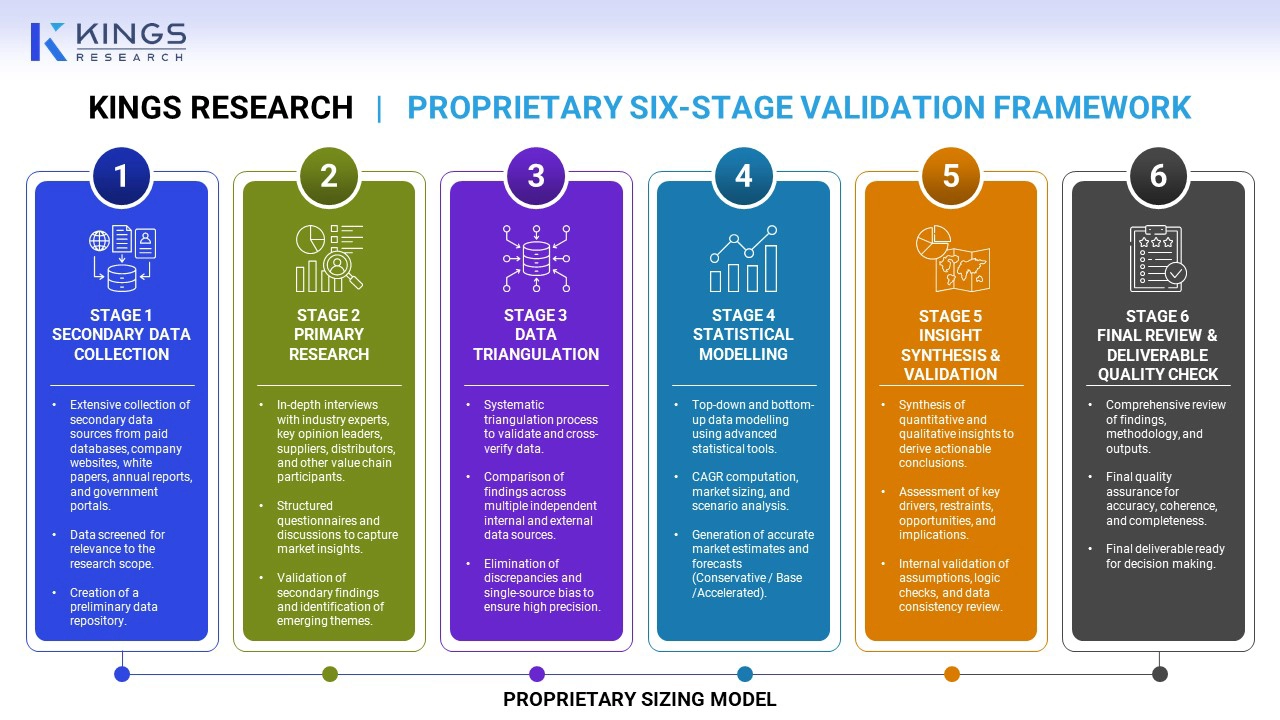
Our methodology triangulates insights from multiple independent and publicly available research databases and is further validated against regulatory filings and public company disclosures. All estimates are cross-verified; no single-source data is presented without validation.
Frequently Asked Questions

Anurag Singh specializes in delivering actionable market intelligence across various domains such as ICT, IoT, Automotive & Transportation, Semiconductor & Electronics, Energy & Power, and Aerospace & Defence. With a background in Computer Science Engineering and extensive experience in market research, he brings a strong understanding of industry dynamics, emerging technologies, competitive landscapes, and evolving market opportunities. His expertise includes market sizing, forecasting, trend analysis, competitive benchmarking, and data-driven strategic insights. Anurag closely monitors technological advancements and shifting industry ecosystems to identify growth opportunities and emerging business trends. His research supports organizations in making informed strategic decisions, assessing market potential, understanding technology adoption, and navigating complex, rapidly evolving industries. Passionate about innovation and technology, he combines analytical expertise with a practical understanding of market developments to deliver meaningful insights that help businesses strengthen their strategies, identify new opportunities, and maintain a competitive edge in dynamic global markets.
Habi is a seasoned research and consulting leader with renowned experience in guiding clients on strategic growth and transformation initiatives across global markets. He has led high-performing research teams that deliver actionable insights on market expansion, M&A strategies, opportunity assessment, new business development, and product launches. His project portfolio spans large petrochemical producers, electronic device manufacturers, lubricants companies, and other leading enterprises across diverse industrial and consumer sectors. He currently heads the research department at Kings Research, where he is responsible for setting the research agenda, mentoring analysts, and ensuring client-ready deliverables that support executive decision-making. With extensive experience in market intelligence, strategic research, and consulting, Habi brings a strong understanding of evolving industry dynamics, competitive landscapes, emerging opportunities, and business growth challenges. His expertise includes developing research frameworks, translating complex market data into actionable strategic recommendations, and working closely with senior stakeholders to address critical business questions. He has also contributed to building research capabilities, strengthening analytical methodologies, and driving a culture of quality and insight-led decision-making within research teams. His cross-industry exposure enables him to connect market trends with broader business implications and provide perspectives that help organizations identify opportunities, mitigate risks, and make informed strategic decisions.