
Inquire Now
Key Strategic Points
The security advisory services market is dedicated to providing organizations with expert advice, strategic consulting, and risk management solutions, all aimed at bolstering their security. These services cover a range of areas, including threat assessments, compliance consulting, incident response planning, and security policies. The market supports organizations in meeting regulatory requirements and safeguarding sensitive data.
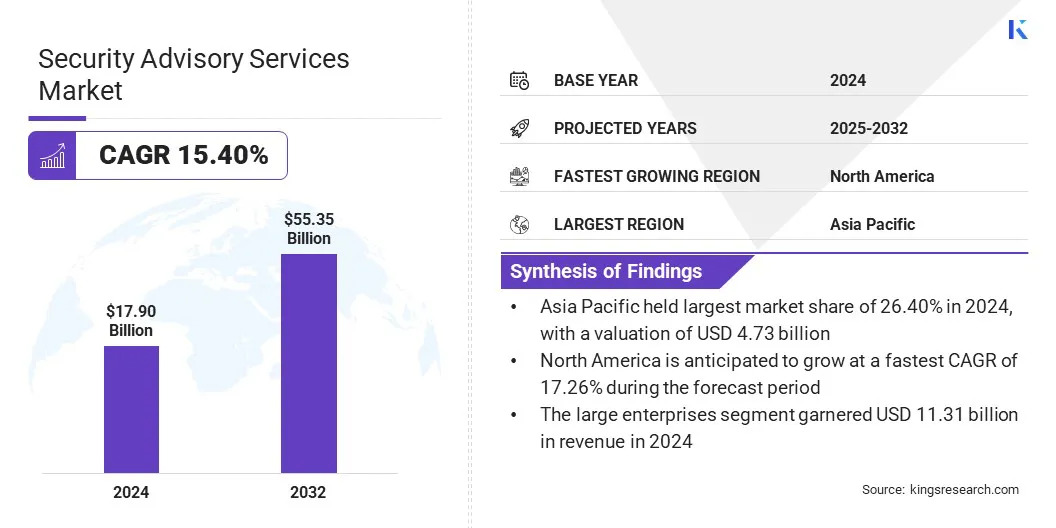
The global security advisory services market size was valued at USD 17.90 billion in 2024 and is projected to grow from USD 20.30 billion in 2025 to USD 55.35 billion by 2032, exhibiting a CAGR of 15.40% during the forecast period. The growth is attributed to the increasing concerns over cybersecurity threats, the rising adoption of advanced security technologies, and the growing need for compliance with regulatory standards across various industries.
Major companies operating in the global market are BAE Systems, KPMG, PwC, Deloitte, Accenture, Ernst & Young Global Limited, IBM, Wipro, TATA Consultancy Services Limited,Cisco Systems, Inc., DXC Technology Company, Palo Alto Networks, Inc., Crowdstrike, F-Secure, and NCC Group.
Companies are outsourcing security consultancy services to protect their strategic assets, to handle risk effectively and to improve their overall security systems. Moreover, the growth of digital transformation initiatives and increased cyberattacks have further driven the need to hire expert security consultation, which thereby contributing to market growth during the forecast period.
The security advisory services market is significantly driven by the evolution of cybersecurity as an IT service to a business risk priority at the board level. Organizations now acknowledge that cyber threats have a direct impact on financial performance, operational continuity, regulatory compliance, and brand reputation. Consequently, cybersecurity has been integrated into the enterprise risk management and top-down strategic decisions. The frameworks established by organizations like National Institute of Standards and Technology (NIST) and International Organization of Standardization (ISO) further underline the necessity of governance-driven organization-wide security practices, which brings the need to pursue advisory services that can help align cybersecurity with business priorities.
In October 2025, the National Cyber Security Centre UK reported a 50% increase in highly significant cyber incidents. Authorities responded by urging business leaders and boards to take greater responsibility for cybersecurity strategy and resilience. Organizations are increasingly engaging specialized security advisors to support strategic planning and leadership, emphasizing cybersecurity as a business risk rather than solely an IT problem at the board level.
One of the important challenges in this market is the difficulty in quantifying cyber risk and proving ROI. Board members usually need specific data and financial rationale to make strategic decisions, whereas cyber risk can be complex, intangible, and changeable and difficult to use in conventional business contexts. This inability to measure cyber risk can lead to inadequate support and investment in the required cybersecurity enhancements, which will leave the organization at a higher risk.
To overcome such a challenge, standardized cyber risk frameworks (e.g., NIST or FAIR) are recommended, where technical risks are converted into business impact. Cyber risk can be made real by formulating clear risk appetite statements, real-life scenarios, and employing risk quantification tools.
The emergence of advisory-led AI risk governance ecosystems is fundamentally transforming the market. The complexity and magnitude of risks associated with the use of AI-driven solutions continue to rise as organizations become more dependent on them, requiring extensive governance structures. Advisory firms are emerging as one of the essential forces that can assist clients in coping with AI-related regulatory, ethical, and operational risks. These enterprises offer tailored guidance on the implementation of the powerful risk assessment processes, ensuring AI compliance, and responsible AI use. Advocacy-led ecosystems enable organizations to be aware of their vulnerability and prevent threats by embedding multidisciplinary skills in the areas of cybersecurity, legal and data ethics. The trend enhances the organizational resilience to changing AI risks and the stakeholder confidence required to adopt AI in long terms.
|
Segmentation |
Details |
|
By Offering |
Monitoring & Threat Intelligence, Incident & Response Planning, Risk Assessment and Management, Compliance & Regulatory Advisory, Security Program Development, and Others |
|
By Organization |
Large Enterprises, and Small and Medium Enterprises (SME) |
|
By Deployment |
On-Premise, Hybrid, and Cloud Based |
|
By End Use |
Banking, Financial Services, and Insurance (BFSI), Healthcare, Government & Defense, IT and Telecommunications, Retail, Energy & Utilities, Industrial, and Others |
|
By Region |
North America: U.S., Canada, Mexico |
|
Europe: France, UK, Spain, Germany, Italy, Russia, Rest of Europe |
|
|
Asia-Pacific: China, Japan, India, Australia, ASEAN, South Korea, Rest of Asia-Pacific |
|
|
Middle East & Africa: Turkey, U.A.E., Saudi Arabia, South Africa, Rest of Middle East & Africa |
|
|
South America: Brazil, Argentina, Rest of South America |
Based on region, the global security advisory services market has been classified into North America, Europe, Asia Pacific, Middle East & Africa, and South America.
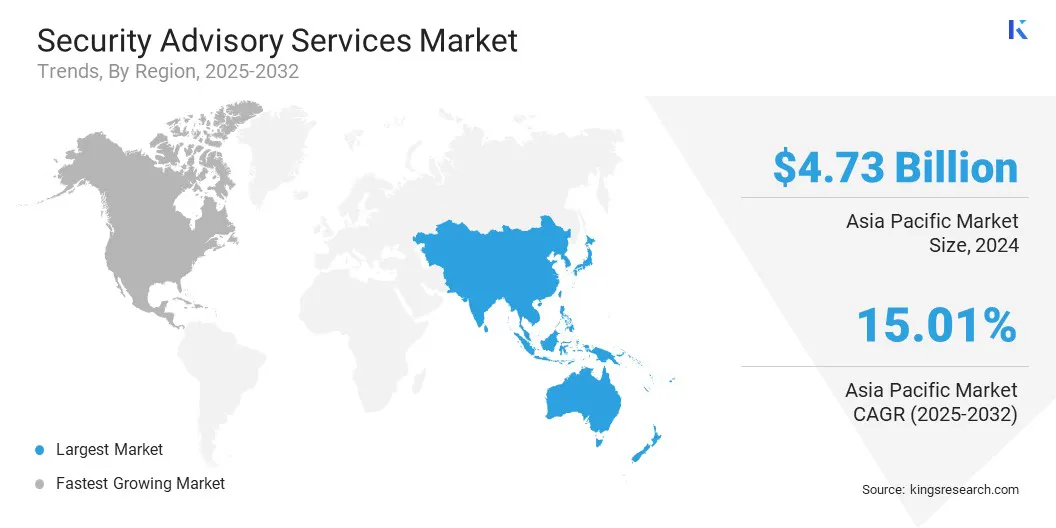
Asia Pacific market share stood at 26.40% in 2024, valued at USD 4.73 billion. The market is growing due to the rapid pace of growing digital transformation programs in the emerging economies resulting in the adoption of advanced security solutions. Cybersecurity regulations and frameworks have become an active endeavor by governments across the region, which is drawing organizations to invest in security advisory services.
Moreover, the development of smart cities, the advancements in the e-commerce business, and growth in digital payment systems have established the need of effective security. The market expansion is also supported by increasing IT and telecommunications sector, increasing awareness of cyber threats by businesses of both large and small size, making Asia Pacific a key market in terms of security advisory services.
North America security advisory services industry is set to grow at a CAGR of 17.26% over the forecast period. This expansion can be attributed to frequent and complex cyberattacks within the region designed to disrupt critical infrastructure and businesses The presence of large technology companies and financial institutions with substantial cybersecurity budgets continues to drive demand in the market.
Moreover, the increased regulatory pressure, including adherence to privacy regulations and industry-related norms, forces organizations to employ professional advisor services. The ongoing investment in new technologies, such as artificial intelligence and machine learning in detecting threats, and an increased use of cloud-based security systems will even drive further growth in the market in North America.
The security advisory services market is highly competitive, due to the growing complexity of cyber threats and the changing regulation requirements. Organizations enlist professional advisors to enhance their security positioning, risk mitigation, and compliance. Providers can be distinguished by their innovative solution, the possibility to offer full range of services, and the capability of providing customized strategies. Rapid technological innovations, increasing digital transformation efforts, and an increase in the awareness of the strategic value of cybersecurity are also shaping the market. Organizations are focusing more on proactive threat management and resilience. As a result, they are becoming more competitive, which leads to better services and new expert solutions for specific industry problems and emerging security challenges.
Frequently Asked Questions

Aswathi holds cross-domain expertise, translating market trends and competitive intelligence into decision-ready insights. Her work helps clients interpret evolving market conditions and identify growth opportunities. She brings a focused, insight-led approach to research execution. She translates these findings into clear, prioritized action plans that align with client capabilities. Her research often includes scenario modeling to test growth strategies under varying economic conditions. She maintains a rigorous validation process, cross-checking primary and secondary sources to ensure reliability. Clients value her ability to synthesize noisy data into concise executive summaries that drive board-level discussions. Her sector-specific lens, combined with a pragmatic focus on execution, consistently delivers high-impact, commercially sound recommendations. Her structured yet flexible research frameworks adapt to client timelines without compromising depth. She is known for distilling complex trade-offs into straightforward, defensible positions that facilitate confident decision-making.
Habi is a seasoned research and consulting leader with renowned experience in guiding clients on strategic growth and transformation initiatives across global markets. He has led high-performing research teams that deliver actionable insights on market expansion, M&A strategies, opportunity assessment, new business development, and product launches. His project portfolio spans large petrochemical producers, electronic device manufacturers, lubricants companies, and other leading enterprises across diverse industrial and consumer sectors. He currently heads the research department at Kings Research, where he is responsible for setting the research agenda, mentoring analysts, and ensuring client-ready deliverables that support executive decision-making. With extensive experience in market intelligence, strategic research, and consulting, Habi brings a strong understanding of evolving industry dynamics, competitive landscapes, emerging opportunities, and business growth challenges. His expertise includes developing research frameworks, translating complex market data into actionable strategic recommendations, and working closely with senior stakeholders to address critical business questions. He has also contributed to building research capabilities, strengthening analytical methodologies, and driving a culture of quality and insight-led decision-making within research teams. His cross-industry exposure enables him to connect market trends with broader business implications and provide perspectives that help organizations identify opportunities, mitigate risks, and make informed strategic decisions.