
Inquire Now
Key Strategic Points
Sales performance management involves strategies and solutions designed to monitor, evaluate, and enhance sales team effectiveness through goal setting, performance tracking, and incentive alignment. It enables organizations to improve sales productivity, optimize resource allocation, and drive revenue growth.
SPM is applied across industries in sales planning, forecasting, training, and performance-based compensation. Its adoption is increasing through digital tools, analytics platforms, and integration with enterprise performance management systems.
The global sales performance management market size was valued at USD 3,195.3 million in 2024 and is projected to grow from USD 3,601.5 million in 2025 to USD 9,326.4 million by 2032, exhibiting a CAGR of 14.56% during the forecast period.
This growth is driven by increasing adoption of sales performance management solutions aimed at improving revenue outcomes and maximizing sales efficiency Increasing demand from enterprises across industries is further accelerating adoption due to the focus on data-driven decision-making and performance-based incentive structures.
Major companies operating in the sales performance management market are Anaplan, Inc., beqom, Varicent, Iconixx, NiCE, Oracle, SAP SE, Xactly, Salesforce, Inc., Incentivate, Performio, IBM, Optymyze, SPOTIO, Inc., and CaptivateIQ, Inc.
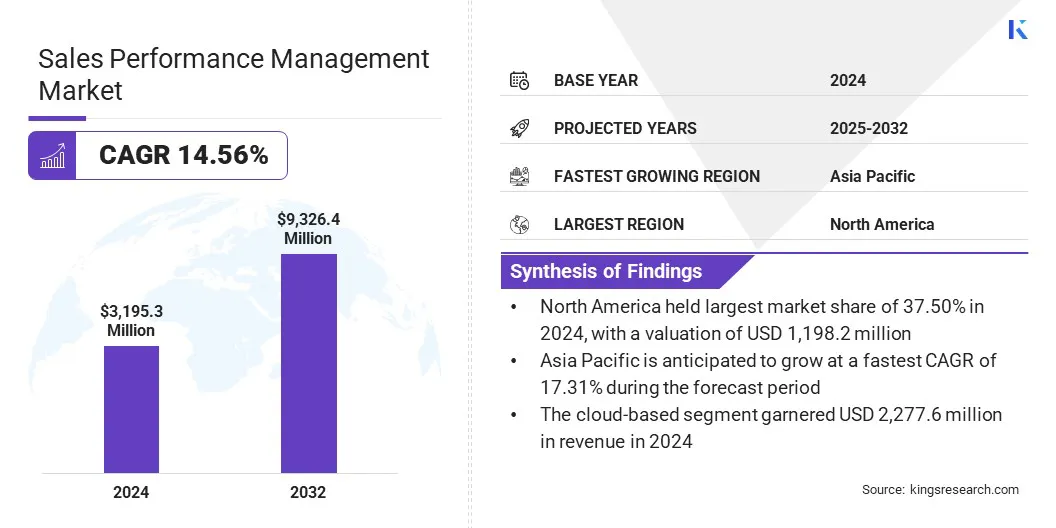
Expanding deployment of cloud-based platforms, advanced analytics, and automation tools is promoting broader implementation across North America, and Asia Pacific. Additionally, ongoing technological innovations, strategic partnerships, and integration with enterprise performance management systems are supporting market expansion.
Growing Focus on Sales Performance Optimization
The growth of the sales performance management market is primarily fueled by organizations’ increasing focus on enhancing sales productivity and revenue outcomes. Adoption of structured frameworks, cloud-based platforms, and analytics solutions is promoting investments in performance tracking, incentive management, and process optimization.
For instance, the U.S. General Services Administration (GSA) announced a OneGov agreement with Amazon Web Services (AWS) in August 2025, providing up to USD 1 billion in direct incentive credits to federal civilian agencies to accelerate cloud migration and adoption of AI technologies.
Consequently, enterprises across industries are increasingly leveraging these solutions to improve decision-making, align sales strategies, and achieve business objectives. Continued emphasis on digital transformation, advanced analytics, and AI-driven insights is also promoting technological innovation and broader deployment, positioning sales performance management as a critical tool for organizational growth.
Challenges in Legacy System Integration
Integrating legacy systems poses significant challenges to the adoption of sales performance management solutions across organizations. Outdated technologies, fragmented data, and a lack of interoperability between enterprise resource planning and customer relationship management systems lead to implementation delays, higher operational costs, and the need for extensive customization.
Enterprises seeking to optimize sales operations must address technical constraints, ensure data consistency, and coordinate across multiple departments. Limited expertise in integration and system migration further slows adoption and reduces efficiency.
To address these issues, organizations are investing in middleware solutions, system upgrades, and structured integration strategies. These initiatives aim to streamline connectivity, enhance data flow, and enable effective utilization of sales performance management platforms.
Integration of Artificial Intelligence & Advanced Analytics
The sales performance management market is experiencing a notable trend toward increasing demand for solutions that boost sales productivity and revenue. AI and advanced analytics are being integrated into platforms to provide real-time insights, performance forecasting, and optimized incentive management, while cloud-based deployments enable scalable and flexible implementation. This trend is further supported by organizations’ focus on data-driven decision-making and digital transformation initiatives to remain competitive.
Enterprises, technology providers, and analytics specialists are increasingly adopting AI-powered tools, predictive models, and integrated performance platforms to improve sales effectiveness. Continuous advancements in analytics and AI technologies are expected to enhance decision-making, boost productivity, and foster market growth over the forecast period.
|
Segmentation |
Details |
|
By Component |
Solutions, and Services |
|
By Deployment Mode |
On-Premise, and Cloud-Based |
|
By Organization Size |
Large Enterprises, and Small and Medium Enterprises (SMEs) |
|
By Vertical |
Banking, Financial Services, and Insurance (BFSI), Information Technology (IT) & Telecom, Manufacturing, Consumer Goods & Retail, Healthcare & Life Sciences, Energy & Utilities, Travel & Hospitality, and Other Verticals |
|
By Region |
North America: U.S., Canada, Mexico |
|
Europe: France, UK, Spain, Germany, Italy, Russia, Rest of Europe |
|
|
Asia-Pacific: China, Japan, India, Australia, ASEAN, South Korea, Rest of Asia-Pacific |
|
|
Middle East & Africa: Turkey, U.A.E., Saudi Arabia, South Africa, Rest of Middle East & Africa |
|
|
South America: Brazil, Argentina, Rest of South America |
Based on region, the market has been classified into North America, Europe, Asia Pacific, Middle East & Africa, and South America.
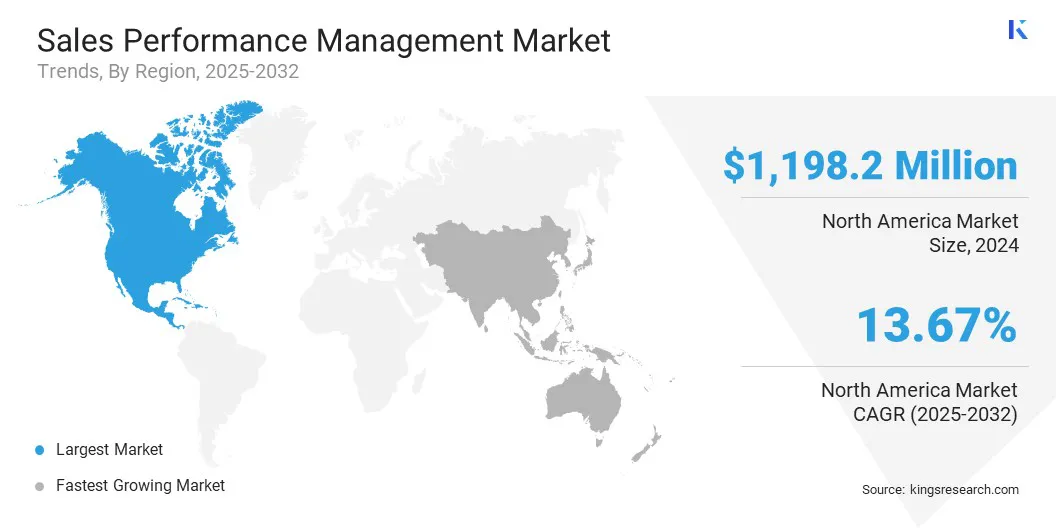
North America sales performance management market share stood at 37.50% in 2024, valued at USD 1,198.2 million. High digital maturity, strong presence of leading technology providers, and increasing adoption of cloud-based and AI-driven solutions are propelling this growth. Enterprises are leveraging advanced platforms to optimize sales processes, enhance incentive management, and enable data-driven decision-making.
Strategic initiatives, including partnerships, technology upgrades, and innovative analytics tools, further strengthen growth prospects. Enhanced integration capabilities, mobile accessibility, and real-time performance tracking reinforce North America’s position as a key hub for sales performance management.
Asia Pacific sales performance management industry is set to grow at a CAGR of 17.31% over the forecast period. This growth is fueled by rapid digital transformation, increasing adoption of cloud-based platforms, and rising emphasis on data-driven decision-making across enterprises. Investments in AI-enabled analytics, mobile solutions, and integrated performance management tools are strengthening the region’s technological capabilities.
The expansion of competitive industries such as technology, retail, telecommunications, and financial services, growing demand for efficient sales operations, and the need to optimize revenue generation are creating opportunities for adoption. Additionally, advancements in real-time performance tracking, predictive analytics, and seamless system integration are accelerating implementation, aiding regional market expansion.
Companies operating in the sales performance management industry are maintaining competitiveness through investments in cloud-based platforms, AI-powered analytics, and advanced performance tracking solutions. They are focusing on enhancing sales productivity, optimizing incentive management, and improving operational efficiency to meet growing demand across industries.
Key players are broadening their portfolios to include integrated performance management, predictive analytics, and mobile-enabled solutions, supported by strategic partnerships, acquisitions, and technology collaborations.
The regional market is witnessing increased collaboration among enterprises, technology providers, and consulting firms to accelerate solution adoption and streamline deployment. Additionally, companies are enhancing system integration, real-time monitoring, and data-driven insights, while leveraging automation and predictive modeling to maintain a competitive edge.
Frequently Asked Questions

Over the years, Versha brings over 15 years of experience managing consulting assignments across industries, including Food and Beverage, Consumer Goods, ICT, Aerospace, and more. Her work has spanned diverse sectors. Her cross-domain expertise and adaptability make her a versatile and dependable professional. She is known for her keen business insight and foresight. With sharp analytical skills and a curious mindset, Versha excels at transforming complex data into actionable insights. She has a proven track record of unraveling market dynamics, identifying trends, and delivering tailored solutions to meet client needs. As a skilled leader, Versha has successfully mentored research teams and directed projects with precision, ensuring high-quality outcomes. Her collaborative approach and strategic vision enable her to turn challenges into opportunities and consistently deliver impactful results. Whether analyzing markets, engaging stakeholders, or crafting strategies, Versha draws on her deep expertise and industry knowledge to drive innovation and deliver measurable value.

With over a decade of research leadership across global markets, Ganapathy brings sharp judgment, strategic clarity, and deep industry expertise. Known for precision and an unwavering commitment to quality, he guides teams and clients with insights that consistently drive impactful business outcomes.



.webp&w=128&q=75&dpl=dpl_9cT76VEyqA3GYX2gzuuRZBM2Vb4x)