
Inquire Now
Key Strategic Points
The market comprises materials and catalytic systems based on platinum group metals such as platinum, palladium, rhodium, and iridium that accelerate chemical reactions, while remaining unconsumed throughout the catalytic process. These catalysts enable high reaction efficiency, selectivity, and stability across critical industrial processes.
Its applications span automotive emission control, petroleum refining, chemical synthesis, pharmaceuticals, and clean energy systems, including fuel cells and hydrogen production, supporting regulatory compliance, process optimization, and sustainable manufacturing.
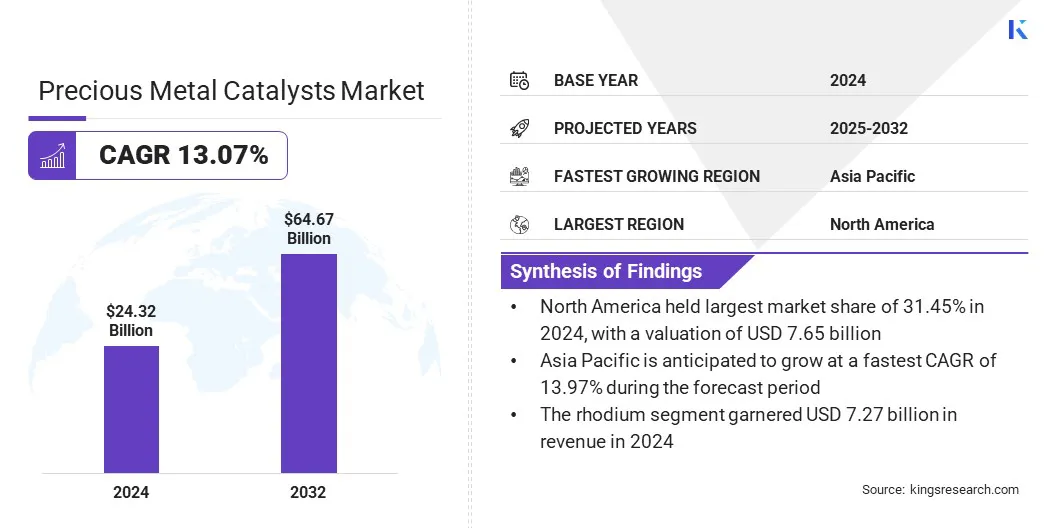
The global precious metal catalysts market size was valued at USD 24.32 billion in 2025 and is projected to grow from USD 27.37 billion in 2026 to USD 64.37 billion by 2033, exhibiting a CAGR of 13.07% during the forecast period.
This growth is driven by evolving vehicular emission regulations, rising adoption of advanced aftertreatment systems, and increasing use of platinum group metal catalysts to improve conversion efficiency and durability in exhaust control applications.
Major companies operating in the precious metal catalysts market are ALS LIMITED, Alfa Chemistry, American Elements, BASF SE, Catalytic Products International, CHIMET, Sabin Metal Corporation, Clariant, Honeywell International Inc., Evonik Industries AG, Umicore, Heraeus Precious Metals, Johnson Matthey, Thermo Fisher Scientific Inc., and N.E. CHEMCAT.
Increasing use of precious metal catalysts in pharmaceutical synthesis reflects the growing reliance on platinum group metals to achieve high selectivity, reaction control, and yield consistency in complex drug manufacturing processes. These catalysts support critical steps such as hydrogenation, oxidation, and carbon–carbon coupling, enabling efficient synthesis of active pharmaceutical ingredients.
Demand continues to rise due to stringent purity standards, shorter development timelines, and expanding biologics and specialty drug pipelines. Market participants are focusing on process optimization and cost efficiency, leading to the introduction of new catalysts to enhance scalability and regulatory compliance.
The expansion of green hydrogen projects is increasing reliance on advanced catalytic materials that maintain high efficiency under demanding operating conditions. Electrolyzers and fuel cells require materials capable of accelerating reaction rates while maintaining long-term stability and minimal energy loss.
Platinum group metal-based catalysts are preferred due to their superior electrochemical properties. Growing investments in large-scale hydrogen infrastructure and stricter performance standards are prompting developers to adopt catalysts that support higher output, extended lifecycles, and consistent operational reliability.
Concerns pertaining to supply chain dependence on limited mining regions remain a significant challenge due to the geographic concentration of platinum group metal reserves. Supply disruptions, geopolitical risks, and regulatory uncertainties increase price volatility and procurement risks for catalyst manufacturers.
Heavy reliance on a few producing countries constrains supply flexibility and complicates long-term capacity planning. These factors impact cost structures, contract stability, and investment decisions across automotive, chemical, and energy sectors that depend on consistent catalyst availability.
To address this challenge, industry participants are diversifying sourcing strategies, increasing recycled metal utilization, forming long-term supply agreements, and investing in alternative catalyst formulations to reduce reliance on geographically concentrated mining regions.
The market is influenced by a growing focus on catalyst recycling and precious metal recovery to address cost pressures and supply constraints. High price volatility of platinum group metals prompts manufacturers and end users to recover valuable metals from end-of-life catalysts Recycling improves material availability, reduces dependence on primary mining, and aligns with sustainability objectives across industries.
Advances in recovery technologies and closed-loop supply models further boost adoption. These efforts enhance resource efficiency and long-term supply security through systematic precious metal recovery.
|
Segmentation |
Details |
|
By Metal |
Palladium, Platinum, Rhodium, Iridium, Ruthenium, Others |
|
By Form |
Powder, Pellet, Extrudate and Honeycomb, Wash coated Monolith |
|
By Application |
Automotive, Petrochemicals, Pharmaceutical, Electronics & Semiconductor, Others |
|
By Region |
North America: U.S., Canada, Mexico |
|
Europe: France, UK, Spain, Germany, Italy, Russia, Rest of Europe |
|
|
Asia-Pacific: China, Japan, India, Australia, ASEAN, South Korea, Rest of Asia-Pacific |
|
|
Middle East & Africa: Turkey, U.A.E., Saudi Arabia, South Africa, Rest of Middle East & Africa |
|
|
South America: Brazil, Argentina, Rest of South America |
The North America precious metal catalysts market accounted for a share of 31.45% in 2025, valued at USD 7.65 billion. The region demonstrates high adoption of advanced catalyst technologies due to stringent environmental regulations and continuous upgrades in industrial processing standards. This dominance is reinforced by strong demand from automotive emission control, petroleum refining, and specialty chemical manufacturing.
Mature refining infrastructure and consistent investments in clean energy systems further sustain demand for platinum group metal catalysts. A strong presence of pharmaceutical manufacturing and chemical synthesis activities also contributes to steady consumption. Additionally, well-established recycling and recovery ecosystems enhance material availability, stabilizing supply chains and fostering regional market expansion.
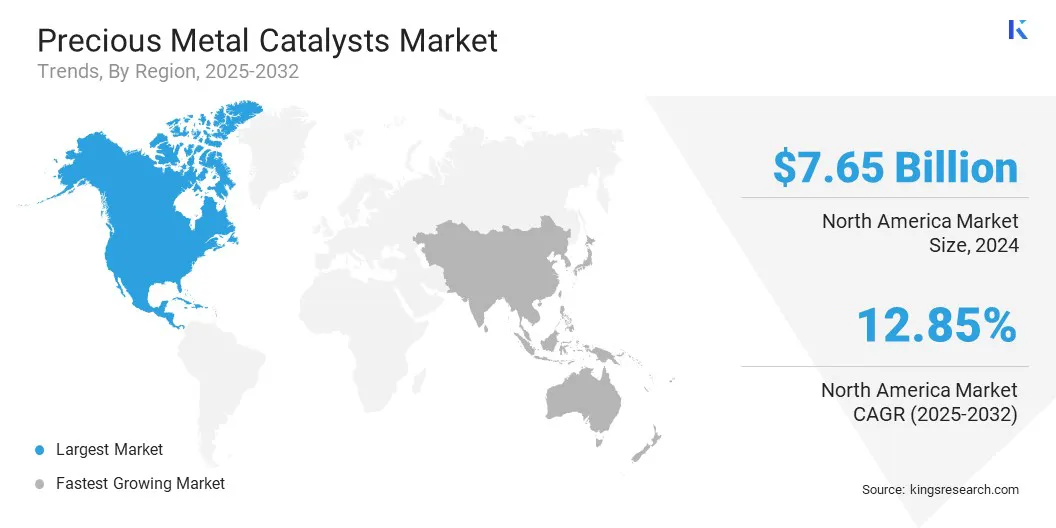
The Asia-Pacific precious metal catalysts industry is projected to register a CAGR of 13.97% over the forecast period. This growth is largely attributed to rapid industrial expansion and increasing demand across automotive, refining, and chemical processing sectors. Accelerated capacity additions in petrochemicals and the rising adoption of emission control technologies lead to widespread catalyst consumption.
Growth in pharmaceutical manufacturing and fine chemical production further strengthens demand for high-performance catalysts. Expanding investments in clean energy technologies, including hydrogen and fuel cell systems, increase reliance on platinum and iridium-based catalysts. The region’s cost-competitive manufacturing environment and expanding downstream industries support sustained volume growth and long-term market expansion.
Key participants operating in the precious metal catalysts industry are prioritizing capacity expansion to address the rising demand across automotive, chemical, and energy-related applications. They are investing in advanced catalyst formulations to improve activity, selectivity, and thermal stability under demanding operating conditions. Strategic focus remains on strengthening recycling and precious metal recovery capabilities to manage raw material constraints and price volatility.
Several players are entering long-term supply agreements across industrial value chains to secure consistent feedstock availability. Increased allocation toward research and development supports process optimization and adaptation to evolving regulatory standards. Collaborations, technology partnerships, and portfolio diversification across end-use industries remain central actions to maintain competitive positioning.
Frequently Asked Questions

Antriksh is an experienced analyst specializing in cross-domain research across diverse industries. With a strong foundation in data analysis and statistical interpretation, he delivers insightful market reports that guide strategic decision-making. Antriksh excels in conducting primary research, with a focus on identifying trends and understanding consumer behavior. Thriving in dynamic and high-pressure environments, he combines analytical expertise with a commitment to delivering impactful outcomes. Beyond his professional pursuits, Antriksh's passion for travel fuels his curiosity and broadens his perspectives, enriching his ability to uncover unique insights that enhance his research capabilities. He is equally adept at synthesizing quantitative findings with qualitative context, which allows him to present holistic viewpoints to clients. His disciplined work ethic and intellectual agility make him a trusted partner in navigating market uncertainties. He consistently seeks out new methodologies to refine his analytical toolkit, and his ability to communicate complex insights clearly ensures stakeholders act confidently on his recommendations.

Ganapathy Subramaniam Suresh
With over a decade of research leadership across global markets, Ganapathy brings sharp judgment, strategic clarity, and deep industry expertise. Known for precision and an unwavering commitment to quality, he guides teams and clients with insights that consistently drive impactful business outcomes.



.webp&w=128&q=75&dpl=dpl_DPva2LrvfsBdTJm1XZj67UTrvMHL)