
Inquire Now
Key Strategic Points
Powersports vehicles market covers motorcycles, ATVs, side-by-side vehicles, personal watercraft, and snowmobiles designed for recreation and utility. The report has also segmented the market based on propulsion into gasoline, diesel, or electric and hybrid systems that deliver performance across different terrains. Powersport vehicles are used off-road and on-road for adventure, leisure, and utility activities in various environments.
The global powersports market size was valued at USD 42.72 billion in 2024 and is projected to grow from USD 45.16 billion in 2025 to USD 70.02 billion by 2032, exhibiting a CAGR of 6.47% over the forecast period.
The growth is driven by the rising consumer preference for high-performance and reliable vehicles that deliver enhanced comfort, durability, and advanced safety features.The market is also witnessing a shift towards all-electric powersports vehicles, with manufacturers introducing electric motorcycles, ATVs, and side-by-side vehicles to meet changing consumer preferences and emission standards.
Major companies operating in the powersports market are Bombardier Recreational Products Inc., CFMOTO, Polaris Inc., Yamaha Motor Corporation, Honda Motor Co., Ltd., Kawasaki Heavy Industries, Ltd., Harley-Davidson Motor Company, Inc., KTM Sportmotorcycle GmbH, Arctic Cat Inc., Triumph Motorcycles, BMW AG, HISUN, TAIGA MOTORS INC., Deere & Company, ARGO.
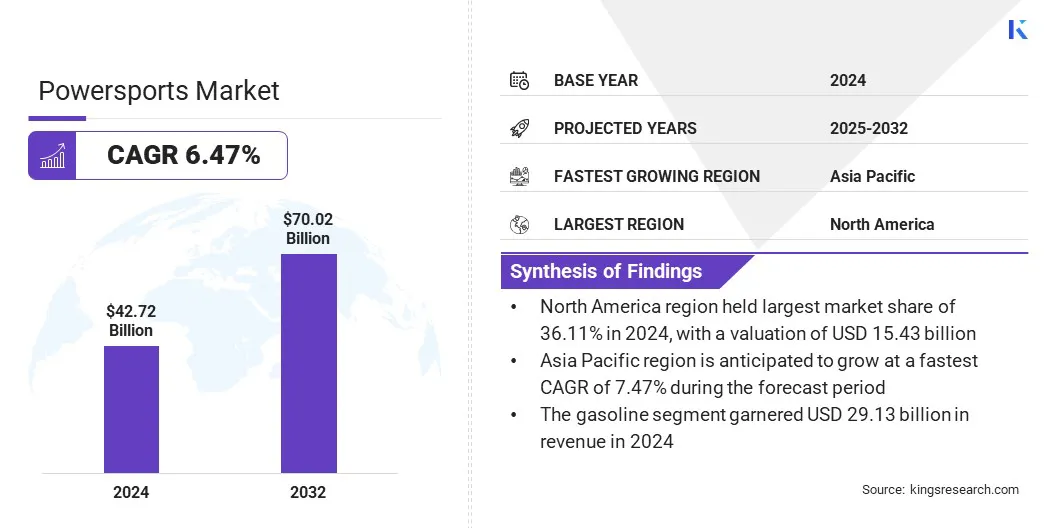
Companies are developing more reliable and luxury powersports vehicles to meet the growing consumer demand for quality, performance, and safety. They are also focusing on improving suspension, ground clearance, and seating comfort to enhance the overall riding experience. This approach supports the adoption of premium powersports vehicles and encourages innovation in vehicle design and functionality.
The powersports market is expanding as consumers show a stronger preference for high-performance and reliable vehicles. Technological advancements such as improved engine systems and advanced 4WD configurations have increased vehicle stability, control, and durability.
Manufacturers are incorporating digital instrument clusters, smart connectivity, and adaptive control systems to enhance functionality and user experience. These developments are driving broader consumer interest across recreational and utility applications. The ongoing focus on innovation and operational efficiency continues to strengthen the adoption of powersports vehicles globally.
A major challenge in the powersports market is the high maintenance and operational costs of vehicles such as motorcycles, ATVs, and side-by-side vehicles. These costs include servicing, fuel, spare parts, and repairs, which can limit user adoption and delay market growth.
To address this, manufacturers are introducing vehicles with durability, lower maintenance needs, and higher fuel efficiency. Better service networks and reliable after-sales also help in reducing operational burdens, encouraging the use of powersports vehicles.
The powersports market is witnessing a strong shift toward all-electric vehicles across multiple segments, including heavyweight motorcycles, all-terrain vehicles (ATVs), side-by-side vehicles, personal watercraft, and snowmobiles.
Manufacturers are focusing on developing advanced electric drivetrains and high-capacity battery systems to improve performance and range. This transition aligns with global emission reduction targets and the growing consumer preference for sustainable and low-maintenance mobility solutions.
|
Segmentation |
Details |
|
By Vehicle Type |
Heavyweight Motorcycles, Side-by-Side Vehicles, All-Terrain Vehicles (ATVs), Personal Watercraft, Snowmobiles |
|
By Propulsion |
Gasoline, Diesel, Electric/ Hybrid |
|
By Application |
Off-Road, On-Road |
|
By Region |
North America: U.S., Canada, Mexico |
|
Europe: France, UK, Spain, Germany, Italy, Russia, Rest of Europe |
|
|
Asia-Pacific: China, Japan, India, Australia, ASEAN, South Korea, Rest of Asia-Pacific |
|
|
Middle East & Africa: Turkey, U.A.E., Saudi Arabia, South Africa, Rest of Middle East & Africa |
|
|
South America: Brazil, Argentina, Rest of South America |
Based on region, the global powersports market has been classified into North America, Europe, Asia Pacific, Middle East & Africa, and South America.
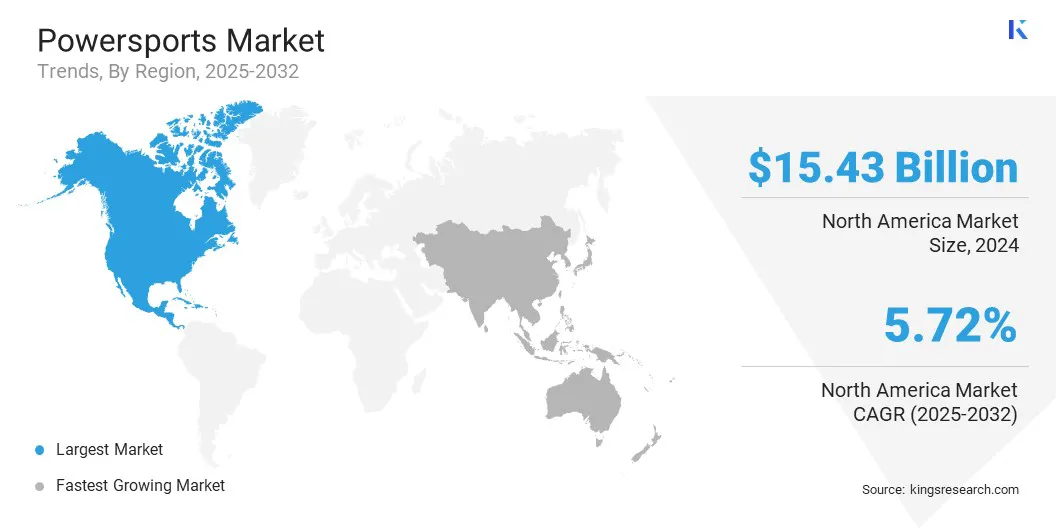
North America powersports market share accounted for the largest share of 36.11% in 2024, with a valuation of USD 15.43 billion. The dominance is supported by the rising participation in outdoor recreational activities and motorsport events. Consumers are engaging in off-roading, trail riding, and snowmobiling, which is creating sustained demand for high-performance powersports vehicles.
According to the 2024 Outdoor Participation Trends Report, outdoor recreation participation in the U.S. grew by 4.1% in 2023 to reach 175.8 million people, representing 57.3% of the population. This sharp increase in recreational activity is reinforcing demand for advanced and durable vehicles, strengthening North America’s dominance in the market.
Asia Pacific is poised to grow at a CAGR of 7.47% over the forecast period. The growth is driven by rising tourism and adventure sports activities across countries such as Japan, Thailand, Australia, and India. Governments are promoting outdoor recreation, which is increasing the demand for powersports vehicles across leisure segments.
According to the Pacific Asia Travel Association (PATA), international visitor arrivals across 47 destinations in Asia Pacific reached 522 million in 2023, reflecting a 94.3% year-on-year increase. The rise in tourist arrivals is increasing participation in outdoor and adventure activities, which is driving the adoption of powersports vehicles across the region.
Key players in the powersports industry are focusing on reinforcing their competitive position through strategic product launches and portfolio expansion. Companies are introducing new models with heated seats, improved suspension systems, and higher ground clearance to attract diverse customer segments.
Manufacturers are regularly updating existing vehicle lines and adding variants across propulsion types, including gasoline, diesel, and electric or hybrid models. They are also expanding offerings in off-road and on-road applications to maintain market presence and respond to evolving consumer preferences.
Frequently Asked Questions

Sunanda is a proficient research analyst with strong cross-domain expertise, excelling in identifying market trends and delivering insightful analyses across various industries, including consumer goods, food & beverages, healthcare, and more. Her ability to connect insights from diverse sectors enables her to offer actionable recommendations that support strategic decision-making in a range of business contexts. Sunanda's research is driven by thorough data analysis and her commitment to providing relevant, data-driven insights. Her keen eye for patterns allows her to spot emerging opportunities before they become mainstream. Sunanda's synthesis of cross-sector learnings often reveals unconventional solutions that clients find invaluable. She adapts her analytical frameworks to suit each industry's unique nuances, ensuring reports are both accurate and contextually relevant. Clients appreciate her ability to deliver crisp, actionable findings under tight deadlines, consistently exceeding expectations with her thoroughness and insight.

Ganapathy Subramaniam Suresh
With over a decade of research leadership across global markets, Ganapathy brings sharp judgment, strategic clarity, and deep industry expertise. Known for precision and an unwavering commitment to quality, he guides teams and clients with insights that consistently drive impactful business outcomes.