
Inquire Now
Key Strategic Points
The personalization engines market comprises software platforms and services that enable organizations to identify and deliver relevant experiences for individual customers or prospects based on historical interactions, current context, and predicted intent. The solutions leverage technologies comprising AI and machine learning, data analytics and big data, rule-based systems, and natural language processing to tailor content, offers, and interactions across customer touchpoints. The market is segmented on the basis of organization size, deployment mode, application, and end-use industries, including retail and e-commerce, banking and financial services, healthcare, media, travel, and IT and telecommunications.
The global market size was valued at USD 1,940.0 million in 2024 and is projected to grow from USD 2,240.8 million in 2025 to USD 7,100.4 million by 2032, exhibiting a CAGR of 17.91% during the forecast period (2025 – 2032). The demand for advanced decisioning platforms capable of converting fragmented customer data into real-time, relevant customer journeys at scale is driving the widespread adoption of personalization engines.
Major companies operating in the global personalization engines industry are Insider One, Mastercard, SAP SE, Adobe, Bloomreach, Inc., CleverTap Private Limited, Braze, Optimizely, Salesforce, Inc., Twilio Inc, Monetate, Netcore Pvt. Ltd, Personyze, Iterable, Inc., and BLUESHIFT LABS, INC.
Companies are restructuring their product design and innovation teams into a unified creation engine to accelerate product development, support growth, and enhance the overall consumer experience.
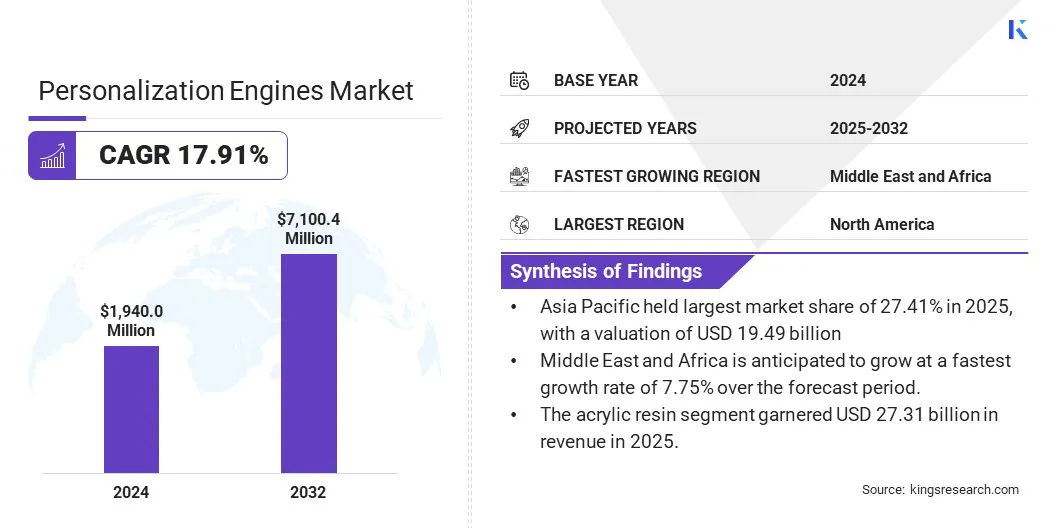
The rising consumer expectations for real-time, relevant, and individualized browsing experiences are prompting brands to adopt advanced AI-powered personalization engines. These platforms utilize agentic AI and machine learning to analyze customer behavior, anticipate intent, and dynamically optimize experiences across multiple channels such as email, web, mobile apps, and paid advertising. This enables the delivery of tailored product recommendations and empowers brands with enhanced client engagement, increased business avenues, enhanced customer lifetime value, and measurable marketing ROI.
The key challenge associated with balancing the delivery of hyper-personalized customer experiences with stringent data privacy requirements exists in the market. The increasing expectations of brands to provide highly relevant, tailored interactions across digital and offline touchpoints require access to vast amounts of personal data, which is collected, stored, and utilized for personalized search recommendations. The leakage of customer data due to incidents like hacking erodes trust and invites legal consequences, thereby restricting widespread adoption of personalization engines.
To address this challenge, market players are adopting privacy-first strategies comprising privacy-by-design, AI-driven data anonymization, federated learning, and transparent communication to ensure that personalization initiatives are both effective and compliant.
Innovations such as the adoption of hyper-personalization, which leverages artificial intelligence, real-time data, and predictive analytics to create experiences tailored at the individual level, are reshaping market dynamics. These trends enable brands to deliver individualized experiences at scale across digital, physical, and immersive channels.
Additionally, the adoption of predictive and privacy-focused personalization, where enterprises leverage AI to analyze spending patterns and psychographic data to offer timely and relevant products and solutions to customers, is gaining pace. The ability of these systems to identify shifts in transaction data or engagement patterns enables the recommendations of tailored products or services and helps flag potential risks, thereby safeguarding consumer interests, generating higher ROI, and driving stronger user engagement.
|
Segmentation |
Details |
|
By Technology |
AI & Machine Learning-based Personalization, Data Analytics & Big Data, Rule-based Personalization Engines, Natural Language Processing (NLP) |
|
By Organization Size |
Large Enterprises |
|
By Component |
Software, Services |
|
By Deployment Mode |
Cloud-based, On-Premises |
|
By Application |
Product Recommendations, Web Content Personalization, Targeted Marketing, Email Campaign Personalization, Customer Segmentation, Cross-selling & Up-selling |
|
By End-User Industry |
Retail & E-commerce, IT & Telecommunications, Media & Entertainment, BFSI, Healthcare & Life Sciences, Travel & Hospitality, Others |
|
By Region |
North America: U.S., Canada, Mexico |
|
Europe: France, UK, Spain, Germany, Italy, Russia, Rest of Europe |
|
|
Asia-Pacific: China, Japan, India, Australia, ASEAN, South Korea, Rest of Asia-Pacific |
|
|
Middle East & Africa: Turkey, U.A.E., Saudi Arabia, South Africa, Rest of Middle East & Africa |
|
|
South America: Brazil, Argentina, Rest of South America |
Based on region, the personalization engines market has been classified into North America, Europe, Asia Pacific, Middle East & Africa, and South America.
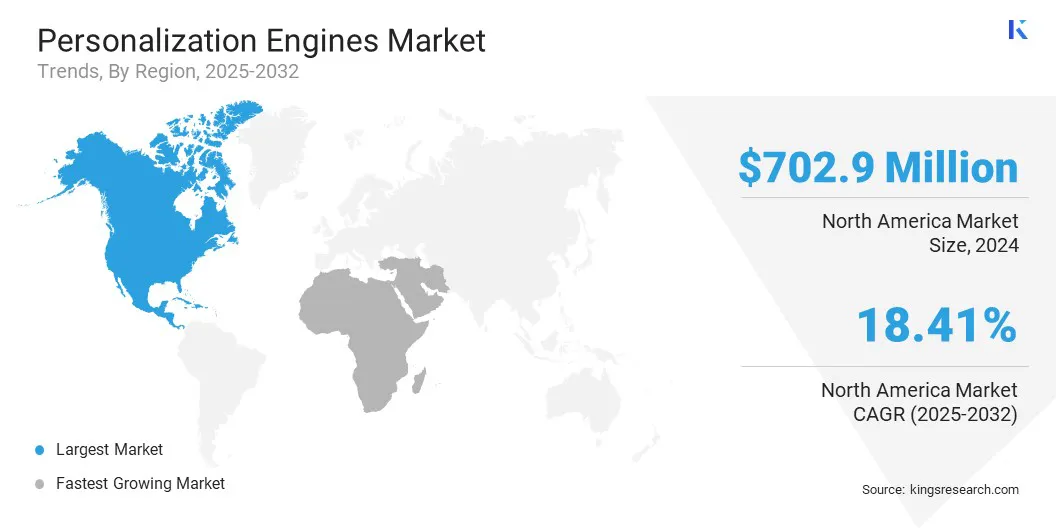
North America accounted for a substantial share of 36.23% in 2024, valued at USD 702.9 million. The high share is attributable to advanced digital infrastructure, the presence of major technology companies driving innovation, and a vast consumer base that fuels the adoption and implementation of personalized product or service recommendations to users.
The U.S. accounts for the largest share in North America, propelled by its extensive retail and e-commerce ecosystem that fosters the adoption of systems that enable the delivery of customized product and service recommendations to users. According to the U.S. Census Bureau, total e-commerce sales for 2025 were estimated at USD 1,233.7 billion, representing a y-o-y increment of 5.4%. This continued expansion reinforces the increasing adoption of personalized recommendation technologies across the region.
The Middle East and Africa personalization engines market is anticipated to register the fastest CAGR of 19.10% over the forecast period. This growth is fueled by rapid AI adoption across retail, e-commerce, and financial services, supported by extensive internet penetration and a digitally engaged demographic. Additionally, government-led digital transformation initiatives in countries like the UAE, Saudi Arabia, and Qatar are accelerating the shift toward automated trade and commerce through AI integration.
The personalization engines market is witnessing increased investments by business and commercial enterprises in technologies that deliver more relevant, tailored experiences to individual users. Market players are combining consumer data, AI, and real-time insights to strengthen recommendation systems, enhance customer engagement, and drive conversions. The market is transitioning due to the rising demand from diverse end-use sectors for seamless digital interactions and accelerated business growth.
Manufacturers are leveraging generative AI, natural language processing, and computer vision to transform customer engagement through hyper-personalized experiences. This approach goes beyond basic personalization by analyzing customer behavior, preferences, and context in real time to create tailored content, recommendations, support, and marketing across channels.
Frequently Asked Questions

Faizy brings over four years of experience in market research and consulting, with a proven ability to support strategic engagements across diverse industries and business environments. His work focuses on understanding complex market structures, identifying emerging opportunities, and translating research findings into clear, commercially relevant insights. With strong analytical capabilities and a structured approach to problem-solving, he evaluates industry trends, competitive landscapes, customer dynamics, and evolving business models. His expertise encompasses market research, competitive intelligence, market sizing and forecasting, industry assessment, company benchmarking, and strategic analysis. Faizy combines technical proficiency with a strong research orientation, enabling him to interpret both qualitative and quantitative information effectively. He has contributed to projects that help organizations assess growth potential, strengthen market positioning, and evaluate strategic priorities. His adaptable approach allows him to work across sectors while maintaining a consistent focus on accuracy, relevance, and delivering insights that support informed decision-making for clients and stakeholders.
Habi is a seasoned research and consulting leader with renowned experience in guiding clients on strategic growth and transformation initiatives across global markets. He has led high-performing research teams that deliver actionable insights on market expansion, M&A strategies, opportunity assessment, new business development, and product launches. His project portfolio spans large petrochemical producers, electronic device manufacturers, lubricants companies, and other leading enterprises across diverse industrial and consumer sectors. He currently heads the research department at Kings Research, where he is responsible for setting the research agenda, mentoring analysts, and ensuring client-ready deliverables that support executive decision-making. With extensive experience in market intelligence, strategic research, and consulting, Habi brings a strong understanding of evolving industry dynamics, competitive landscapes, emerging opportunities, and business growth challenges. His expertise includes developing research frameworks, translating complex market data into actionable strategic recommendations, and working closely with senior stakeholders to address critical business questions. He has also contributed to building research capabilities, strengthening analytical methodologies, and driving a culture of quality and insight-led decision-making within research teams. His cross-industry exposure enables him to connect market trends with broader business implications and provide perspectives that help organizations identify opportunities, mitigate risks, and make informed strategic decisions.