
Inquire Now
Key strategic points
Pentylene glycol is a multifunctional organic compound used as a humectant, solvent, and preservative across cosmetics, personal care, and pharmaceutical products.
The market scope covers cosmetic grade, industrial grade, and pharmaceutical grade variants tailored to different performance needs. Key applications include personal care and cosmetics, pharmaceuticals, and the food industry, where it enhances product stability, safety, and shelf life.
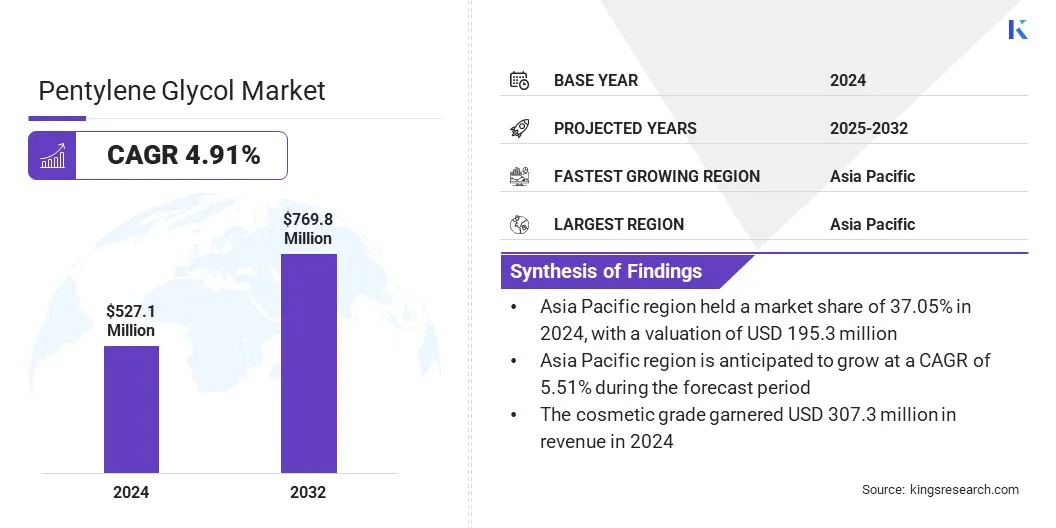
The global pentylene glycol market size was valued at USD 527.1 million in 2024 and is projected to grow from USD 550.3 million in 2025 to USD 769.8 million by 2032, exhibiting a CAGR of 4.91% over the forecast period.
This growth is fueled by the growing demand for antimicrobial agents in cosmetics, which increases its incorporation in skincare and personal care products. The market is further shaped by the shift toward naturally derived innovative formulations, where the ingredient is used in products combining moisturizing, preservative, and solvent properties. These properties support broader applications in cosmetics, personal care, and pharmaceuticals.
Major companies operating in the pentylene glycol market are Symrise, Cosroma, Cefa-Cilinas Biotics, Yantai Aurora Chemical Co., LTD., Prod'Hyg, Novaphene, DKSH Performance Materials International Ltd., Jiangsu Suoteng New Material Technology Co., Ltd., Uniproma, and Shengqing Materials Co., Ltd.
Companies are formulating products that leverage pentylene glycol’s inherent antimicrobial, humectant, solvent, and emollient properties to address the increasing demand for multifunctional solutions in cosmetics, personal care, and pharmaceuticals.
Its inclusion enhances product hydration, preservation, and texture while reducing the need for additional ingredients. This approach enables the development of efficient, high-performance products that deliver multiple benefits within a single application.
Growing Demand for Antimicrobial Agents in Cosmetics
The expansion of the pentylene glycol market is driven by the growing demand for antimicrobial agents in cosmetics. Pentylene glycol acts as an effective preservative, preventing the growth of bacteria, mold, and yeast in personal care and skincare products.
According to the article “Mechanism of action of preservatives in cosmetics” published in the Journal of Dermatologic Science and Cosmetic Technology, December 2024, pentylene glycol belongs to the class of 1,2-alkanediols, which exert antimicrobial effects through membrane disruption.
Its amphiphilic nature allows it to integrate into microbial cell membranes, destabilizing their structure and inhibiting microbial growth. Rising consumer awareness of product safety and hygiene is prompting manufacturers to include pentylene glycol in formulations, supporting market growth.
High Production Costs
A major challenge impeding the expansion of the pentylene glycol market is the high cost of production due to complex synthesis processes and the requirement for high-purity raw materials. These costs limit adoption in personal care, cosmetics, and pharmaceutical applications.
To address this challenge, companies are investing in energy-efficient manufacturing technologies and process optimization. Market players are also expanding production facilities and exploring alternative raw material sources to reduce costs and maintain a consistent supply.
Shift Toward Naturally Derived Innovative Formulations
The pentylene glycol market is experiencing a shift toward innovative formulations using 100% naturally derived ingredients in personal care, cosmetics, and pharmaceutical products.
Manufacturers are focusing on combining moisturizing, preservative, and solvent properties in a single ingredient to enhance product performance. This trend is driving the development of high-performance, safe, and natural formulations, influencing product development and formulation strategies across the market.
|
Segmentation |
Details |
|
By Type |
Cosmetic Grade, Industrial Grade, Pharmaceutical Grade |
|
By Function |
Moisturizer, Solvent, Preservative, Others |
|
By End Use Industry |
Personal Care & Cosmetics, Pharmaceuticals, Food Industry, Others |
|
By Region |
North America: U.S., Canada, Mexico |
|
Europe: France, UK, Spain, Germany, Italy, Russia, Rest of Europe |
|
|
Asia-Pacific: China, Japan, India, Australia, ASEAN, South Korea, Rest of Asia-Pacific |
|
|
Middle East & Africa: Turkey, U.A.E., Saudi Arabia, South Africa, Rest of Middle East & Africa |
|
|
South America: Brazil, Argentina, Rest of South America |
Based on region, the market has been classified into North America, Europe, Asia Pacific, Middle East & Africa, and South America.
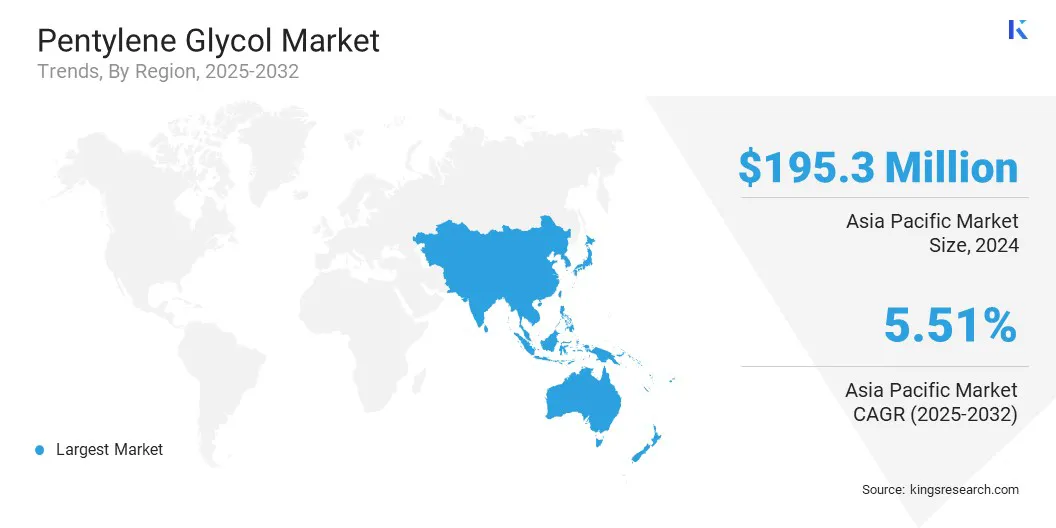
Asia Pacific pentylene glycol market share stood at 37.05% in 2024, valued at USD 195.3 million. This dominance is reinforced by the rapid expansion of pharmaceutical sector and increasing consumer spending on personal care and cosmetic products.
High demand from countries such as China, India, and Japan is driven by a growing middle-class population and rising disposable incomes. The region’s expanding pharmaceutical sector further contributes to regional market growth, as pentylene glycol is used in various pharmaceutical formulations.
The Europe pentylene glycol industry is poised to grow at a significant CAGR of 4.82% over the forecast period. This growth is propelled by the private-sector investments in new production facilities aimed at increasing manufacturing capacity for multifunctional ingredients.
These investments support the personal care and cosmetics industry by ensuring a reliable supply of high-quality pentylene glycol. The expanded production capabilities enable companies to meet rising regional demand efficiently while adhering to sustainability standards, strengthening Europe’s market position.
Key players in the pentylene glycol industry are expanding their production capabilities by establishing new manufacturing facilities in key regions. These investments aim to meet the growing demand for sustainable and multifunctional ingredients, ensuring a reliable supply chain and reduced transportation emissions.
Additionally, firms are introducing innovative formulations of pentylene glycol to cater to evolving consumer preferences for eco-friendly and high-performance products. These efforts are designed to strengthen market presence and align with industry trends favoring natural and effective ingredients.
Frequently Asked Questions

Sunanda is a proficient research analyst with strong cross-domain expertise, excelling in identifying market trends and delivering insightful analyses across various industries, including consumer goods, food & beverages, healthcare, and more. Her ability to connect insights from diverse sectors enables her to offer actionable recommendations that support strategic decision-making in a range of business contexts. Sunanda's research is driven by thorough data analysis and her commitment to providing relevant, data-driven insights. Her keen eye for patterns allows her to spot emerging opportunities before they become mainstream. Sunanda's synthesis of cross-sector learnings often reveals unconventional solutions that clients find invaluable. She adapts her analytical frameworks to suit each industry's unique nuances, ensuring reports are both accurate and contextually relevant. Clients appreciate her ability to deliver crisp, actionable findings under tight deadlines, consistently exceeding expectations with her thoroughness and insight.

With over a decade of research leadership across global markets, Ganapathy brings sharp judgment, strategic clarity, and deep industry expertise. Known for precision and an unwavering commitment to quality, he guides teams and clients with insights that consistently drive impactful business outcomes.