
Inquire Now
Key Strategic Points
The market comprises technologies, services, and platforms that streamline patient access to healthcare services, insurance benefits, and treatment support programs. These solutions facilitate appointment scheduling, eligibility verification, benefits investigation, prior authorization, financial counseling, and patient cost estimation to improve operational workflows and reduce administrative burdens.
The report covers segmentation based on solution type, deployment model, end user, and geographic region. Patient access solutions are applied in hospitals, clinics, specialty practices, and health systems to enhance patient experience, accelerate care delivery, ensure accurate reimbursement, and optimize revenue cycle performance across diverse healthcare settings.
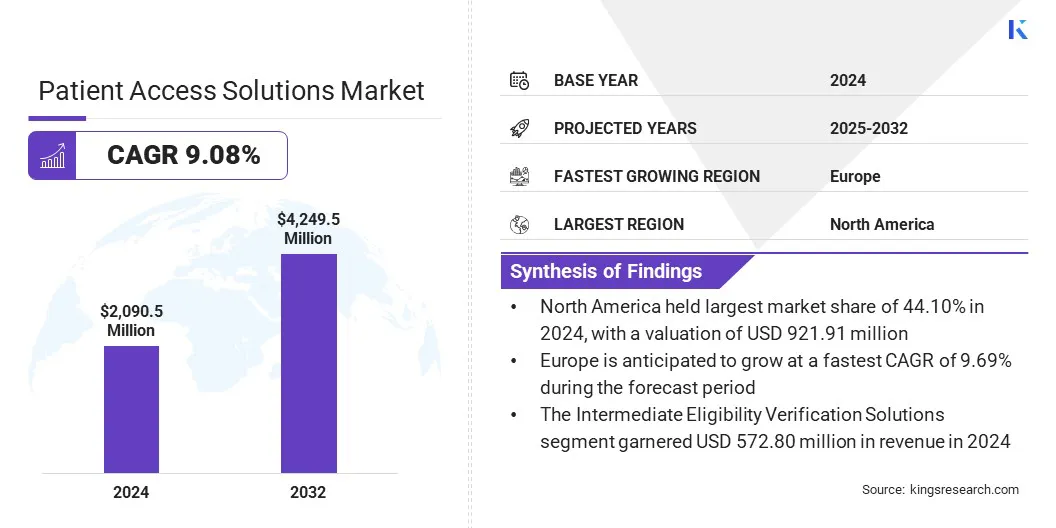
The global patient access solutions market size was valued at USD 2090.5 million in 2024 and is projected to grow from USD 2,260.4 million in 2025 to USD 4,249.5 million by 2032, exhibiting a CAGR of 9.08% over the forecast period.
The growth of the market is driven primarily by rising regulatory requirements for healthcare data accuracy and payer compliance. Additionally, rising demand to simplify insurance verification and prior authorization processes is driving adoption by improving operational efficiency and patient experience.
Major companies operating in the patient access solutions market are MEDHOST, Cerner Corporation, TransUnion LLC, KYRUUS, United BioSource LLC, GAFFEY Healthcare, Stericycle Inc., FormFast, Cardinal Health, McKesson, AccuReg, Yosi Health, QGenda, Zocdoc, and Solv Health.
Key market players are investing heavily in R&D, targeted at developing next-generation digital platforms. These efforts focus on greater automation, enhanced interoperability, AI-driven decision support, and real-time integration with electronic health records (EHR) and payment systems.
Companies are expanding system capabilities to incorporate eligibility verification, authorization management, price estimation, and patient engagement tools targeted primarily at reducing payment reimbursement denials and enhancing cash flow.
Increasing administrative complexity in healthcare systems such as insurance workflows and electronic health record (EHR) management is placing a growing operational burden on providers. This is driving the adoption of advanced patient access and automation solutions.
Moreover, rising patient expectations for faster, more transparent care, combined with the broader shift toward digital health tools, including seamless scheduling, clear financial communication, and EHR integration are further boosting demand for patient access platforms.
The market faces challenges related to complex healthcare administration and fragmented operational workflows. Patient access functions are frequently distributed across multiple teams and systems, leading to inefficiencies in scheduling, insurance eligibility verification, and prior authorization processes.
These inefficiencies contribute to higher claim denial rates, revenue leakage for healthcare providers, and lower patient satisfaction. To address these challenges, market players are investing in integrated platforms, workflow automation, interoperability with EHR systems, and data-driven tools to streamline front-end revenue cycle operations.
The market is experiencing accelerated innovation, driven by increasing demand for automation, digital transformation, and improved patient engagement. Healthcare organizations are adopting AI-enabled eligibility verification, automated prior authorization, and predictive analytics to reduce administrative workload and minimize claim denials.
In addition, the adoption of cloud-based platforms, robotic process automation for repetitive tasks, and real-time communication tools is improving reimbursement timelines and enhancing operational efficiency for healthcare providers.
|
Segmentation |
Details |
|
By Type |
Intermediate Eligibility Verification Solutions, Prior Authorization Solutions, Scheduling Solutions, Registration & Intake Solutions, Others. |
|
By Solution |
Software, Services |
|
By Deployment |
On-Premise, Cloud, Hybrid |
|
By End Use |
Healthcare Providers, Pharmaceutical Manufacturers, Specialty Pharmacies, Payers/Health Plans, Others |
|
By Region |
North America: U.S., Canada, Mexico |
|
Europe: France, UK, Spain, Germany, Italy, Russia, Rest of Europe |
|
|
Asia-Pacific: China, Japan, India, Australia, ASEAN, South Korea, Rest of Asia-Pacific |
|
|
Middle East & Africa: Turkey, U.A.E., Saudi Arabia, South Africa, Rest of Middle East & Africa |
|
|
South America: Brazil, Argentina, Rest of South America |
Based on region, the global patient access solutions market is classified into North America, Europe, Asia Pacific, Middle East & Africa, and South America.
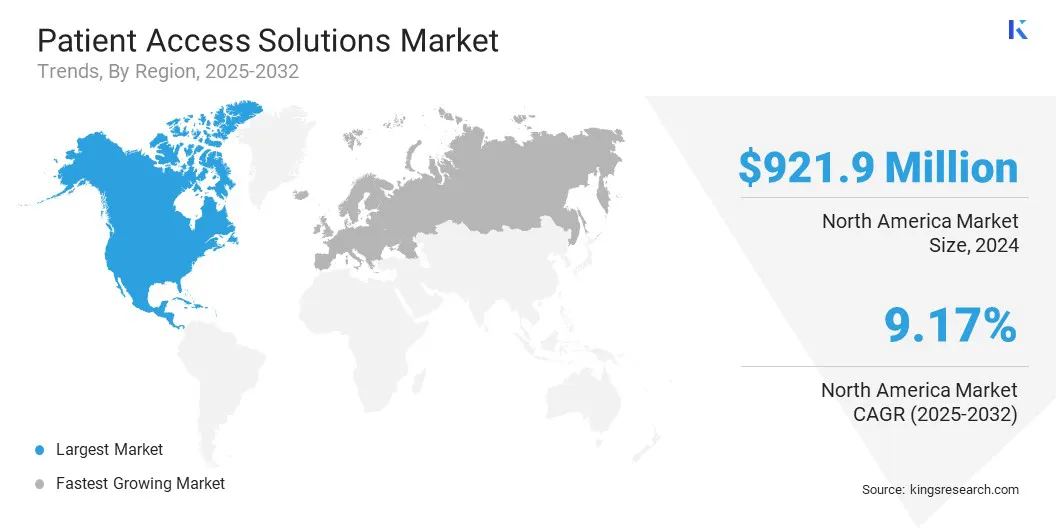
The North America patient access solutions market accounted for a 44.10% share in 2024, valued at USD 921.91 million. market growth in the region is supported by a mature healthcare ecosystem, increasing adoption of digital health technologies, and stricter regulatory requirements related to patient data accuracy and revenue cycle management. These factors are contributing to greater administrative complexity and driving demand for advanced patient access solutions.
For instance, a large majority of U.S. hospitals now enable patients to view, download, and transmit electronic health information, with foundational patient access capabilities adopted by over 80% of facilities. Moreover, the regulatory landscape in North America is a key driver of the market, as federal mandates increasingly require healthcare providers to ensure accurate, standardized, and portable patient data.
Initiatives such as the 21st Century Cures Act accelerate adoption by obligating organizations to enable secure electronic access to health information, thereby increasing compliance complexity and driving demand for advanced patient access and data management solutions.
The Asia-Pacific patient access solutions industry is anticipated to grow at a CAGR of 7.85%, over the forecast period. This growth is driven by rapid expansion of healthcare infrastructure, increasing patient volumes, and large-scale digitization initiatives across China, India, Japan, and South Korea.
Rising investments in healthcare modernization, including digital appointment scheduling, AI-driven triage systems, online patient registration, and automated insurance eligibility verification, are further supporting market growth across the region.
Leading players in the patient access solutions industry are focusing on workflow automation, data integration, and expansion of digital service offerings to meet growing demand for efficient and patient-centric healthcare access. Companies are advancing interoperable platforms, telehealth capabilities, and patient support programs to support regulatory compliance, strengthen patient engagement, and improve treatment outcomes.
Frequently Asked Questions

Over the years, Versha brings over 15 years of experience managing consulting assignments across industries, including Food and Beverage, Consumer Goods, ICT, Aerospace, and more. Her work has spanned diverse sectors. Her cross-domain expertise and adaptability make her a versatile and dependable professional. She is known for her keen business insight and foresight. With sharp analytical skills and a curious mindset, Versha excels at transforming complex data into actionable insights. She has a proven track record of unraveling market dynamics, identifying trends, and delivering tailored solutions to meet client needs. As a skilled leader, Versha has successfully mentored research teams and directed projects with precision, ensuring high-quality outcomes. Her collaborative approach and strategic vision enable her to turn challenges into opportunities and consistently deliver impactful results. Whether analyzing markets, engaging stakeholders, or crafting strategies, Versha draws on her deep expertise and industry knowledge to drive innovation and deliver measurable value.

Ganapathy Subramaniam Suresh
With over a decade of research leadership across global markets, Ganapathy brings sharp judgment, strategic clarity, and deep industry expertise. Known for precision and an unwavering commitment to quality, he guides teams and clients with insights that consistently drive impactful business outcomes.



.webp&w=128&q=75&dpl=dpl_DPva2LrvfsBdTJm1XZj67UTrvMHL)