
Inquire Now
Key Strategic Points
The market involves medical procedures, devices, and consumables used to selectively separate and collect leukocytes from whole blood while returning the remaining components to circulation. This process enables the targeted removal or collection of white blood cells for therapeutic and research purposes.
Leukapheresis systems support applications such as management of hematologic disorders, treatment of autoimmune conditions, and preparation of cellular material for advanced therapies and clinical research. These technologies rely on controlled centrifugation, filtration, and automated flow systems to ensure efficiency, safety, and reproducibility.
Leukapheresis plays a critical role in cell therapy development, immunology research, and oncology studies by enabling precise leukocyte isolation across hospitals, blood centers, and academic research settings.
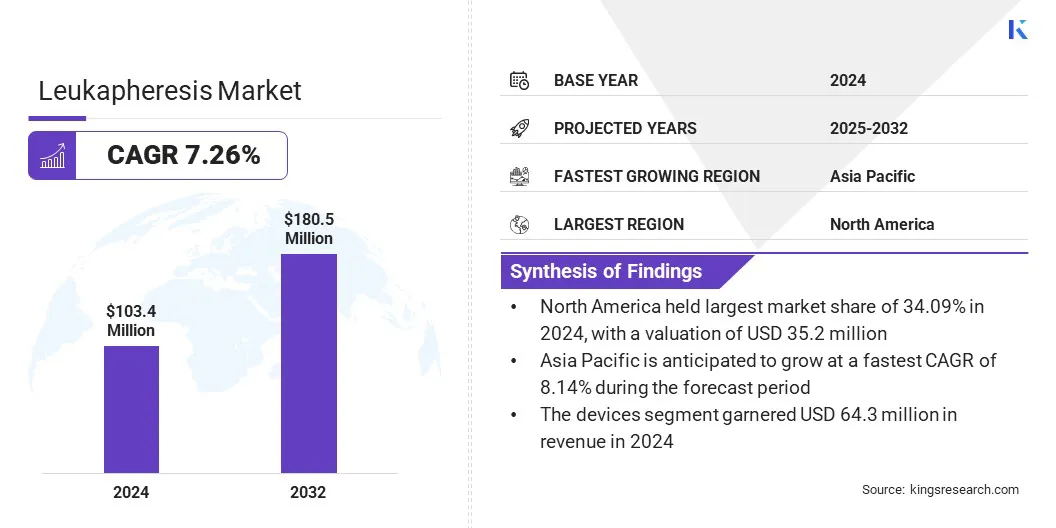
The global leukapheresis market size was valued at USD 103.4 million in 2024 and is projected to grow from USD 110.5 million in 2025 to USD 180.5 million by 2032, exhibiting a CAGR of 7.26% over the forecast period. Market growth is driven by increasing use of targeted blood processing for selective leukocyte removal in therapeutic and research settings.
Rising utilization of leukapheresis in hematologic and autoimmune disease management is supporting precise leukocyte control and standardized treatment delivery. Moreover, Expanding integration of leukapheresis into clinical protocols, supported by growing procedure volumes and advancing apheresis technologies is further driving market growth.
Major companies operating in the leukapheresis market are Terumo Corporation, Fresenius Kabi USA, LLC, Haemonetics Corporation, Asahi Kasei Group, Miltenyi Biotec, Macopharma, B. Braun SE, Medica SPA, Charles River Laboratories, ZenBio, Inc., Adacyte Therapeutics, Sysmex Corporation, AllCells, Lonza Group AG, and Cerus Corporation.
The increasing prevalence of hematologic and autoimmune disorders is driving demand for leukapheresis procedures across therapeutic settings. Rising incidence of conditions such as leukemia, lymphoma, and multiple sclerosis is increasing reliance on targeted leukocyte removal and collection therapies.
Expanding diagnostic awareness, earlier disease detection, and longer treatment durations are further increasing procedure volumes. Growing integration of leukapheresis into standardized hospital and blood center care pathways is reinforcing its role in managing chronic and treatment-intensive patient populations.
Expansion of mobile based leukapheresis centers is supported by the need to extend specialized blood processing capabilities beyond centralized hospital settings. Flexible deployment enables on site leukocyte collection for clinical trials, donor initiatives, and patients located in remote or underserved areas. This approach minimizes travel requirements, accelerates scheduling, and improves participation rates.
Pharmaceutical sponsors and research institutions increasingly rely on mobile platforms to streamline trial operations, ensure sample consistency, and support decentralized care models, strengthening scalable and cost efficient outreach across advanced therapeutic programs globally.
Availability of qualified professionals remains constrained due to the specialized technical competencies required for leukapheresis procedures. Operation demands precise system handling, strict protocol compliance, and continuous patient monitoring, which limits workforce entry. Training programs remain limited in scale, while certification requirements extend onboarding timelines.
Smaller healthcare facilities and emerging regions face additional barriers due to inadequate training infrastructure. Increasing system sophistication and regulatory oversight further elevate skill thresholds, restricting workforce flexibility and slowing service expansion across therapeutic and research oriented leukapheresis environments globally.
To address this challenge, manufacturers and healthcare providers invest in structured training programs, standardized protocols, and automation enabled systems. Digital monitoring, remote support tools, and simplified device interfaces reduce operator dependency, improve procedural consistency, and support workforce scalability across diverse clinical environments worldwide sustainably long-term.
Growing adoption of cell and gene therapies is driving increased use of leukapheresis across research, clinical, and commercial manufacturing stages. Advanced therapies such as CAR-T, stem cell treatments, and immune-engineered products require consistent, high-quality leukocyte collection to ensure cell viability, process standardization, and regulatory compliance.
Expanding clinical pipelines, rising therapy approvals, and increasing manufacturing capacity are further elevating procedural demand. As a result, biopharmaceutical companies are incorporating leukapheresis early in therapy development to support scalability, supply chain reliability, and global commercialization of cell-based therapies.
|
Segmentation |
Details |
|
By Product |
Devices, Disposables |
|
By Application |
Therapeutic, Research |
|
By End User |
Hospitals & Clinics, Blood Centers, Academic & Research Institutes, Others |
|
By Region |
North America: U.S., Canada, Mexico |
|
Europe: France, UK, Spain, Germany, Italy, Russia, Rest of Europe |
|
|
Asia-Pacific: China, Japan, India, Australia, ASEAN, South Korea, Rest of Asia-Pacific |
|
|
Middle East & Africa: Turkey, U.A.E., Saudi Arabia, South Africa, Rest of Middle East & Africa |
|
|
South America: Brazil, Argentina, Rest of South America |
Based on region, the market has been classified into North America, Europe, Asia Pacific, Middle East & Africa, and South America.
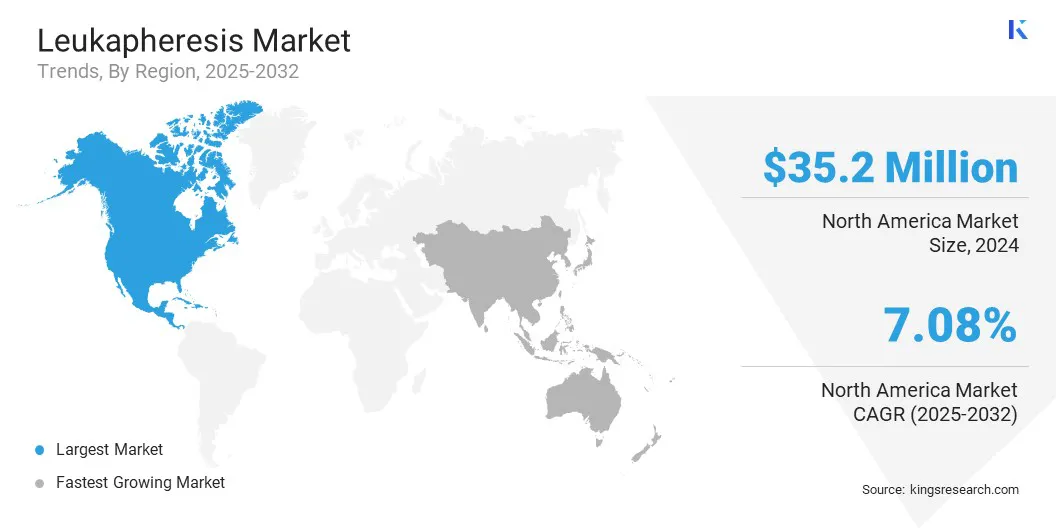
The North America leukapheresis market accounted for a 34.09% share in 2024, valued at USD 35.2 million, supported by strong procedural volumes and early adoption of advanced apheresis technologies. Market growth is driven by mature healthcare infrastructure, widespread availability of automated leukapheresis systems, and integration of procedures across hospitals, blood centers, and research institutions.
A high concentration of cell and gene therapy programs, active clinical trials, and translational research further support consistent demand for leukocyte collection. Additionally, regulatory clarity, established reimbursement pathways, and continuous investments in system upgrades, consumables, and workforce training reinforce procedural adoption and revenue stability in the region.
Asia Pacific leukapheresis industry is set to grow at a CAGR of 8.14% over the forecast period, supported by expanding healthcare capacity and rising focus on advanced therapeutic procedures. Increasing diagnosis of hematologic and immune related disorders drives procedural demand across hospitals and specialty centers. Research activity continues to expand due to growing investments in oncology, immunology, and regenerative medicine programs.
Pharmaceutical and biotechnology companies are strengthening clinical development pipelines, increasing requirements for consistent leukocyte collection. Adoption of automated systems and disposable kits improves procedural efficiency and safety. Expansion of academic research institutes and contract research activity further supports sustained growth momentum, positioning the region as a high potential contributor to future market expansion.
Market participants are focusing on broadening product portfolios for devices and disposables to meet evolving therapeutic and research needs. Key strategies emphasize advancing automation, closed-system designs, and digital monitoring to comply with regulatory and operational standards. Companies are scaling manufacturing capacity and enhancing supply chain resilience to accommodate growing procedural volumes.
Collaborations with research institutions, clinical trial sponsors, and healthcare providers remain central to market penetration efforts. Investments in system reliability, workflow integration, and compliance readiness continue, while geographic expansion, localized service support, and workforce training help strengthen presence in high-growth regions and maintain competitive positioning in the technology-driven and highly regulated market.
Frequently Asked Questions

Antriksh is an experienced analyst specializing in cross-domain research across diverse industries. With a strong foundation in data analysis and statistical interpretation, he delivers insightful market reports that guide strategic decision-making. Antriksh excels in conducting primary research, with a focus on identifying trends and understanding consumer behavior. Thriving in dynamic and high-pressure environments, he combines analytical expertise with a commitment to delivering impactful outcomes. Beyond his professional pursuits, Antriksh's passion for travel fuels his curiosity and broadens his perspectives, enriching his ability to uncover unique insights that enhance his research capabilities. He is equally adept at synthesizing quantitative findings with qualitative context, which allows him to present holistic viewpoints to clients. His disciplined work ethic and intellectual agility make him a trusted partner in navigating market uncertainties. He consistently seeks out new methodologies to refine his analytical toolkit, and his ability to communicate complex insights clearly ensures stakeholders act confidently on his recommendations.
With many years of consulting experience across global pharma, biotech, and MedTech markets, Minaz brings deep domain expertise, strategic clarity, and analytical rigor to every engagement. She has led 130+ consulting assignments spanning market entry, competitive landscaping, and portfolio prioritization, helping clients navigate complex, high-stakes decisions with confidence. Known for her ability to synthesize primary and secondary research into executive-ready recommendations, Minaz has built forecasting models and market sizing frameworks that have informed multi-million dollar investment decisions in oncology, diagnostics, and peptide therapeutics. Beyond her analytical strength, Minaz is a trusted client partner, translating complex datasets into clear, actionable insights for senior stakeholders. She currently leads a team of research analysts, driving business expansion, and shaping client engagement strategy.



.webp&w=128&q=75&dpl=dpl_DPva2LrvfsBdTJm1XZj67UTrvMHL)
