
About Us
Services
Report Store
Press Release
Our Blogs
Connect with Us
HAZMAT PACKAGING MARKET

Enquire Now

Report thumbnail for Hazmat Packaging Market
Hazmat Packaging Market

Hazmat Packaging Market

Hazmat Packaging Market Size, Share, Growth & Industry Analysis, By Product Type (Drums, Intermediate Bulk Containers (IBCs), Pails, Bottles & Jars, Boxes and Cartons, Others), By Material Type (Plastic, Metals, Corrugated Paper, Glass, Others) By End Use (Agriculture, Chemicals, Pharmaceuticals, Oil and Gas, Others) and Regional Analysis, 2025-2032

Pages: 170 | Base Year: 2024 | Release: December 2025 | Author: Swati J. | Last Updated: December 2025

Key strategic points

Market Definition

The market covers specialized containers and materials engineered to ensure the safe storage and transportation of hazardous substances in liquid, solid, and gaseous forms. These solutions are designed to prevent leakage, contamination, and environmental harm when dangerous goods such as chemicals, biological agents, radioactive elements, and explosives are moved through industrial supply chains.

The report examines the market across product types, material categories, end-use sectors, and major regional markets. Hazmat packaging supports regulatory compliance and enhances the safety and efficiency of logistics operations for industries including chemicals, pharmaceuticals, oil and gas, and agriculture.

Hazmat Packaging Market Overview

The global Hazmat Packaging market size was valued at USD 10.43 billion in 2024 and is projected to grow from USD 10.97 billion in 2025 to USD 16.37 billion by 2032, exhibiting a CAGR of 5.89% over the forecast period.

Market growth is driven by expanding regulations that govern the safe handling, transport, and storage of hazardous materials across industrial supply chains. Growing awareness of environmental protection and workplace safety further strengthens demand for reliable hazmat packaging, prompting organizations to adopt compliant and secure handling solutions.

Key Market Highlights:

  1. The hazmat packaging industry size was recorded at USD 10.43 billion in 2024.
  2. The market is projected to grow at a CAGR of 5.89% from 2025 to 2032.
  3. North America held a share of 36.28% in 2024, valued at USD 3.78 billion.
  4. The intermediate bulk containers (IBC) segment garnered USD 2.46 billion in revenue in 2024.
  5. The boxes and cartons segment is expected to reach USD 1.24 billion by 2032.
  6. The plastics material type segment is anticipated to witness the fastest CAGR of 6.30% over the forecast period.
  7. Asia Pacific is anticipated to grow at a CAGR of 5.97% through the projection period.

Major companies operating in the hazmat packaging market are Air Sea Containers, Inc., Balmer Lawrie & Co. Ltd., C.L. Smith, Deufol SE, ENPAC, Fibre Drum Packaging Solutions, UK, Greif, HOOVER CS, Labelmaster, Mauser Packaging Solutions, NEFAB GROUP, Schutz, Söhner Kunststofftechnik GmbH, Smurfit Westrock, and The Cary Company.

Hazmat Packaging Market Size & Share, By Revenue, 2025-2032

Key market players in the market are investing in R&D to develop next-generation packaging solutions that deliver greater durability, improved sustainability, and full compliance with international handling and transport protocols. 

Companies are expanding testing and certification processes, introducing innovative containment systems by enhancing research oriented towards developing materials technology to enhance the safety of packaging used in hazardous materials. Additionally, industry leaders are refining commercialization strategies, strengthening collaborations with logistics providers, chemical manufacturers, and emergency response services in order to accelerate the adoption of advanced hazmat packaging solutions.

  • In August 2024, Mauser Packaging Solutions expanded operations in South Africa by acquiring a plastic drum business in Pinetown, KwaZulu-Natal. The facility holds ISO 9001, ISO 14001, and ISO 45001 certifications and produces UN-certified tight-head and open-head plastic drums for hazardous materials, including chemicals, petrochemicals, lubricants, and coatings.

What key driving factors are fueling demand for hazmat packaging?

Key driving factors fueling demand for hazmat packaging include the expanding use of hazardous materials across industrial sectors, rising production volumes that require compliant transport solutions, and growing emphasis on safe handling to reduce operational risks and environmental impact. 

Key end use sectors comprising chemicals, petrochemicals, oil and gas, pharmaceuticals, manufacturing, and waste management are witnessing significant expansion, resulting in a rise in the volume of dangerous goods in transit. 

The growth is attributable to factors including rising global consumption of industrial and pharmaceutical products, technological advancements, economic development of emerging markets, and the extensive operations by the oil and gas industry, which involves continuous movement of crude oil, refined fuels, and by-products, thereby requiring durable tanks, barrels, and specialized containers capable of safely containing hazardous liquids.

  • According to the Indian Brand Equity Foundation (IBEF) under the Department of Commerce (Government of India), the rapidly expanding Indian chemical industry serves as a major driver for the HAZMAT packaging market. The end use sector covers approximately 80,000 commercial products and is projected to reach USD 300 billion by 2028, becoming the sixth-largest chemical producer and a leading manufacturer of agrochemicals, dyes, and pharmaceuticals in the world and thereby driving demand for hazardous material packaging solutions due to the growing output of hazardous substances such as petrochemicals, specialty chemicals, and active pharmaceutical ingredients.

What are the key challenges faced by the hazmat packaging market?

The market faces significant challenges due to the inherent complexity and risk of transporting hazardous materials, which mandates companies to navigate strict regulatory frameworks at local, national, and international levels, thus adhering to the safety protocols and ensuring packaging caters to safety requirements for chemicals, flammable liquids, gases, and corrosive substances. 

Additionally, technical complexity associated with technology adoption in hazardous material packaging, comprising shipment tracking, operations of digital compliance tools further acts as a central challenge for the market.

The market is shifting toward sustainable, high-performance solutions as companies respond to regulatory expectations and rising demand for environmentally responsible practices. 

Manufacturers of chemicals and dangerous goods are adopting recycled plastics, bio-based materials, and reusable container systems that reduce waste while maintaining safety and durability. Advances in design and engineering support better efficiency and easier compliance with global standards. This trend enhances operational performance, strengthens brand credibility, and improves long-term competitiveness for hazmat packaging producers.

  • In January 2025, DGeo, the hazardous‑materials (DG) packaging division of Labelmaster, launched innovative sustainable packaging solutions for hazardous materials. The company introduced BioEPS coolers, which are a biodegradable alternative to traditional EPS foam that helps in reducing CO₂ emissions by 30 kg per 1,000 units and decomposes 92% in four years.

Hazmat Packaging Market Report Snapshot

Segmentation

Details

By Product Type

Drums, Intermediate Bulk Containers (IBCs), Pails, Bottles & Jars, Boxes and Cartons, Others

By Material Type

Plastic, Metals, Corrugated Paper, Glass, Others

By End Use

 Agriculture, Chemicals, Pharmaceuticals, Oil and Gas, Others

By Region

North America: U.S., Canada, Mexico

Europe: France, UK, Spain, Germany, Italy, Russia, Rest of Europe

Asia-Pacific: China, Japan, India, Australia, ASEAN, South Korea, Rest of Asia-Pacific

Middle East & Africa: Turkey, U.A.E., Saudi Arabia, South Africa, Rest of Middle East & Africa

South America: Brazil, Argentina, Rest of South America

Market Segmentation

  • By Product Type (Drums, Intermediate Bulk Containers (IBCs), Pails, Bottles & Jars, Boxes and Cartons, and Others): The intermediate bulk containers (IBCs) is the fastest growing segment which accounted for USD 2.46 billion in 2024 and is anticipated to grow with a CAGR of 5.64 % during the forecast period. The growth is attributable majorly to the bulk storage and transportation property associated with IBC in addition to the reduced packaging costs, minimized environmental footprints and widespread applicability across diverse ends use sectors comprising chemicals, petrochemicals and many others.
  • By Material Type (Plastic, Metals, Corrugated Paper, Glass, and Others): Plastics dominate the material type segment accounting for USD 4.49 billion owing to its lightweight nature, chemical resistance, cost efficiency, and versatility across diverse hazardous goods. The widespread applicability of plastics in manufacturing drums, containers, and liners for handling hazardous materials makes it a preferred choice over metals, corrugated paper, glass, and others for safe and compliant material handling.
  • By End Use (Agriculture, Chemicals, Pharmaceuticals, Oil and Gas, and Others). The chemicals end use sector was estimated at USD 1.69 billion in 2024, which is attributable to the high volume and diversity of hazardous substances produced across diverse end use sectors. This mandates the adoption of robust packaging solutions which are critical for safe handling of corrosive, flammable, and toxic chemicals.

What is the market scenario in North America and Asia-Pacific region?

Based on region, the market has been classified into North America, Europe, Asia Pacific, Middle East & Africa, and South America.

North America Hazmat Packaging market share stood at 36.28% in 2024, valued at USD 3.78 billion. Industrial expansion across the region continues to accelerate demand for reliable hazardous material handling solutions, including steel drums, fiberboard boxes, and advanced UN-certified containers that comply with U.S. DOT, EPA, and OSHA requirements. 

Growing movement of flammable, corrosive, and biohazardous substances is also increasing the need for leak-proof, vented, and multi-layered packaging across the U.S. In Canada, regulations set by the Transportation of Dangerous Goods (TDG) program and Environment and Climate Change Canada (ECCC) further shape material, design, and labeling standards for compliant hazmat packaging.
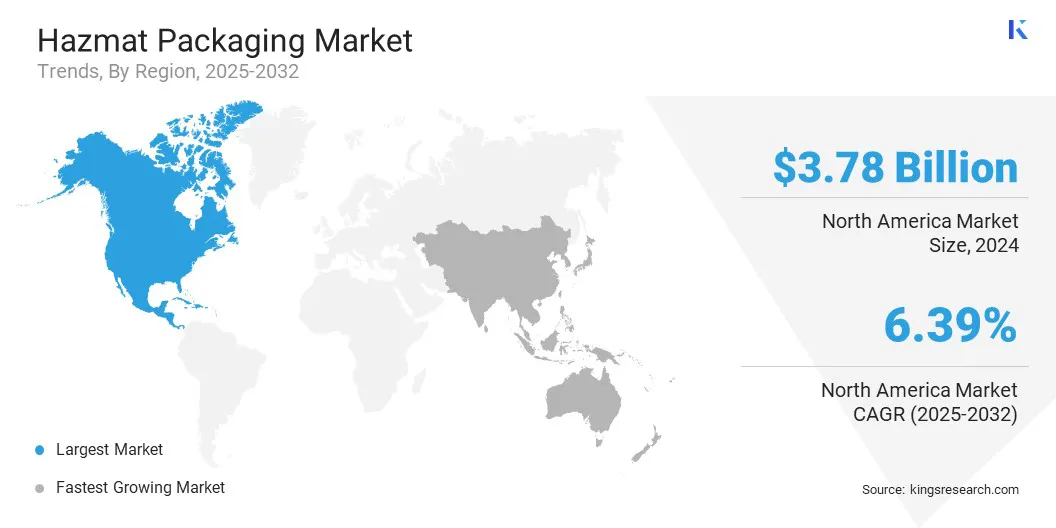
Hazmat Packaging Market Size & Share, By Region, 2025-2032

The Asia-Pacific hazmat packaging industry is set to grow at a robust CAGR of 5.97% over the forecast period. This growth is propelled majorly by the rapid industrialization, expanding chemical trade, which mandates efficient hazardous material storage solutions, including steel drums, plastic cans, corrugated cartons and allied solutions that are UN certified and offer leak-proof and anti-static properties. 

Additionally, the widespread adoption of smart tracking systems comprising RFID tags and block chain-based package tracking for bulk shipments of hazardous materials in Asia Pacific oil & gas and chemical sectors contribute significantly to the growth of the market.

  • In December 2023, the China Chemical Safety Association introduced two standards for hazardous chemical labeling and electronic tagging. These standards outline the use of two-dimensional barcodes and RFID tags to enable end-to-end tracking of chemicals during production, storage, and transportation.

Regulatory Frameworks

  • The U.S. Federal Hazardous Materials Transportation Law forms the core legal framework governing the safe transport of hazardous materials in the country. It authorizes the Department of Transportation to set safety standards for packaging, handling, and transportation to protect people and the environment from hazmat-related risks.
  • The United Nations Committee on the Transport of Dangerous Goods introduced updates in Revision 24 (2025) of the UN Model Regulations, strengthening globally harmonized standards for hazmat transport and packaging. Key changes include new provisions for lithium-ion and sodium-ion hybrid batteries, clarified rules for solids that may liquefy, and guidance on using recycled plastics in flexible intermediate bulk containers (FIBCs). The revision also covers liquid organic hydrogen carriers, salvage pressure receptacles, energetic samples, and limited-quantity exemptions for environmentally hazardous materials.

Competitive Landscape

Leading players operating in the hazmat packaging industry are focusing on portfolio expansion, and strategic partnerships to address the growing demand for sustainable, safe, and efficient hazardous materials handling solutions. Companies are emphasizing the development and testing of new advanced packaging materials, reusable containers, and eco-friendly alternatives in order to ensure compliance with regulatory frameworks, operational safety, and environmental sustainability.

  • In August 2025, SCHÜTZ GmbH & Co. KGaA opened a new manufacturing plant in Kenosha, Wisconsin, to support production of intermediate bulk containers (IBCs) and plastic drums for the U.S. Midwest region. The facility spans over 370,000 square feet and is designed to enhance supply security and shorten logistics
  • In May 2025, Mauser Packaging Solutions introduced a new line of stainless-steel intermediate bulk containers (IBCs) ranging from 125 to 550 gallons, aimed at industrial-chemical, food and petroleum sectors. The containers are designed for durability and reusability, featuring heavy-duty construction and full lifecycle support, including collection, cleaning, inspection and reuse
  • In January 2024, DEUFOL opened a new branch in Opole, Poland, featuring a 1,000 m² warehouse and an 8,000 m² outdoor storage area. The facility is equipped with a 35-tonne and an 80-tonne outdoor gantry crane and provides direct harbour access to support heavy- and large-goods logistics operations

Key Companies in Hazmat Packaging Market:

  • Air Sea Containers, Inc.
  • Balmer Lawrie & Co. Ltd.
  • C.L. Smith
  • Deufol SE
  • ENPAC
  • Fibre Drum Packaging Solutions, UK
  • Greif
  • HOOVER CS
  • Labelmaster
  • Mauser Packaging Solutions
  • NEFAB GROUP
  • Schutz
  • Söhner Kunststofftechnik GmbH
  • Smurfit Westrock
  • The Cary Company

Recent Developments

  • In March 2025, Novvia Group acquired MegaChem, Inc., a North Carolina-based supplier of pails, drums, plastic and glass containers. The acquisition expands Novvia’s industrial packaging distribution capabilities and strengthens its presence in the Southeastern U.S. market.
  • In December 2024, Greif, Inc. launched ModCan, an innovative modular packaging solution, featuring a wedge-shaped modular design that fits precisely inside a standard 55-gallon drum, enabling multiple materials, chemicals, or waste components to be shipped together safely without risk of contamination or exposure. The product is developed in collaboration with a longstanding chemical industry partner and refined by the in-house innovation Team of Grief.
  • In October 2023, Stora Enso, FrostPharma, and Mälarplast collaborated for the development of WoodSafe, a new line of biocomposite clinical waste containers designed to reduce environmental impact in the healthcare sector. The product is made from Nordic wood fibers and bio-based polypropylene, which offer same functionality as conventional plastic versions and aid in CO₂ emissions reduction by up to 66% compared to virgin plastic alternatives.

Frequently Asked Questions

What is the projected growth of the Hazmat Packaging market?Arrow Right
What are the main drivers of demand for Hazmat Packaging Market?Arrow Right
Which product type captures the maximum market share?Arrow Right
Which regions are leading adoption of Hazmat Packaging?Arrow Right
What challenges does the market face?Arrow Right
Who are the key players in this market?Arrow Right
What innovations are shaping the market?Arrow Right
What opportunities exist for investors and developers?Arrow Right
How does this report help investor assess long-term potential?Arrow Right
How does the report highlight technologies enhancing safety and efficiency?Arrow Right

Author

Swati is a committed research analyst with a passion for optimizing systems and processes across industries, specializing in healthcare but also bringing valuable expertise to sectors such as consumer goods, life sciences, and more. Her cross-domain research approach allows her to generate clear, actionable reports that inform strategic decisions in a variety of fields. Swati is committed to staying ahead of evolving trends, leveraging her broad understanding of different sectors to provide insights that are relevant to a range of industries. In her personal time, she enjoys music and spending quality time with her family, which inspires her creativity and enriches her professional approach.
With over a decade of research leadership across global markets, Ganapathy brings sharp judgment, strategic clarity, and deep industry expertise. Known for precision and an unwavering commitment to quality, he guides teams and clients with insights that consistently drive impactful business outcomes.