
Inquire Now
Key Strategic Points
Extended detection and response (XDR) is a cybersecurity approach that integrates multiple security products into a unified system to detect, investigate, and respond to threats across an organization’s entire IT environment.
XDR collects and correlates data from endpoints, networks, cloud workloads, servers, and applications. The XDR market encompasses solutions and platforms that provide cross-layered security analytics, real-time monitoring, incident response automation, threat intelligence integration, and centralized management.
The global extended detection and response market size was valued at USD 3,367.6 million in 2024 and is projected to grow from USD 4,305.1 million in 2025 to USD 30,247.4 million by 2032, exhibiting a CAGR of 32.12% over the forecast period.
Market growth is driven by the increasing adoption of cloud services, which are expanding the digital footprint and creating complex security challenges. The rise in remote and hybrid work is further accelerating demand for comprehensive XDR solutions that provide real-time threat detection for endpoints and applications.
Major companies operating in the extended detection and response market are Palo Alto Networks, Inc, Microsoft Corporation, CrowdStrike, Inc, SentinelOne, Inc, Trend Micro Incorporated, Cisco Systems, Inc, Cybereason Inc, Sophos Ltd, Musarubra LLC, Fortinet, Inc, Rapid7, Inc, S.C. BITDEFENDER S.R.L, Elasticsearch B.V., Secureworks, Inc, and Cynet.
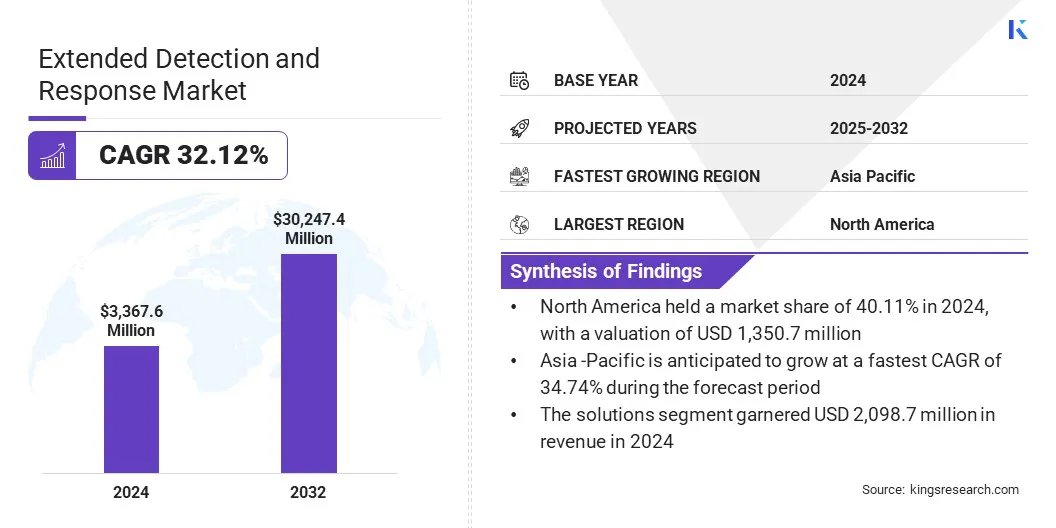
Increasing sophistication of cyber threats is compelling organizations to adopt advanced security solutions that offer real-time monitoring and automated response. Enterprises are facing more complex attacks, including ransomware and phishing, which can breach multiple layers of IT infrastructure, thereby driving market growth.
Growing Awareness of Insider Threats
A key factor propelling the growth of the extended detection and response market is the increasing awareness of insider threats and their financial impact on organizations.
Enterprises are adopting XDR solutions to provide comprehensive visibility across endpoints, networks, cloud workloads, and applications, enabling the identification of potential threats in real time. These platforms also support automated response, helping organizations contain incidents quickly and protect sensitive data while maintaining regulatory compliance.
Integration Complexity with Existing Security Tools
A key challenge impeding the growth of the extended detection and response market is the complexity of integrating XDR solutions with existing security tools and IT infrastructure. Organizations operate diverse environments with multiple legacy systems, point solutions, and cloud-based applications, making seamless integration difficult.
Ensuring compatibility and effective communication between these tools requires significant technical expertise and resources. This complexity can delay the deployment of XDR solutions and limit their ability to deliver efficient threat detection across the enterprise.
To address this challenge, market players are developing XDR solutions with enhanced compatibility and interoperability with existing security tools and IT infrastructure. Vendors are offering pre-configured connectors and standardized APIs to streamline deployment and data correlation across diverse systems. Additionally, they are investing in professional services, training, and support to assist organizations in implementing XDR platforms.
Integration of AI in XDR Solutions
A key trend influencing the extended detection and response market is the integration of AI into detection and response solutions. Vendors are incorporating AI-driven capabilities such as autonomous triage, threat hunting, and real-time response across XDR platforms.
These innovations are helping reduce alert fatigue, prioritize vulnerabilities, and accelerate the remediation of security incidents. This shift is driving the adoption of intelligent, unified cybersecurity platforms across enterprises to strengthen the security framework.
|
Segmentation |
Details |
|
By Component |
Solutions, Services |
|
By Deployment Mode |
Cloud-based, On-premises, Hybrid |
|
By Organization Size |
Small and Medium Enterprises (SMEs), Large Enterprises |
|
By End-Use Industry |
BFSI, Healthcare and Life Sciences, IT & Telecom, Government and Defense, Retail and E-commerce, Others |
|
By Region |
North America: U.S., Canada, Mexico |
|
Europe: France, UK, Spain, Germany, Italy, Russia, Rest of Europe |
|
|
Asia-Pacific: China, Japan, India, Australia, ASEAN, South Korea, Rest of Asia-Pacific |
|
|
Middle East & Africa: Turkey, U.A.E., Saudi Arabia, South Africa, Rest of Middle East & Africa |
|
|
South America: Brazil, Argentina, Rest of South America |
Based on region, the Market has been classified into North America, Europe, Asia Pacific, Middle East & Africa, and South America.
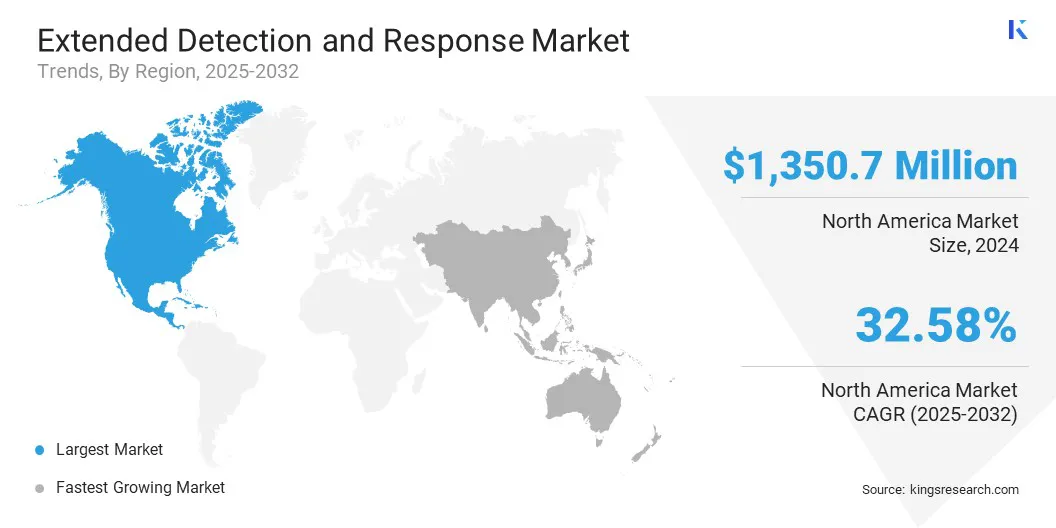
North America extended detection and response market share stood at 40.11% in 2024 in the global market, valued at USD 1,350.7 million. This dominance is attributed to the increasing sophistication and frequency of cyberattacks, which are prompting organizations to adopt advanced XDR solutions for threat detection.
The rising adoption of cloud services and hybrid IT environments in the region is creating demand for unified security platforms that provide centralized visibility and monitoring. Stringent regulatory compliance requirements, such as the Health Insurance Portability and Accountability Act (HIPAA) and the California Consumer Privacy Act (CCPA), are prompting enterprises to strengthen security frameworks to ensure data protection.
Additionally, regional players are expanding their XDR capabilities through technology integration, platform enhancements, and strategic acquisitions to improve operational efficiency, further driving market expansion in the region.
Asia Pacific is set to grow at a robust CAGR of 34.74% over the forecast period. This growth is driven by rapid digitalization in the banking, healthcare, and government sectors, prompting organizations to adopt XDR solutions for proactive threat detection and response. The region’s expanding small and medium-sized enterprise (SME) sector is accelerating demand for managed XDR and cost-effective cybersecurity solutions.
Rising investments in cloud infrastructure and hybrid IT environments by large enterprises and government across the region are creating a need for unified security platforms with centralized visibility. Additionally, increasing adoption of integrated XDR solutions with threat exposure management is strengthening cybersecurity, further driving market growth in the region.
Companies operating in the extended detection and response industry are actively strengthening their platform capabilities by integrating endpoint, network, and application security into unified solutions.
They are expanding product offerings to include services such as exposure monitoring, compliance, and device management, enabling organizations to streamline operations while enhancing security. Additionally, players are focusing on strategic acquisitions to expand their market presence, improve operational efficiency, and deliver comprehensive XDR solutions to enterprises.
Frequently Asked Questions

Swati is a committed research analyst with a passion for optimizing systems and processes across industries, specializing in healthcare but also bringing valuable expertise to sectors such as consumer goods, life sciences, and more. Her cross-domain research approach allows her to generate clear, actionable reports that inform strategic decisions in a variety of fields. Swati is committed to staying ahead of evolving trends, leveraging her broad understanding of different sectors to provide insights that are relevant to a range of industries. In her personal time, she enjoys music and spending quality time with her family, which inspires her creativity and enriches her professional approach. Her systematic methodology ensures that every report is both thorough and practical. Swati's ability to bridge regulatory frameworks with market realities gives her recommendations a distinct edge. She collaborates seamlessly with cross-functional teams, distilling complex data into straightforward narratives. Her proactive monitoring of policy and technological shifts keeps her analysis forward-looking.

Ganapathy Subramaniam Suresh
With over a decade of research leadership across global markets, Ganapathy brings sharp judgment, strategic clarity, and deep industry expertise. Known for precision and an unwavering commitment to quality, he guides teams and clients with insights that consistently drive impactful business outcomes.