
Inquire Now
Key Strategic Points
Enterprise mobility management (EMM) market refers to the technologies, services, and solutions that facilitate organizations in managing their mobile devices, applications, and data within their operations in a secure manner. It encompasses mobile device management (MDM), mobile application management (MAM), and mobile content management (MCM), which enables the safe use of corporate resources.
With increased adoption of remote working, cloud computing, and BYOD (Bring Your Own Device) policies, the EMM market addresses major issues such as data security, compliance, and productivity and assists in ensuring the smooth operations of the mobile workforce worldwide.
The global enterprise mobility management market size was valued at USD 21.40 billion in 2024 and is projected to grow from USD 25.55 billion in 2025 to USD 103.38 billion by 2032, exhibiting a CAGR of 22.10% during the forecast period. This growth is attributed to the increasing adoption of remote and hybrid work practices, greater deployment of mobile devices and enterprise applications, and a rising emphasis on protecting corporate data in mobile environments.
Major companies operating in the global enterprise mobility management industry are Microsoft, IBM, SOTI Inc., BlackBerry, Cloud Software Group, Inc., Cisco Systems, Inc., Zoho Corporation Pvt. Ltd., 42Gears Mobility Systems Pvt Ltd., Jamf, baramundi software GmbH., Ivanti, Scalefusion, Flexera, Mitsogo Inc., and Matrix42 Marketplace GmbH.
Additional factors influencing the market include developments in cloud computing, the incorporation of automation, and shifts in regulatory compliance standards. Flexible work arrangements and new security requirements are contributing to the rising demand for enterprise mobility management platforms.
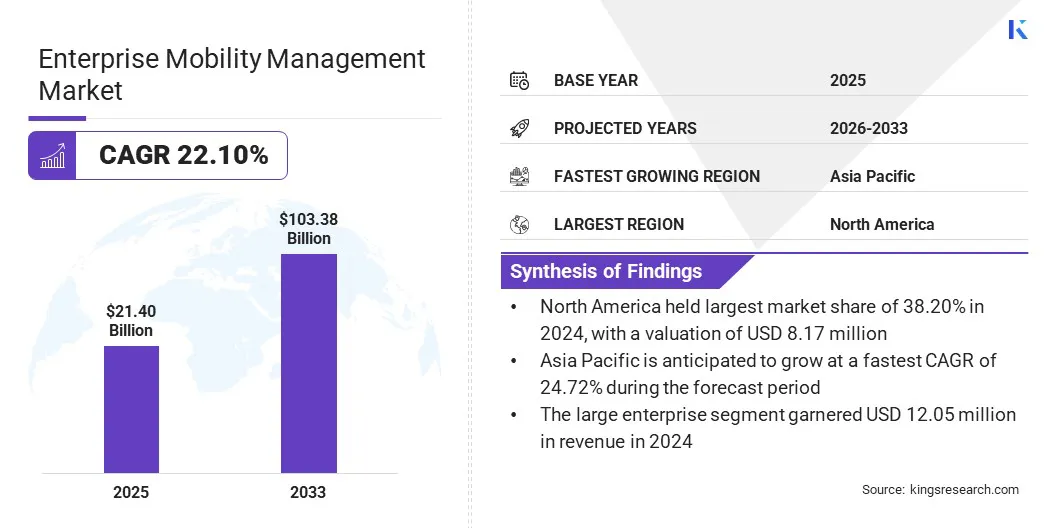
Enterprises are shifting from using conventional local deployment systems to cloud-based ones because of their flexible nature, scalable characteristics, and economic benefits. Cloud-based EMM enables organizations to manage, secure, and monitor a wide range of mobile devices and endpoints from a centralized interface, regardless of employees’ location.
This approach supports the needs of remote and hybrid workforces by allowing real-time updates, policy enforcement, and streamlined device provisioning. Increased integration capabilities with SaaS applications and improved disaster recovery options further contribute to the appeal of cloud-based EMM.
Managing multi-OS and BYOD (Bring Your Own Device) environments presents a significant operational challenge for organizations. The presence of various operating systems, device vendors, and hardware owned by users creates a fragmented environment in which it becomes challenging to implement similar security measures and policies.
Such diversity increases the risk of data leakage, unauthorized access, and compatibility problems, which may impede adherence to industry regulations and internal standards. IT departments face additional burdens related to problem-solving, software delivery, and monitoring across platforms.
To address this challenge, organizations are implementing unified endpoint management solutions that centralize control and support multiple operating systems. Implementing containerization and strong access controls helps standardize security, reduce risks, and enable the secure and flexible use of devices.
Unified endpoint management (UEM) is gaining traction as enterprises seek to streamline oversight of all endpoints on a single platform. UEM builds on the functionality of the conventional enterprise mobility management (EMM) by offering centralized control, security, and compliance for smartphones, tablets, laptops, desktops, wearables, and Internet of Things (IoT) devices.
This development addresses the complexity arising from the proliferation of endpoints within modern organizations and the growing use of remote and hybrid working environments.
An example of such a trend is IBM MaaS360, which provides integrated features of UEM that help enforce policies, configure devices, and provide threat protection along with AI-driven analytics on a single interface. Through these features, organizations can streamline IT operations, enhance their security posture, and ensure regulatory compliance across a wide variety of device environments.
The transition to UEM signals the strategic requirement for companies to adopt digital transformation, support mobile workforces, and mitigate the threats posed by the extensive adoption of cloud and SaaS.
|
Segmentation |
Details |
|
By Component |
Mobile Device Management (MDM), Mobile Identity Management (MIM), Mobile Application Management (MAM), Mobile Content Management (MCM), and Others |
|
By Deployment |
On-premise, and Cloud-based |
|
By Organization Size |
Large Enterprise, and Small and Medium Enterprises (SME) |
|
By End User Vertical |
Banking, Financial Services, and Insurance (BFSI), Retail, Healthcare, IT & Telecommunications, Transportation & Logistics, and Others |
|
By Region |
North America: U.S., Canada, Mexico |
|
Europe: France, UK, Spain, Germany, Italy, Russia, Rest of Europe |
|
|
Asia-Pacific: China, Japan, India, Australia, ASEAN, South Korea, Rest of Asia-Pacific |
|
|
Middle East & Africa: Turkey, U.A.E., Saudi Arabia, South Africa, Rest of Middle East & Africa |
|
|
South America: Brazil, Argentina, Rest of South America |
Based on region, the global market has been classified into North America, Europe, Asia Pacific, Middle East & Africa, and South America.
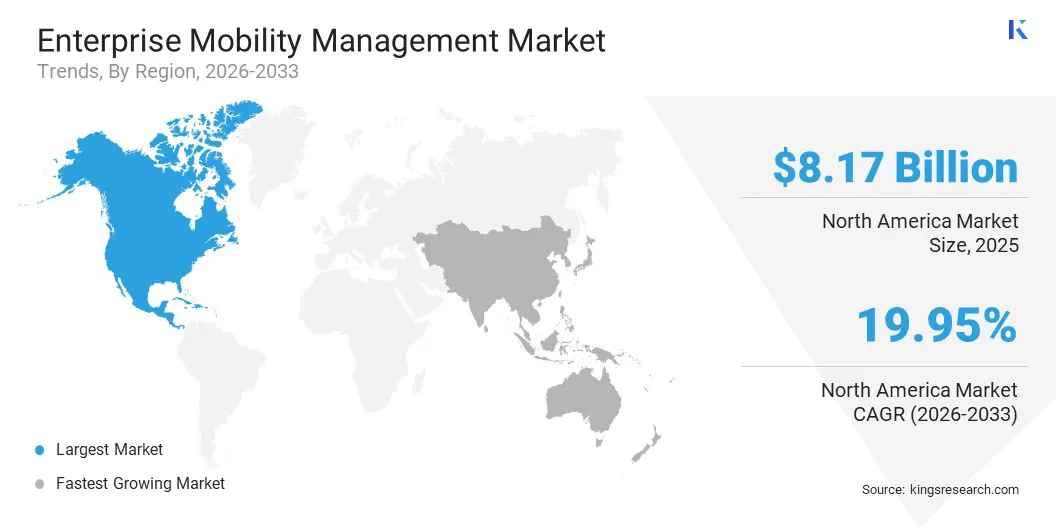
North America enterprise mobility management market share stood at 38.20% in 2024, valued at USD 8.17 billion. This dominance is due to the presence of key technology providers and the high adoption of advanced mobile solutions by enterprises in the region. Additionally, the presence of stringent data privacy and cybersecurity solutions supported regional market expansion by investing in a mobility management platform.
The wider application of BYOD (Bring Your Own Device) solutions and a highly mobile workforce are also creating a strong demand for highly advanced enterprise mobility solutions.
The Asia-Pacific enterprise mobility management market is set to grow at a CAGR of 24.72% over the forecast period. This rapid growth is attributed to the increase in digital transformation initiatives in emerging markets, the expansion of mobile internet access, and the adoption of smartphones and tablets to conduct business.
Moreover, government initiatives to develop smart cities and the development of new-age IT infrastructure are compelling businesses to adopt enterprise mobility management solutions.
Furthermore, the region is witnessing the adoption of cloud-based enterprise mobility management solutions among small and medium-sized businesses to improve business efficiency and employee productivity. As businesses in the Asia Pacific region continue to transform their business processes, the adoption of enterprise mobility management solutions is expected to gain momentum.
The enterprise mobility management market is highly competitive and comprises a large number of global as well as regional vendors, offering customers a variety of solutions. Providers compete by delivering advanced unified endpoint management capabilities, strong data security, and support for diverse operating systems and device types. The market is also characterized by the constant evolution of technology such as the integration with cloud platforms, analytics platforms powered by AI, and IoT device management.
Vendors differ in terms of their scalability, deployment processes, compliance, and solutions to particular industries. Companies also engage in partnerships and acquisitions to strengthen their product lines and expand into new markets. The pace of innovation and the need to solve the ever-changing enterprise mobility challenges remain paramount to staying competitive.
Frequently Asked Questions

Aswathi holds cross-domain expertise, translating market trends and competitive intelligence into decision-ready insights. Her work helps clients interpret evolving market conditions and identify growth opportunities. She brings a focused, insight-led approach to research execution. She translates these findings into clear, prioritized action plans that align with client capabilities. Her research often includes scenario modeling to test growth strategies under varying economic conditions. She maintains a rigorous validation process, cross-checking primary and secondary sources to ensure reliability. Clients value her ability to synthesize noisy data into concise executive summaries that drive board-level discussions. Her sector-specific lens, combined with a pragmatic focus on execution, consistently delivers high-impact, commercially sound recommendations. Her structured yet flexible research frameworks adapt to client timelines without compromising depth. She is known for distilling complex trade-offs into straightforward, defensible positions that facilitate confident decision-making.
Habi is a seasoned research and consulting leader with renowned experience in guiding clients on strategic growth and transformation initiatives across global markets. He has led high-performing research teams that deliver actionable insights on market expansion, M&A strategies, opportunity assessment, new business development, and product launches. His project portfolio spans large petrochemical producers, electronic device manufacturers, lubricants companies, and other leading enterprises across diverse industrial and consumer sectors. He currently heads the research department at Kings Research, where he is responsible for setting the research agenda, mentoring analysts, and ensuring client-ready deliverables that support executive decision-making. With extensive experience in market intelligence, strategic research, and consulting, Habi brings a strong understanding of evolving industry dynamics, competitive landscapes, emerging opportunities, and business growth challenges. His expertise includes developing research frameworks, translating complex market data into actionable strategic recommendations, and working closely with senior stakeholders to address critical business questions. He has also contributed to building research capabilities, strengthening analytical methodologies, and driving a culture of quality and insight-led decision-making within research teams. His cross-industry exposure enables him to connect market trends with broader business implications and provide perspectives that help organizations identify opportunities, mitigate risks, and make informed strategic decisions.