
Inquire Now
Key Strategic Points
Decorative coatings are surface finishing solutions applied across residential, commercial, and industrial settings to enhance aesthetics while delivering supplementary protective benefits. These coatings encompass paints, varnishes, stains, and specialty finishes offering matte, gloss, metallic, and textured effects.
Beyond visual appeal, decorative coatings improve surface performance through limited resistance to moisture, abrasion, and environmental exposure. They are widely employed in modern architectural and interior applications, offering versatile design and functionality across diverse materials and construction settings.
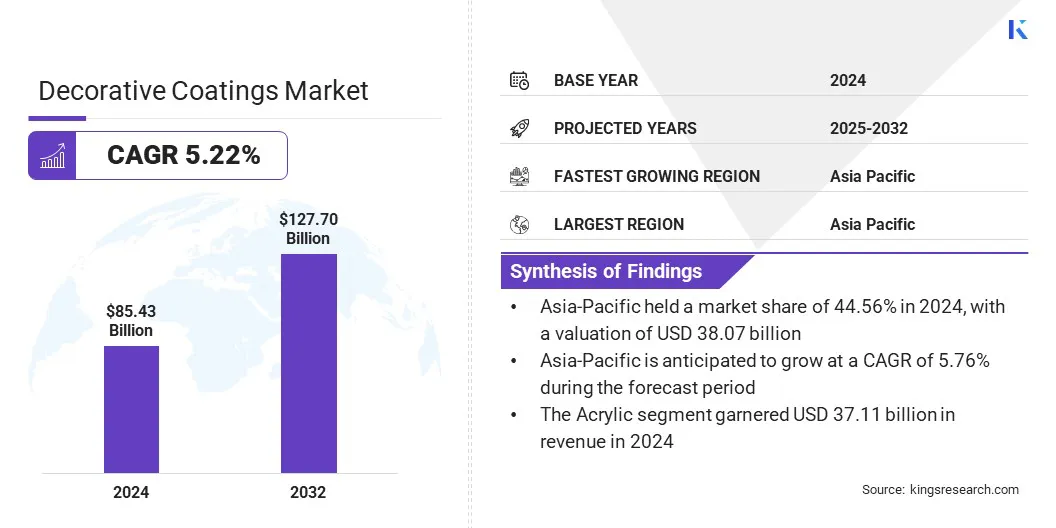
The global decorative coatings market size was valued at USD 85.43 billion in 2024 and is projected to grow from USD 89.48 billion in 2025 to USD 127.7 billion by 2032, exhibiting a CAGR of 5.22% during the forecast period.
This growth is driven by surging construction activity, rising renovation demand, and increased focus on aesthetic enhancements. Product innovations in low-VOC and environmentally sustainable formulations are further boosting demand. Advancements in coating technologies are improving durability, application efficiency, and design versatility, reinforcing their importance across residential, commercial, and industrial segments.
Major companies operating in the decorative coatings market are The Sherwin-Williams Company, PPG Industries, Inc., Akzo Nobzl N.V., NIPPONPAINT, RPM International, Axalta Coating Systems, LLC, BASF SE, Asian Paints, Kansai Paint Co.,Ltd., Masco Corporation, Hempel A/S, Beckers Group, Berger Paints India, Benjamin Moore & Co., and DAW SE.
The growing consumer preference for visually appealing and high-performance surfaces is creating a strong demand for decorative coatings. Homeowners and commercial developers are seeking coatings that combine design appeal with functionality, such as durability, stain resistance, and easy maintenance.
In response, manufacturers are investing in advanced formulations, innovative textures, and specialty finishes to meet evolving consumer expectations. Companies are also developing customizable color palettes, integrating smart coatings technologies, and enhancing product performance to deliver both aesthetic value and long-term protection, thereby supporting market expansion.
Rising urbanization is fueling the expansion of the decorative coatings market, as expanding cities increase residential and commercial construction. Builders and developers are relying on these coatings to enhance aesthetic appeal, protect surfaces, and improve durability across new and renovated structures.
Growing urban populations are creating consistent demand for high-quality finishes that combine functionality with visual appeal. Decorative coatings enable better surface protection and long-term performance, supporting modern construction requirements and maintaining design standards, thereby supporting market expansion.
A significant challenge impeding the progress of the decorative coatings market is the volatility of raw material prices, including resins, pigments, solvents, and additives. Fluctuations in crude oil prices and global supply chain disruptions directly affect production costs and profit margins for manufacturers.
This instability creates uncertainty in pricing strategies and can limit investment in innovation or expansion. To mitigate these risks, companies are increasingly exploring alternative bio-based materials, localized sourcing, and strategic supplier partnerships.
A notable trend influencing the decorative coatings market is the growing adoption of eco-friendly and low-VOC (volatile organic compound) formulations. Manufacturers are focusing on water-based and sustainable coatings that minimize environmental impact while meeting regulatory standards. These products provide improved indoor air quality and reduced emissions, addressing consumer and governmental demand for greener building solutions.
Additionally, innovations in bio-based resins, recyclable materials, and energy-efficient production processes are enabling companies to offer coatings that combine environmental responsibility with high performance and aesthetic versatility, propelling market growth.
|
Segmentation |
Details |
|
By Resin Type |
Acrylic, Alkyd, Polyurethane, Vinyl |
|
By Product Type |
Emulsions, Wood Coatings, Enamels, Powder Coatings |
|
By Application |
Residential, Commercial, Industrial |
|
By Region |
North America: U.S., Canada, Mexico |
|
Europe: France, UK, Spain, Germany, Italy, Russia, Rest of Europe |
|
|
Asia-Pacific: China, Japan, India, Australia, ASEAN, South Korea, Rest of Asia-Pacific |
|
|
Middle East & Africa: Turkey, U.A.E., Saudi Arabia, South Africa, Rest of Middle East & Africa |
|
|
South America: Brazil, Argentina, Rest of South America |
Based on region, the global decorative coatings market has been classified into North America, Europe, Asia Pacific, Middle East & Africa, and South America.
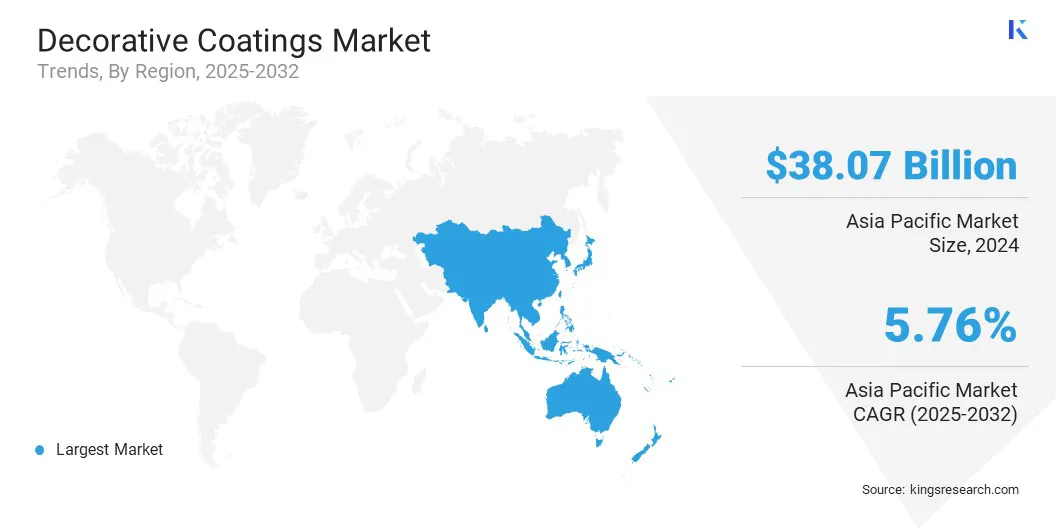
Asia Pacific decorative coatings market share stood at 44.56% in 2024, valued at USD 38.07 billion. This dominance is reinforced by expanding construction activities, rising disposable incomes, and increasing consumer focus on home aesthetics. Rapid urbanization and economic development in countries such as China, India, and Southeast Asian nations are fueling demand for residential and commercial construction, highlighting the need for interior and exterior coatings.
Regional players are focusing on eco-friendly and low-VOC formulations to meet growing environmental regulations and consumer preferences, contributing to regional market expansion.
The North America decorative coatings industry is set to grow at a CAGR of 5.05% over the forecast period, propelled by increasing residential and commercial construction, renovation activities, and growing consumer preference for durable, aesthetically appealing finishes. This is leading to the widespread adoption of high-performance coatings with advanced functionalities, such as low-VOC formulations and stain-resistant properties.
Manufacturers are investing in R&D and expanding production capacities to develop eco-friendly and technologically advanced products that comply with stringent environmental regulations. Additionally, urbanization, higher disposable incomes, and growing awareness of sustainable building practices are supporting regional market expansion.
Major players operating in the decorative coatings industry are focusing on product innovation, sustainability, and geographic expansion to meet growing demand. Companies are developing eco-friendly, low-VOC, and high-performance coatings that combine aesthetic appeal with functional benefits such as durability, stain resistance, and easy application. Investment in R&D and advanced production technologies enables customization of colors, textures, and specialty finishes to meet evolving consumer preferences.
Frequently Asked Questions

Swati is a committed research analyst with a passion for optimizing systems and processes across industries, specializing in healthcare but also bringing valuable expertise to sectors such as consumer goods, life sciences, and more. Her cross-domain research approach allows her to generate clear, actionable reports that inform strategic decisions in a variety of fields. Swati is committed to staying ahead of evolving trends, leveraging her broad understanding of different sectors to provide insights that are relevant to a range of industries. In her personal time, she enjoys music and spending quality time with her family, which inspires her creativity and enriches her professional approach. Her systematic methodology ensures that every report is both thorough and practical. Swati's ability to bridge regulatory frameworks with market realities gives her recommendations a distinct edge. She collaborates seamlessly with cross-functional teams, distilling complex data into straightforward narratives. Her proactive monitoring of policy and technological shifts keeps her analysis forward-looking.

With over a decade of research leadership across global markets, Ganapathy brings sharp judgment, strategic clarity, and deep industry expertise. Known for precision and an unwavering commitment to quality, he guides teams and clients with insights that consistently drive impactful business outcomes.