
Inquire Now
Key Strategic Points
The market refers to the application of specialized technologies such as blockchain analytics, artificial intelligence, automated identity verification, and real-time transaction monitoring to oversee and secure the digital asset ecosystem. This includes the integration of AML software, KYC protocols, and forensic auditing to ensure that activities across exchanges, DeFi platforms, and traditional financial institutions align with global legal mandates.
The market covers the end-to-end processes needed to detect financial crime, verify the identities of participants, and validate smart contract integrity by using cloud-based or on-premises infrastructure to promote transparency and trust within the decentralized economy.
The global crypto compliance solutions market size was valued at USD 3.14 billion in 2024 and is projected to grow from USD 3.54 billion in 2025 to USD 9.09 billion by 2032, exhibiting a CAGR of 14.44% during the forecast period.
This growth is primarily driven by the urgent need for financial institutions and virtual asset service providers (VASPs) to meet the rigorous oversight requirements established by global financial regulators. This regulatory push has led to a technological transformation, highlighting a notable shift toward real-time, collaborative compliance and security solutions that move beyond static checks to active monitoring.
Major companies operating in the crypto compliance solutions industry are Chainalysis, Alessa Inc., StarCompliance, ChainUp, PixelPlex, azakaw, AML Incubator, Elliptic Enterprises Limited, CipherTrace (A Mastercard Company), Merkle Science, Solidus Labs, Crystal Blockchain B.V., Scorechain, TRM Labs, Inc., and Sumsub.
Numerous companies are focusing on integrating traditional cash systems with regulated crypto access to facilitate secure transfers between fiat and digital assets. This initiative includes combining automated identity verification and anti-money laundering procedures into payment gateways to ensure that all transactions comply with legal standards globally. These regulated entry and exit points reduce the risks of currency conversion, boosting institutional confidence and supporting the growth of the digital economy.
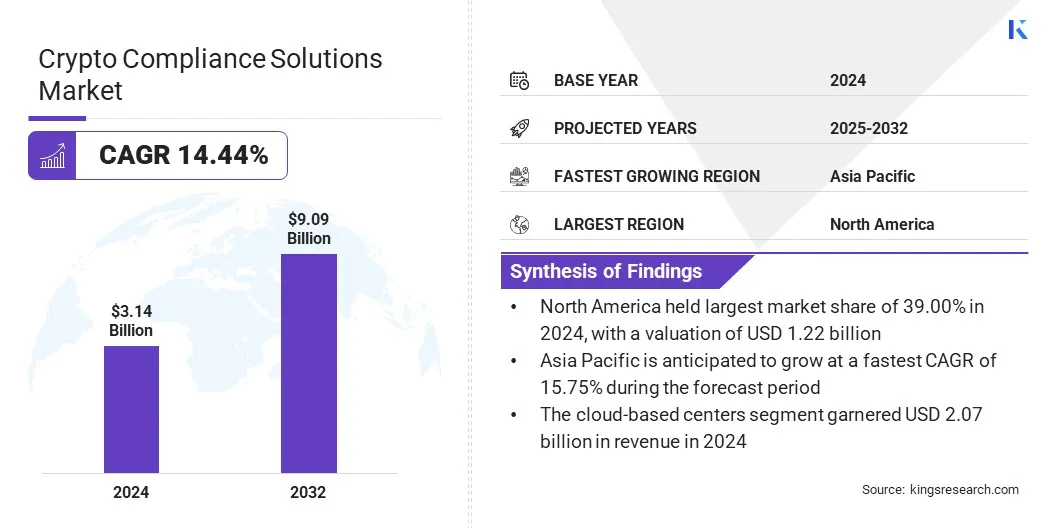
The crypto compliance solutions market is expanding steadily to meet the rigorous oversight requirements established by global financial regulators. This intensifying enforcement environment necessitates that service providers implement robust systems to maintain legal standing and avoid significant penalties. In addition to basic identity verification, compliance solutions are now essential for anti-money laundering (AML) monitoring, sanctions screening, and automated suspicious activity reporting.
Technologies such as blockchain forensics and transaction tracking increase transparency within the digital asset ecosystem. These technologies offer the initial backbone infrastructure to the safe transaction space to ensure that the digital asset companies remain compliant within global financial regulatory frameworks.
The main concern in the crypto compliance solutions market is the unskilled workforce issue. The regulatory environment is technically complex and evolves quickly; hence, chances are high that the wrong data will be analyzed and that there will be non-adherence to regulations.
The niche of blockchain technology demands the knowledge of financial legislation and digital forensics, and is still lacking in the international economy. Compliance teams also face challenges in managing various international regulations that may bring legal risks and consequently increase operational costs.
To address this challenge, firms are offering best-niche job board and guide to empower recruiters as well as professionals. These platforms match organizations with certified block chain researchers and AML specialists and recommend clear career standards for high-demand positions.
Through prioritizing vital certification and emerging skill demands, such resources empower firms to recruit the finest talent, minimize friction in new hires, and guarantee that the compliance teams have the technical capability to navigate frameworks through shifting global requirements.
Real-time, collaborative compliance and security solutions for transaction oversight are designed to share threat intelligence and risk data across a network of financial institutions and regulatory bodies. They are in contrast to the traditional siloed databases, which are not able to exchange information instantaneously across the platform.
The adoption of crypto compliance solutions is increasingly shifting toward collaborative solutions in the market because transactions involving digital assets are becoming more complex and cross-border, which is becoming commonly a accepted standard for ensuring market integrity.
|
Segmentation |
Details |
|
By Solution Type |
AML software, KYC / Identity verification, Transaction monitoring, Blockchain forensics & analytics, Risk & regulatory reporting, Smart contract auditing, Others |
|
By Deployment |
Cloud-based, On-premises |
|
By Enterprise Size |
Large enterprises, Small & medium enterprises |
|
By End Use |
Crypto-Native Businesses( Exchanges & DeFi Platform), Financial institutions & banks, Government agencies, Enterprises (non-finance), Others |
|
By Region |
North America: U.S., Canada, Mexico |
|
Europe: France, UK, Spain, Germany, Italy, Russia, Rest of Europe |
|
|
Asia-Pacific: China, Japan, India, Australia, ASEAN, South Korea, Rest of Asia-Pacific |
|
|
Middle East & Africa: Turkey, U.A.E., Saudi Arabia, South Africa, Rest of Middle East & Africa |
|
|
South America: Brazil, Argentina, Rest of South America |
Based on region, the crypto compliance solutions market has been classified into North America, Europe, Asia Pacific, Middle East & Africa, and South America.
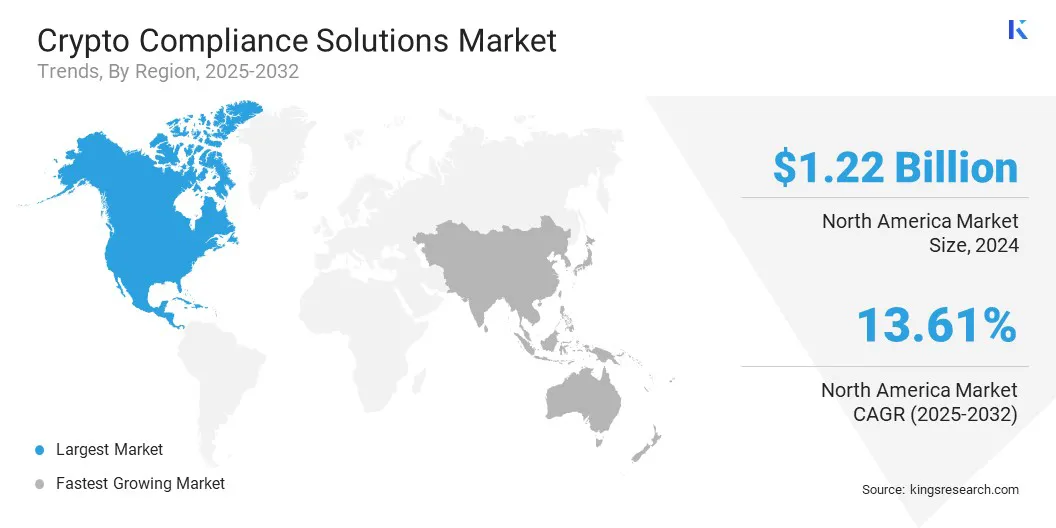
North America crypto compliance solutions market share of 39.00% in 2024, valued at USD 1.22 billion. This is because regional leaders pay strategic attention to comprehensive compliance with digital assets and operational solutions to comply with strict federal and state regulatory standards.
This leadership is supported by a high level of concentration of institutional investors and other large crypto exchanges, who must deal with the complexities of the U.S. financial system through complex and integrated constructs.
The Asia-Pacific crypto compliance solutions industry is expected to register the fastest CAGR of 15.75% over the forecast period. This rapid expansion is supported by the fast digitalization of the financial services sector and the increasing adoption of cryptocurrency as a means of carrying out cross-border payments in the emerging economies.
Expanding regulatory changes in hubs such as Singapore, Hong Kong, and Japan are also highlighting the need to have tools set that ease regulations and support mobile-first ecosystems. Moreover, decentralized finance gains and a large base of tech-savvy retailers mean that robust transaction monitoring systems must be in place to mitigate financial crime, thereby driving regional market expansion.
Leading players in the crypto compliance solutions industry are developing high-performance data platforms to ensure that the new digital asset financial system offers enterprise reliability, robustness, and scalability. Several developers are developing robust system architectures that can sustain high levels of transactions with 24/7 operational availability of mission- critical regulatory reporting.
Moreover, the compliance solution providers have developed fault-resistant data pipes and secure data protocols that would hasten the migration to a stable, institutional-grade infrastructure. Such customized technologies and robust frameworks have assisted in transforming the financial system into a more reliable system, enabling the transition to the high frequency compliance controls, and accelerating the implementation of international institutional standards.
Frequently Asked Questions

Tejasv specializes in secondary research and data validation, transforming complex information into clear market insights. He supports multi-industry research initiatives by delivering reliable intelligence that informs planning and strategic direction. With a disciplined and detail-focused approach, he emphasizes analytical clarity and practical application. His interest in geopolitics and history informs his broader market perspective. This unique lens allows him to contextualize industry shifts within larger socio-political frameworks, adding depth to his analyses. He maintains rigorous documentation standards, making his findings auditable and easily reproducible. His ability to distill vast amounts of secondary data into concise, decision-ready summaries has earned him the trust of project leads across multiple verticals. Tejasv actively tracks regulatory changes and economic indicators, which he incorporates into his research to enhance its forward-looking relevance. His methodical work ethic, combined with a calm demeanor under tight deadlines, ensures that his contributions remain both timely and impactful.

With over a decade of research leadership across global markets, Ganapathy brings sharp judgment, strategic clarity, and deep industry expertise. Known for precision and an unwavering commitment to quality, he guides teams and clients with insights that consistently drive impactful business outcomes.