
Inquire Now
Key Strategic Points
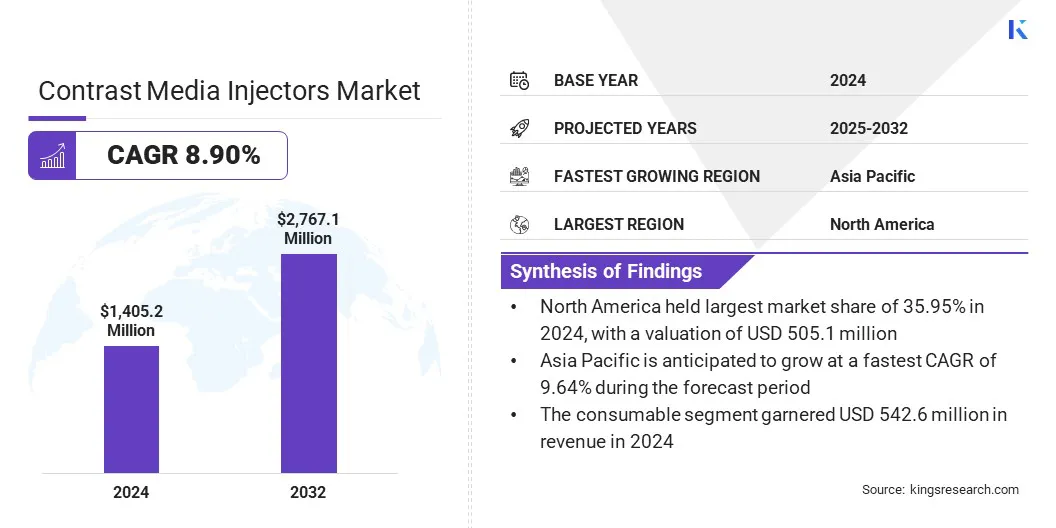
The global contrast media injectors market size was valued at USD 1,405.2 million in 2024 and is projected to grow from USD 1,523.5 million in 2025 to USD 2,767.1 million by 2032, exhibiting a CAGR of 8.90% during the forecast period.
This growth is driven by the rising use of CT and MRI imaging in emergency and critical care, along with the growing demand for rapid diagnosis and precise contrast agent delivery through advanced injection systems.
Major companies operating in the contrast media injectors market are Bayer, Bracco Spa, Guerbet LLC, Nemoto Kyorindo Co., Ltd., ulrich GmbH & Co. KG, MEDTRON AG, Siemens, LnkMed, Shenzhen Antmed Co.,Ltd., B. Braun SE, Shenzhen Boon Medical Supply Co., Ltd., General Electric Company, APOLLO RT Co. Ltd., Vygon, and Shenzhen KND Jumao Medical Equipment Co., Ltd.
Technological advancements in radiology-based systems are enhancing precision, automation, and operational consistency in diagnostic workflows. Market growth is supported by advanced injector software enabling real-time monitoring and protocol customization for accurate contrast delivery. Continuous improvements in CT and MRI systems enhance the clinical value of contrast-enhanced imaging.
Radiology departments are increasingly adopting integrated injector-system interfaces to maintain standardized procedures and reduce variability across examinations. These advancements are boosting the adoption of next-generation contrast media injectors.
Geographical expansion of imaging infrastructure strengthens market penetration through rising installations of CT, MRI, and angiography systems in emerging healthcare sector. This growth is further supported by enhanced diagnostic capacity, increased healthcare investment, and broader access to imaging services.
Hospitals and diagnostic centers in Tier II and Tier III regions are upgrading radiology departments to address rising patient volumes. The ongoing expansion of imaging infrastructure across underserved areas fuels demand for contrast media injectors.
Frequent calibration and maintenance requirements are creating operational disruptions for imaging departments, presenting a major challenge to market expansion. High-performance injectors require routine calibration to maintain flow accuracy, pressure control, and device reliability.
These requirements increase workload for technical staff, elevate service costs, and affect procedure scheduling during peak hours. Healthcare facilities operating multiple imaging modalities experience higher downtime risk, which influences injector preference and long-term utilization.
To address this challenge, manufacturers are improving injector durability, enhancing self-diagnostic capabilities, and integrating predictive maintenance analytics to reduce service frequency and support efficient imaging workflows.
Growing adoption of AI-powered portable MRI systems that support faster, point-of-care imaging in acute and resource-limited environments is emerging as a notable trend in the contrast media injectors market. These systems improve diagnostic accessibility and streamline clinical evaluation timelines through automated reconstruction algorithms and advanced processing tools.
Healthcare providers increasingly rely on compact MRI platforms for rapid assessments. The rising integration of AI-enabled portable MRI solutions aligns closely with the evolving demand for compatible contrast media injectors.
|
Segmentation |
Details |
|
By Component |
System, Consumable, Accessories |
|
By Type |
Single-head, Dual-head, Syringeless |
|
By Application |
Radiology, Interventional Cardiology, Interventional Radiology |
|
By End Use |
Hospitals, Diagnostic Centers, Ambulatory Surgery Centers |
|
By Region |
North America: U.S., Canada, Mexico |
|
Europe: France, UK, Spain, Germany, Italy, Russia, Rest of Europe |
|
|
Asia-Pacific: China, Japan, India, Australia, ASEAN, South Korea, Rest of Asia-Pacific |
|
|
Middle East & Africa: Turkey, U.A.E., Saudi Arabia, South Africa, Rest of Middle East & Africa |
|
|
South America: Brazil, Argentina, Rest of South America |
Based on region, the global contrast media injectors market has been classified into North America, Europe, Asia Pacific, Middle East & Africa, and South America.
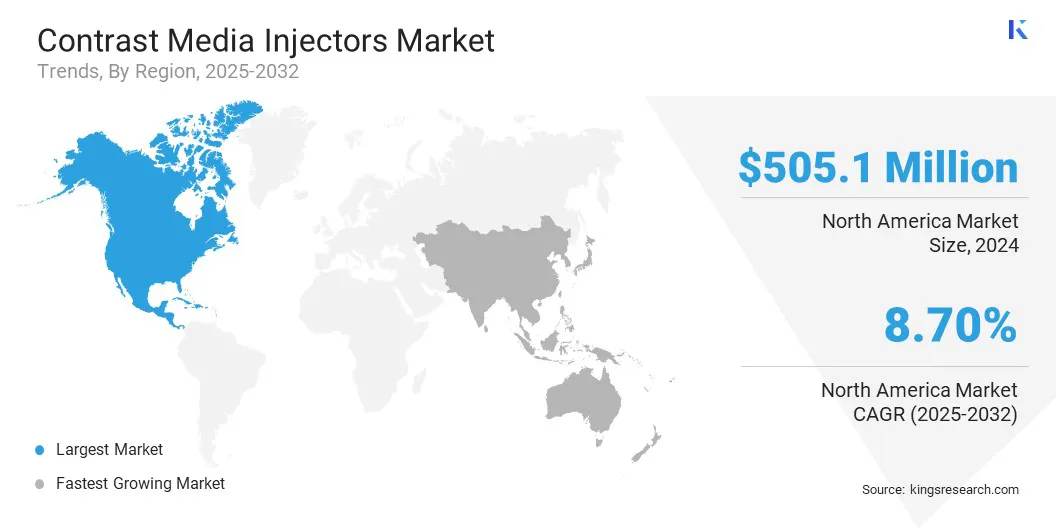
The North America contrast media injectors market accounted for a share of 35.95% in 2024, valued at USD 505.1 million. This dominance is reinforced by ongoing investments in diagnostic imaging infrastructure and continuous upgrades across radiology, interventional radiology, and interventional cardiology units.
Healthcare facilities emphasize operational precision and workflow standardization, which increases the adoption of advanced injector systems and associated consumables. Growth in CT and angiography procedure volumes creates a strong demand for contrast-enhanced imaging technologies, propelling regional market growth.
The Asia-Pacific contrast media injectors industry is set to grow at a CAGR of 9.64% over the forecast period. This growth is largely attributed to rising imaging capacity and increasing adoption of modern radiology systems across healthcare institutions. Rising procedure volumes and greater availability of advanced diagnostic technologies highlight the need for efficient contrast delivery solutions.
Healthcare providers in metropolitan and developing urban centers continue to upgrade angiography, MRI, and CT systems, which generate demand for multi-head and automated injector systems. The region’s large patient population and growing focus on early disease detection further support sustained regional market expansion through the forecast period.
Key players operating in the contrast media injectors industry are focusing on structured product development supported by investments in software-enabled injectors, connected interfaces, and integrated workflow platforms. They are expanding consumable portfolios to strengthen recurring revenue streams and maintain consistent device utilization across imaging departments.
Strategic partnerships with imaging system manufacturers are enabling enhanced interoperability and streamlined installation cycles. Market participants are reinforcing distribution coverage across high-growth regions through channel expansion and localized service capabilities.
Continuous refinement of automation features, safety controls, and device ergonomics is essential for sustaining competitive positioning and product differentiation in the market.
Frequently Asked Questions

Antriksh is an experienced analyst specializing in cross-domain research across diverse industries. With a strong foundation in data analysis and statistical interpretation, he delivers insightful market reports that guide strategic decision-making. Antriksh excels in conducting primary research, with a focus on identifying trends and understanding consumer behavior. Thriving in dynamic and high-pressure environments, he combines analytical expertise with a commitment to delivering impactful outcomes. Beyond his professional pursuits, Antriksh's passion for travel fuels his curiosity and broadens his perspectives, enriching his ability to uncover unique insights that enhance his research capabilities. He is equally adept at synthesizing quantitative findings with qualitative context, which allows him to present holistic viewpoints to clients. His disciplined work ethic and intellectual agility make him a trusted partner in navigating market uncertainties. He consistently seeks out new methodologies to refine his analytical toolkit, and his ability to communicate complex insights clearly ensures stakeholders act confidently on his recommendations.

Ganapathy Subramaniam Suresh
With over a decade of research leadership across global markets, Ganapathy brings sharp judgment, strategic clarity, and deep industry expertise. Known for precision and an unwavering commitment to quality, he guides teams and clients with insights that consistently drive impactful business outcomes.



.webp&w=128&q=75&dpl=dpl_DPva2LrvfsBdTJm1XZj67UTrvMHL)