
Inquire Now
Key Strategic Points
The contact center analytics market is an ecosystem of solutions, services, and technologies that are aimed at gathering, analyzing, and processing customer interactions. These interactions are between agents of contact centers and customers across various communication platforms, such as telephone calls, e-mails, chat, and social media. These analytics systems leverage advanced data processing, artificial intelligence (AI), machine learning (ML), and natural language processing (NLP) to convert structured and unstructured data into actionable insights. The main goal is to identify patterns, discern customer intent and sentiment at a granular level, and transform large amounts of interaction data into strategic choices that lead to enhanced service quality, improved operational efficiency, and greater customer satisfaction.
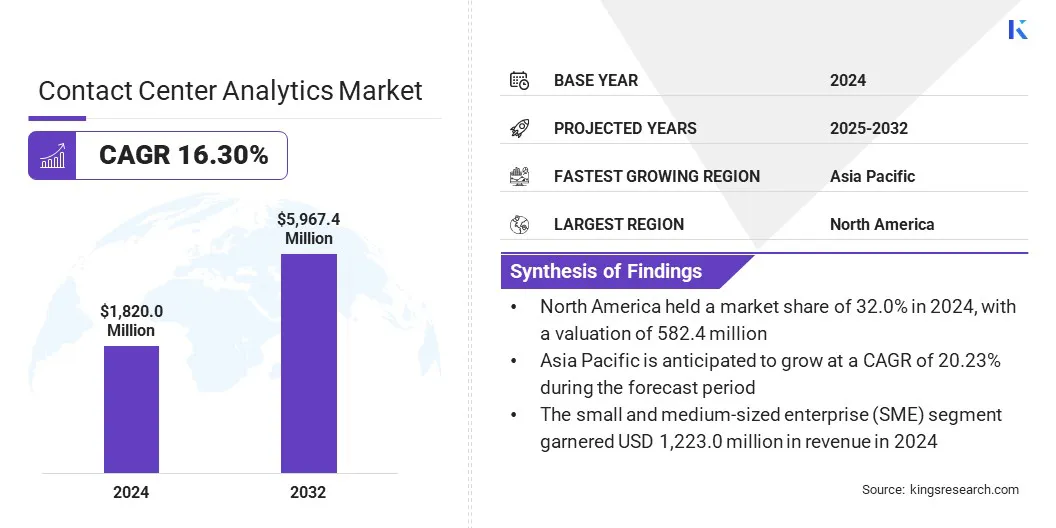
The global market size was valued at USD 1,820.0 million in 2024 and is projected to grow from USD 2,073.5 million in 2025 to USD 5,967.4 million by 2032, exhibiting a CAGR of 16.30% during the forecast period. This rapid expansion is attributed to the rising enterprise need for superior analytics solutions to improve customer experience, streamline business operations, and enhance decision-making processes.
Major companies operating in the global contact center analytics industry are NiCE, Genesys, Cisco Systems, Inc., Five9, Inc., Amazon Web Services, Inc., 8x8, Inc., Talkdesk, Microsoft, Verint Systems Inc., Mitel Networks Corp., Genpact, Zendesk, CallMiner, Avaya LLC, and Salesforce, Inc.
The adoption of artificial intelligence, machine learning, and cloud-based analytics platforms is creating a strong demand for contact center analytics. The market is anticipated to experience long-term growth in organizations around the world as companies continue to focus on data-driven approaches and invest in digital transformation programs.
The rapid enterprise adoption of AI is a key driver in the contact center analytics market. Companies are incorporating AI-based solutions to improve their customer relationships, automate their processes, and extract actionable information from large volumes of unstructured data. AI-powered analytics allow real-time tracking, sentiment analysis, and predictive modelling, which assist the contact centers to detect trends, find solutions to problems, and offer personalized customer experiences.
This adoption also facilitates automation of routine tasks, reducing operational costs and improving agent productivity. With the rising business interest in data-driven decision-making, the demand for sophisticated analytics solutions is growing, highlighting the importance of AI incorporation to enhance customer interaction and improve operational efficiency within contact centers.
AI-driven voice fraud and identity risks present a significant challenge in the contact center analytics industry. The development of AI has allowed malicious users to compromise voice biometrics and impersonate customers convincingly, posing a threat to authentication integrity. This issue is heightened by initiatives like the FTC Voice Cloning Challenge that point out the increasing dangers of synthetic voice technologies and the necessity to have creative solutions to exclude and combat abuse.
Companies are addressing these challenges by implementing multi-factor authentication, investing in fraud detection tools, and regularly updating their security measures. Moreover, it is possible to introduce real-time anomaly detection systems to detect suspicious activity and prevent unauthorized access before serious damage is done.
The growth of cloud-based contact center platforms, or Contact Center as a Service (CCaaS), is reshaping the market. Companies are rapidly moving away from on-premise systems and switching to cloud-based systems to achieve scalability, flexibility, and cost-efficiency. CCaaS solutions can be easily integrated with sophisticated analytics solutions, which allow real-time monitoring and data-driven insights across different communication channels.
This transition supports the rapid deployment of new features and facilitates remote workforce management. Consequently, cloud-based platforms are accelerating the wider adoption of analytics functionalities, expanding operational efficiency, and enhancing the quality of customer engagement in the contact center environment.
|
Segmentation |
Details |
|
By Type |
Speech Analytics, Interaction Analytics, Predictive Analytics, Text Analytics, Cross-Channel Analytics, and Others |
|
By Organization Size |
Small and Medium-sized Enterprise (SME), and Large Enterprise |
|
By Deployment |
On-Premise, and Cloud-Based |
|
By Application |
Real-Time Monitoring, Risk & Compliance Management, Workforce Optimization, Customer Experience Management, and Others |
|
By End-User Vertical |
Banking, Financial Services, and Insurance (BFSI), Healthcare, IT & Telecommunications, Commercial, Travel & Hospitality, and Others |
|
By Region |
North America: U.S., Canada, Mexico |
|
Europe: France, UK, Spain, Germany, Italy, Russia, Rest of Europe |
|
|
Asia-Pacific: China, Japan, India, Australia, ASEAN, South Korea, Rest of Asia-Pacific |
|
|
Middle East & Africa: Turkey, U.A.E., Saudi Arabia, South Africa, Rest of Middle East & Africa |
|
|
South America: Brazil, Argentina, Rest of South America |
Based on region, the global market has been classified into North America, Europe, Asia Pacific, Middle East & Africa, and South America.
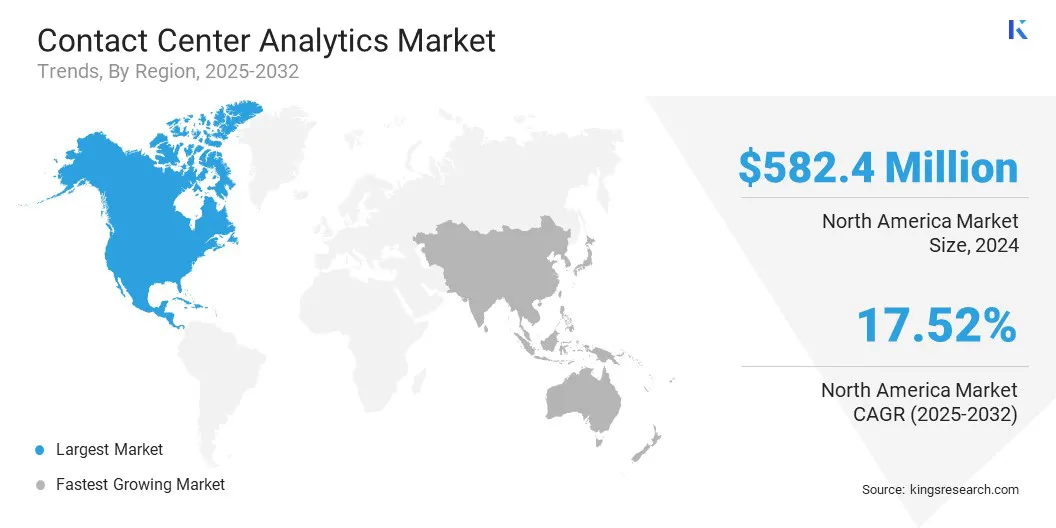
North America contact center analytics market share stood at 32.0% in 2024, with a valuation of USD 582.4 million. This growth is reinforced by the adoption of innovative technologies at an early stage and the presence of advanced digital infrastructure that facilitates the development of advanced analytics solutions. Customer experience is very important to North American organizations, and they are eager to use the tools that enable monitoring customers in real-time, provide sentiment analysis, and support personalized engagement.
Additionally, the presence of a large number of established global enterprises and technology providers fosters a competitive environment and drives continuous innovation. The existence of stringent regulatory norms and increased attention to data privacy and security enhances the implementation of advanced analytics platforms. These factors collectively position North America as a key market for contact center analytics.
The Asia-Pacific contact center analytics industry is set to grow at a CAGR of 20.23% over the forecast period. This growth is propelled by the rapid digitalization of different industries, increased use of cloud-based solutions, and the growing need for better customer service in emerging economies like China, India, and Southeast Asia. The increasing population of the region and rising internet penetration are spurring the volume of customer interactions, compelling organizations to invest in more sophisticated analytics tools to ensure improved operational performance and customer insights.
Moreover, the existence of a large and dynamic SME sector is driving adoption faster, as enterprises are trying to use analytics as a competitive advantage. Government efforts toward digitalization, along with continued investment in technology infrastructure, are set to boost regional market growth.
The competitive landscape of the contact center analytics market is characterized by the presence of both established technology giants and innovative niche players. Companies are concentrating on diversifying their product lineups via mergers, acquisitions, and strategic alliances to reinforce their positions in the markets. Research and development efforts remain strong, with vendors adding innovative functionality, including AI-powered analytics, real-time dashboards, and omnichannel capabilities.
The market is also experiencing high levels of customization to meet the needs of various industries and regions. Moreover, other aspects like pricing, scalability, and quality of customer support are becoming major differentiators. With growing competition, providers are focusing on the creation of non-technical solutions and value-added services in order to retain and attract customers.
Frequently Asked Questions

Aswathi holds cross-domain expertise, translating market trends and competitive intelligence into decision-ready insights. Her work helps clients interpret evolving market conditions and identify growth opportunities. She brings a focused, insight-led approach to research execution. She translates these findings into clear, prioritized action plans that align with client capabilities. Her research often includes scenario modeling to test growth strategies under varying economic conditions. She maintains a rigorous validation process, cross-checking primary and secondary sources to ensure reliability. Clients value her ability to synthesize noisy data into concise executive summaries that drive board-level discussions. Her sector-specific lens, combined with a pragmatic focus on execution, consistently delivers high-impact, commercially sound recommendations. Her structured yet flexible research frameworks adapt to client timelines without compromising depth. She is known for distilling complex trade-offs into straightforward, defensible positions that facilitate confident decision-making.
Habi is a seasoned research and consulting leader with renowned experience in guiding clients on strategic growth and transformation initiatives across global markets. He has led high-performing research teams that deliver actionable insights on market expansion, M&A strategies, opportunity assessment, new business development, and product launches. His project portfolio spans large petrochemical producers, electronic device manufacturers, lubricants companies, and other leading enterprises across diverse industrial and consumer sectors. He currently heads the research department at Kings Research, where he is responsible for setting the research agenda, mentoring analysts, and ensuring client-ready deliverables that support executive decision-making. With extensive experience in market intelligence, strategic research, and consulting, Habi brings a strong understanding of evolving industry dynamics, competitive landscapes, emerging opportunities, and business growth challenges. His expertise includes developing research frameworks, translating complex market data into actionable strategic recommendations, and working closely with senior stakeholders to address critical business questions. He has also contributed to building research capabilities, strengthening analytical methodologies, and driving a culture of quality and insight-led decision-making within research teams. His cross-industry exposure enables him to connect market trends with broader business implications and provide perspectives that help organizations identify opportunities, mitigate risks, and make informed strategic decisions.