
Inquire Now
Key strategic points
Conducting polymers are unique plastics that can conduct electricity. They have the flexibility of ordinary polymers but share the conductive nature of metals, which makes them suitable for use in electronics, sensors, and energy devices.
Polyaniline, polypyrrole, and polythiophene are a few conducting polymers that are widely used in electronics, energy storage, sensors, and biomedical devices.
The report covers major factors driving this market's growth along with key companies operating in this market. It also covers various trends and regulatory frameworks that are expected to play a key role in shaping the market over the forecast period.
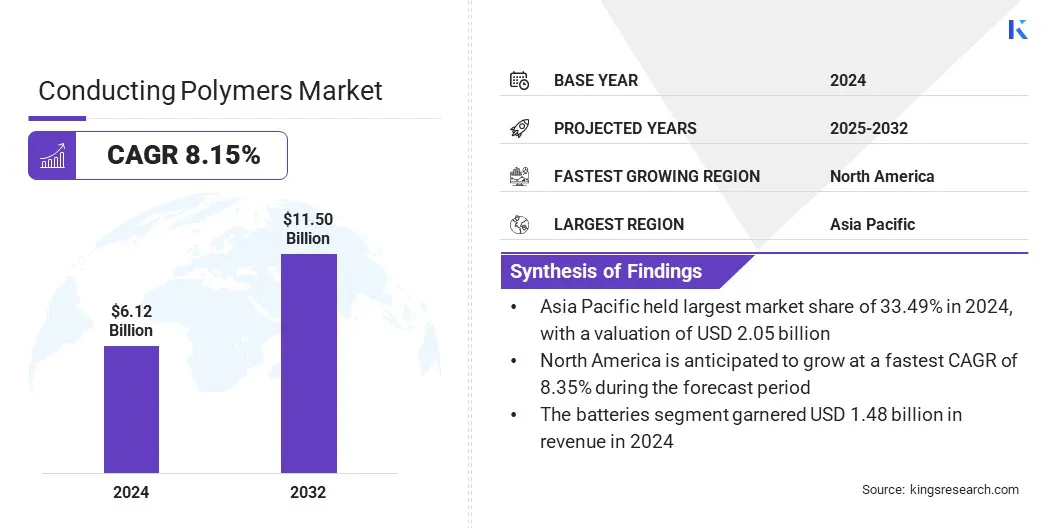
According to Kings Research, the global conducting polymers market size was valued at USD 6.12 billion in 2024 and is projected to grow from USD 6.60 billion in 2025 to USD 11.50 billion by 2032, exhibiting a CAGR of 8.15% over the forecast period.
This growth is driven by increasing investments in organic electronics and smart materials. Advancements in flexible displays, sensors, and energy storage are accelerating the adoption of conducting polymers across healthcare, automotive, and electronics.
Major companies operating in the conducting polymers market are 3M, Agfa-Gevaert Group, Celanese Corporation, Heraeus Group, Premix Group, Lehmann&Voss&Co., Parker Hannifin Corp., Avient Corporation, SABIC, RTP Company, Lubrizol, Merck, Solvay, Rieke Metals, LLC, and Covestro AG.
The use of polyaniline in antistatic coatings is gaining pace due to its conductivity, environmental stability, and cost-effectiveness. These properties have positioned it as a preferred material in electronics packaging, industrial equipment, and protective coatings.
Rising demand for advanced antistatic solutions to safeguard sensitive devices and components has also strengthened the application scope of polyaniline. Its compatibility with diverse substrates and ability to function under varied conditions continue to strengthen its industrial significance and market growth potential.
Enhanced Electrical Conductivity and Process ability of Polythiophene-Based Materials
A key factor boosting the progress of the conducting polymers market is the electrical conductivity and process ability of polythiophene-based materials as they deliver stability, flexibility, and performance in organic photovoltaics, light-emitting diodes, and thin-film transistors.
They can be used with multiple fabrication techniques which makes them ideal for electronics and energy-related applications. Continuous research in material engineering has also optimized their conductivity levels, expanding their usage across industrial and consumer electronics segments.
Limited Durability of Polypyrrole in Harsh Environments
A major challenge facing the conducting polymers market is the low stability of polypyrrole in adverse environments. Exposure to humidity, temperature variations, and corrosive agents can hamper its performance in energy storage and sensor applications.
Therefore, manufacturers are developing composite materials, protective coatings, and hybrid systems to enhance durability while maintaining conductivity. Industry players are also investing in advanced synthesis methods to make polypyrrole more stable for commercial applications.
Increasing Integration of Conducting Polymers in Green Materials
A notable trend influencing the market is their integration into sustainable solutions. Conducting polymers are lightweight, recyclable, and energy-efficient alternatives to traditional materials. In line with rising environmental compliance and corporate sustainability initiatives, their role in eco-friendly coatings, renewable energy devices, and biodegradable electronics is expanding.
Therefore, growing focus on sustainable practices and rising consumer preference for green products are accelerating the use of conducting polymers in sustainable manufacturing practices.
|
Segmentation |
Details |
|
By Type |
Polyaniline, Polypyrrole, Polythiophene, Polyacetylene, Others |
|
By Application |
Batteries, Capacitor, Actuators & sensors, Anti-static packaging, Solar energy, Panel display, Others |
|
By Region |
North America: U.S., Canada, Mexico |
|
Europe: France, UK, Spain, Germany, Italy, Russia, Rest of Europe |
|
|
Asia-Pacific: China, Japan, India, Australia, ASEAN, South Korea, Rest of Asia-Pacific |
|
|
Middle East & Africa: Turkey, U.A.E., Saudi Arabia, South Africa, Rest of Middle East & Africa |
|
|
South America: Brazil, Argentina, Rest of South America |
The global market has been segmented on the basis of region into North America, Europe, Asia Pacific, the Middle East & Africa, and South America.
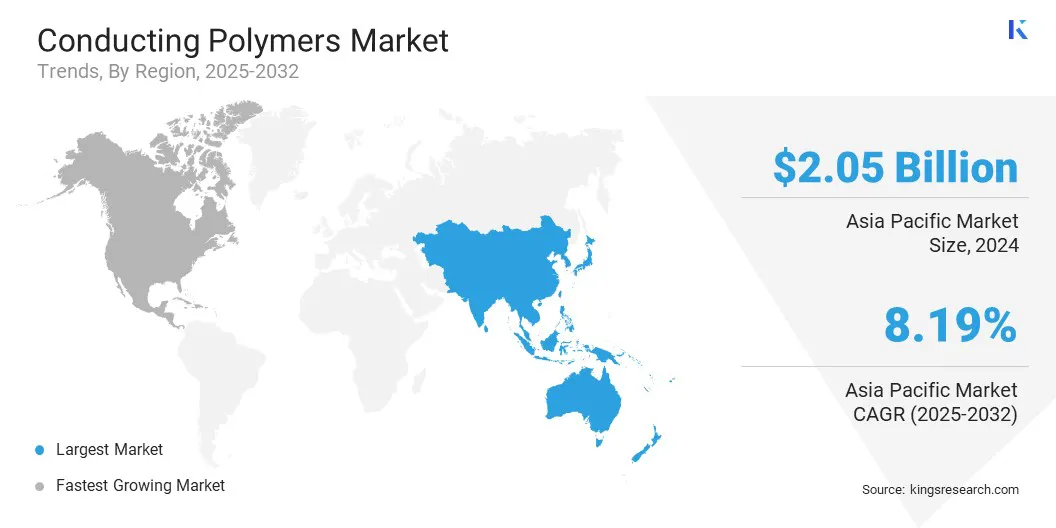
The Asia Pacific market stood at 33.49% in 2024, valued at USD 2.05 billion in the conducting polymers market. This share can be attributed to the rising demand for lightweight, cost-effective, and conductive materials across applications in electronics, packaging, energy storage, and medical devices.
Many key players are adopting conducting polymers in their product portfolios to expand their capabilities to various industrial applications.
Expanding industrial automation, supportive government initiatives promoting industrial innovation and expanding R&D activities focused on high-performance composites are further strengthening the market position across the region.
Strong manufacturing capabilities, increasing investments in advanced materials, and increased use of polymer-based technologies have also boosted regional demand.
The North America market is set to grow at a CAGR of 8.35% over the forecast period. This growth is driven by extensive research and development, expanding scope of conducting polymers in electronics, and their adoption as sustainable materials. Further, their growing use in sensors, actuators, and energy storage systems is aiding their regional growth.
Key players operating in the conducting polymers market are expanding product portfolios primarily by strengthening their research and development capabilities.
They are working on improving polymer stability, scalability, and processing efficiency. Companies are also partnering with research institutions and other companies to improve their technological expertise and global reach. Further, they are undergoing capacity expansion and securing supply chains to meet the increasing demand.
Frequently Asked Questions

Antriksh is an experienced analyst specializing in cross-domain research across diverse industries. With a strong foundation in data analysis and statistical interpretation, he delivers insightful market reports that guide strategic decision-making. Antriksh excels in conducting primary research, with a focus on identifying trends and understanding consumer behavior. Thriving in dynamic and high-pressure environments, he combines analytical expertise with a commitment to delivering impactful outcomes. Beyond his professional pursuits, Antriksh's passion for travel fuels his curiosity and broadens his perspectives, enriching his ability to uncover unique insights that enhance his research capabilities. He is equally adept at synthesizing quantitative findings with qualitative context, which allows him to present holistic viewpoints to clients. His disciplined work ethic and intellectual agility make him a trusted partner in navigating market uncertainties. He consistently seeks out new methodologies to refine his analytical toolkit, and his ability to communicate complex insights clearly ensures stakeholders act confidently on his recommendations.

With over a decade of research leadership across global markets, Ganapathy brings sharp judgment, strategic clarity, and deep industry expertise. Known for precision and an unwavering commitment to quality, he guides teams and clients with insights that consistently drive impactful business outcomes.



.webp&w=128&q=75&dpl=dpl_3pUwJtNgpk6oXgXnK9PBcvvUhHi3)