
Inquire Now
Key strategic points
Cognitive search is an advanced information retrieval method that uses artificial intelligence (AI) technologies such as natural language processing (NLP), machine learning, and semantic analysis to deliver contextual and accurate results.
By understanding user intent, context, and content meaning, it allows precise information discovery across both structured and unstructured data sources such as documents, emails, databases, and websites. Widel used in enterprise settings, it enhances productivity and supports informed decision-making processes by uncovering insights from large datasets.
The global cognitive search market size was valued at USD 7.12 billion in 2024 and is projected to grow from USD 8.20 billion in 2025 to USD 23.48 billion by 2032, exhibiting a CAGR of 15.95% during the forecast period.
This growth is driven by the rising adoption of AI-powered tools that enhance search accuracy and contextual understanding across enterprise environments. This growth is further supported by the integration of generative AI into search platforms to improve discovery and speed up decisions.
Major companies operating in the cognitive search market are Microsoft, IBM Corporation, Google LLC, Amazon Web Services, Inc, Elasticsearch B.V, Coveo Solutions Inc, Lucidworks, Sinequa, Mindbreeze GmbH, Glean Technologies, Inc, Algolia, Chroma, DataStax, Snowflake Inc, and Oracle.
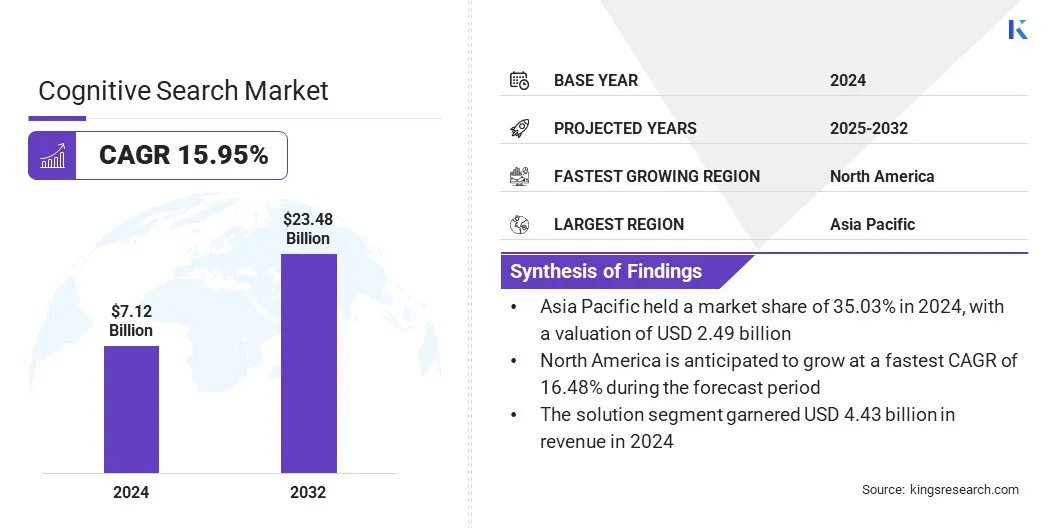
Market expansion is fueled by the increasing efforts to enhance digital product discovery and self-service capabilities within enterprise workflows as organizations aim to improve user access and interaction with structured product data. These integrations streamline search, enhance customer experience, and strengthen supply chain operations, boosting adoption in complex, commerce-driven sectors such as retail, manufacturing, and distribution.
Rising Adoption of AI-powered Tools
The rising adoption of AI-powered tools is fueling the progress of the cognitive search market by enhancing search capabilities with advanced natural language processing (NLP) and machine learning (ML). These tools enable context-aware results, supporting efficient data retrieval across large datasets.
Organizations increasingly integrate AI to streamline operations, improve decision-making, and enhance user experiences. The growing dependence on AI-driven solutions reflects the need for intelligent and scalable search platforms capable of handling complex, unstructured data.
Complex integration with existing IT infrastructure
Complex integration with existing IT infrastructure remains a key barrier to the expansion of the cognitive search market, particularly among traditional enterprises, as legacy systems lack the flexibility to support modern cognitive search solutions. Integrating AI-powered platforms requires significant customization, data migration, and alignment with multiple data sources, which adds to deployment time and cost.
Additionally, concerns around system compatibility, security protocols, and ongoing maintenance create further resistance. These challenges make it difficult for organizations to seamlessly incorporate cognitive search tools into their operational frameworks.
To address this challenge, market players are developing flexible, modular cognitive search platforms that integrate seamlessly with legacy systems. They offer pre-built connectors, APIs, and low-code tools to reduce deployment time and minimize IT disruption.
Vendors are also focusing on cloud-native architectures to simplify scalability and integration. Additionally, providers are enhancing support services and implementation frameworks to guide enterprises through technical transitions, ensuring smoother adoption and alignment with existing infrastructure without compromising performance or security.
Embedding Generative AI into Search Platforms
Embedding generative AI into search platforms is influencing the cognitive search market by enabling more intelligent, conversational, and context-aware enterprise data interaction. These AI models understand natural language queries and generate precise, tailored responses, helping users quickly access relevant information without relying on rigid keyword inputs.
Generative AI also enhances summarization, document synthesis, and content creation directly within the search interface, turning passive queries into dynamic, actionable insights. As data complexity grows, this integration supports faster decision-making and more personalized information retrieval across enterprise functions.
|
Segmentation |
Details |
|
By Component |
Solution, Services |
|
By Organization Size |
Large Enterprises, Small and Medium Enterprises |
|
By Vertical |
Healthcare, BFSI, Retail, Education, Legal, Manufacturing, Others |
|
By Region |
North America: U.S., Canada, Mexico |
|
Europe: France, UK, Spain, Germany, Italy, Russia, Rest of Europe |
|
|
Asia-Pacific: China, Japan, India, Australia, ASEAN, South Korea, Rest of Asia-Pacific |
|
|
Middle East & Africa: Turkey, U.A.E., Saudi Arabia, South Africa, Rest of Middle East & Africa |
|
|
South America: Brazil, Argentina, Rest of South America |
Based on region, the market has been classified into North America, Europe, Asia Pacific, Middle East & Africa, and South America.
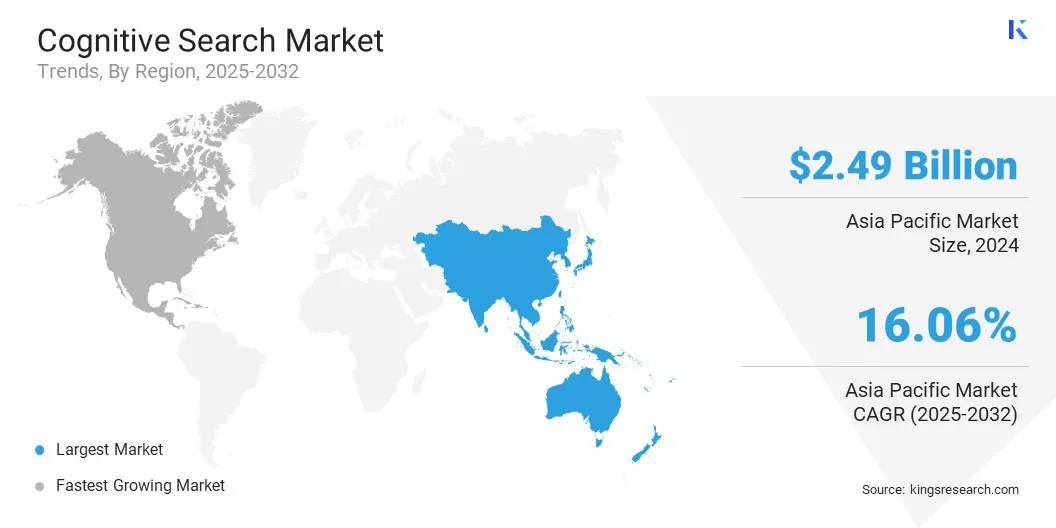
The Asia-Pacific cognitive search market accounted for a share of 35.03% in 2024, valued at USD 2.49 billion. This dominance is attributed to the region’s rapid deployment of AI-powered search solutions that enhance contextual relevance and content discovery across marketing platforms.
The regional market is experiencing rising adoption of cognitive search technologies that support personalized partner identification and data-informed targeting, which improves campaign performance and operational efficiency. Regional market growth is further supported by the demand for tools that convert complex transactional data into accessible insights for strategic planning.
Moreover, the increasing integration of machine learning models into enterprise applications is supporting this expansion. Regional companies are using intelligent search to streamline workflows and match business objectives with high-performing partners. This growing reliance on AI-enhanced discovery is further boosting domestic market growth.
The North America cognitive search industry is set to grow at a robust CAGR of 16.48% over the forecast period. This growth is attributed to the increasing integration of agentic AI, which allows enterprises in the region to automate data science workflows and make analytics more accessible to business users.
Organizations across the region are streamlining advanced functions such as forecasting and pricing analysis by embedding cognitive search tools that reduce time to insight and support more responsive operations.
Additionally, enterprises in the region are aligning technical analytics with business strategy by deploying intelligent agents that simplify complex data processes. Growth continues as companies adopt platforms enabling predictive analytics and data-driven decision-making through advanced cognitive search frameworks.
Major players operating in the cognitive search industry are enhancing their platforms by integrating advanced AI capabilities such as retrieval-augmented generation and natural language processing. They are expanding their global presence to serve a broader range of industries and clients.
Players are offering more sophisticated data processing and enterprise search functionalities to improve information access and insight generation. Efforts are increasingly focused on key sectors such as life sciences, aerospace, and financial services, where intelligent data retrieval is critical. These strategies reflect a shift toward enhanced technological capabilities, digital transformation, and growing enterprise demand for faster, more relevant search experiences.
Frequently Asked Questions

Over the years, Versha brings over 15 years of experience managing consulting assignments across industries, including Food and Beverage, Consumer Goods, ICT, Aerospace, and more. Her work has spanned diverse sectors. Her cross-domain expertise and adaptability make her a versatile and dependable professional. She is known for her keen business insight and foresight. With sharp analytical skills and a curious mindset, Versha excels at transforming complex data into actionable insights. She has a proven track record of unraveling market dynamics, identifying trends, and delivering tailored solutions to meet client needs. As a skilled leader, Versha has successfully mentored research teams and directed projects with precision, ensuring high-quality outcomes. Her collaborative approach and strategic vision enable her to turn challenges into opportunities and consistently deliver impactful results. Whether analyzing markets, engaging stakeholders, or crafting strategies, Versha draws on her deep expertise and industry knowledge to drive innovation and deliver measurable value.

With over a decade of research leadership across global markets, Ganapathy brings sharp judgment, strategic clarity, and deep industry expertise. Known for precision and an unwavering commitment to quality, he guides teams and clients with insights that consistently drive impactful business outcomes.



.webp&w=128&q=75&dpl=dpl_3pUwJtNgpk6oXgXnK9PBcvvUhHi3)