
Inquire Now
Key Strategic Points
Automotive silicone is a high-performance synthetic material that constitutes silicon, oxygen, carbon, and hydrogen. It offers superior thermal stability, flexibility, durability, and resistance to weathering, moisture, and chemicals. As a result, it is widely used in sealing, gasketing, bonding, vibration damping, insulation, thermal management, coatings, lubricants, and protective films.
The market encompasses the production, development, and commercialization of silicone-based materials, components, and solutions specifically for automotive applications.
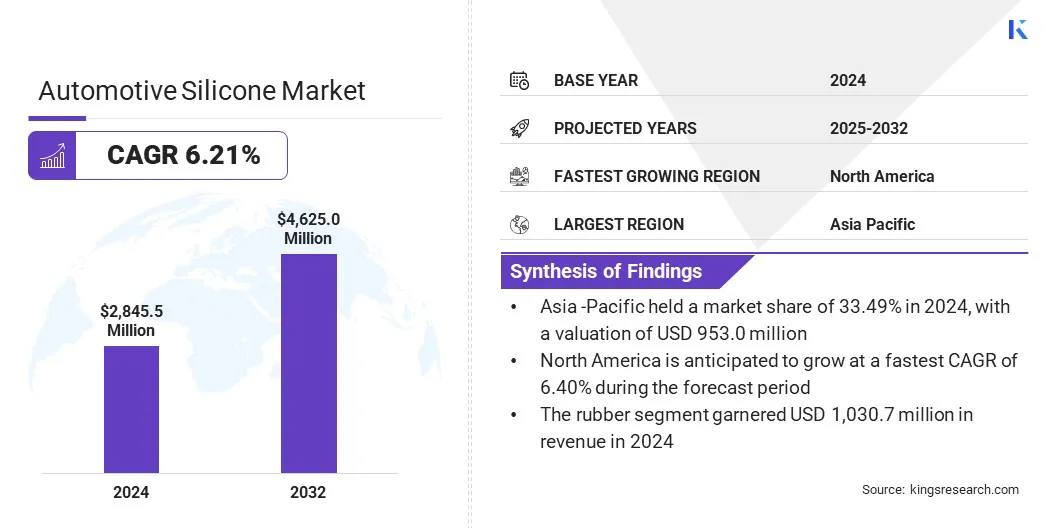
According to Kings Research, the global automotive silicone market size was valued at USD 2,845.5 million in 2024 and is projected to grow from USD 3,015.7 million in 2025 to USD 4,625.0 million by 2032, exhibiting a CAGR of 6.21% over the forecast period.
Rising demand for lightweight vehicle components, such as silicone-based gaskets, seals, engine parts, and other interior parts, is primarily driving the growth of this market. Additionally, increasing focus on vehicle safety and durability is driving the adoption of high-performance silicone solutions in engines, protective coatings, and critical sealing.
Major companies operating in the automotive silicone market are Henkel Centroamericana, S.A., Dow Inc, Wacker Chemie AG, Shin-Etsu Chemical Co., Ltd, Elkem ASA, Evonik Industries AG, KCC SILICONE CORPORATION, 3M Company, CHT Germany GmbH, Primasil Silicones Ltd, Siltech Corporation, Mitsubishi Shoji Chemical Corporation, Rogers Corporation, Zhejiang Xin'an Chemical Industry Group Co., Ltd, and BRB International B.V.
A major trend operating in the market is the rising demand for silicone-based components in EVs (electric vehicles). Silicone is being used in EVs for enhancing battery safety, managing heat, and providing effective sealing solutions. Its superior thermal stability and electrical insulation make it indispensable for EV systems, which is fueling its adoption in the automotive industry.
Rising Demand for Lightweight Materials
The growth of the market is propelled by the rising demand for lightweight materials to improve fuel efficiency and reduce emissions in the automotive industry. Silicone-based components, such as gaskets, seals, engine parts, and interior elements, offer high durability, flexibility, and thermal stability while reducing vehicle weight.
The U.S. Department of Energy (DOE) reports that a 10% reduction in vehicle weight can result in a 6–8% improvement in fuel economy. Regulatory authorities worldwide are also shifting their focus toward vehicle efficiency and compliance, which is prompting investments in silicone-based components.
High Production Cost
The market faces a major challenge in the automotive silicone market in the form of high production cost of silicone-based materials, including elastomers, adhesives, sealants, and coatings.
The manufacturing process requires advanced equipment, energy-intensive operations, and costly raw materials such as siloxanes, which substantially increase expenses. Additionally, costs associated with quality control, specialized processing, and regulatory compliance add to the financial burden.
As a result, market players are adopting process optimization and automation to cut energy use and boost the yield of high-performance silicone. Companies are also expanding research into cost-effective formulations and hybrid materials that retain silicone’s performance while lowering raw material expenses.
Growing Integration of Silicone in EV Battery Packs and Power Electronics
A key trend influencing the market is the growing integration of silicone in electric vehicle (EV) battery packs and power electronics. Manufacturers are incorporating silicone gels, adhesives, and encapsulants in high-voltage components such as inverters, IGBT modules, and battery systems for thermal management, electrical insulation, and vibration damping.
These solutions enhance reliability, improve energy efficiency, and protect against moisture and chemical exposure. It also supports the performance, safety, and longevity of next-generation EV powertrains.
|
Segmentation |
Details |
|
By Product |
Rubber, Adhesives & Sealants, Coatings, Others |
|
By Application |
Interior and Exterior Parts, Engine & Drive Train System, Electrical System, Suspension Systems, Others |
|
By Region |
North America: U.S., Canada, Mexico |
|
Europe: France, UK, Spain, Germany, Italy, Russia, Rest of Europe |
|
|
Asia-Pacific: China, Japan, India, Australia, ASEAN, South Korea, Rest of Asia-Pacific |
|
|
Middle East & Africa: Turkey, U.A.E., Saudi Arabia, South Africa, Rest of Middle East & Africa |
|
|
South America: Brazil, Argentina, Rest of South America |
Based on region, the global market has been classified into North America, Europe, Asia Pacific, the Middle East & Africa, and South America.
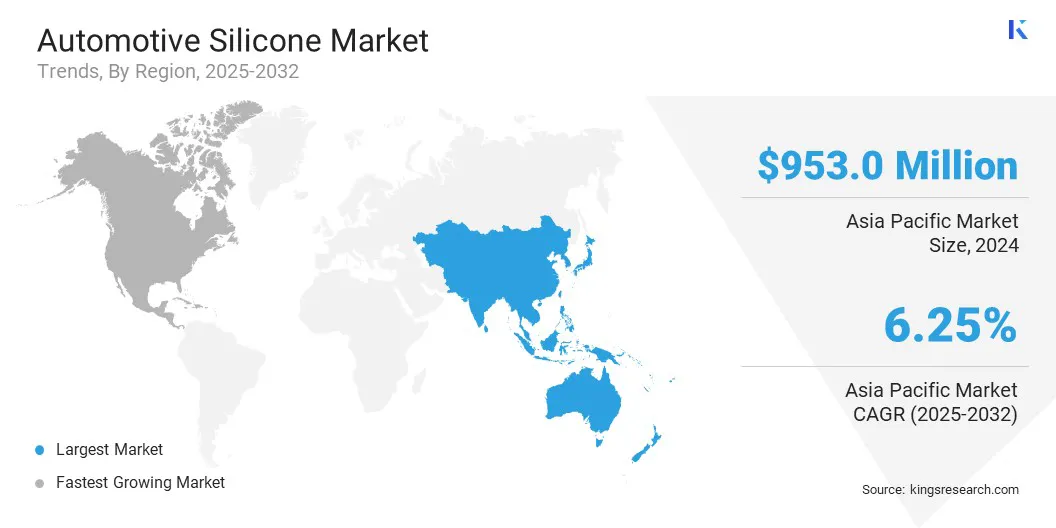
Asia Pacific automotive silicone market share stood at 33.49% in 2024, valued at USD 953.0 million in the global market. This is primarily driven by the rapidly expanding automotive sector, which has fueled the demand for high-performance silicone components in various automotive systems.
Government policies promoting EV adoption, such as tax rebates, direct subsidies, and exemptions from road taxes are further boosting the need for automotive silicone. Advances in automotive manufacturing, including automation, additive manufacturing, and precision molding, are making durable, efficient materials available.
Additionally, regional market players are focusing on enhancing their manufacturing capabilities and distribution networks to meet the growing demand for automotive silicone solutions.
North America is set to grow at a CAGR of 6.40% over the forecast period. This growth is attributed to the increasing adoption of electric vehicles, which drives the demand for silicone in battery insulation, thermal management, and high-voltage system protection.
Stringent vehicle safety and emission regulations, such as fuel economy standards requires durable, high-performance silicone components in engines, gaskets, and seals. Rising integration of advanced electronics and infotainment systems in vehicles further fuels the need for silicone-based insulation and encapsulation for wiring, sensors, and electronic modules.
Additionally, strategic expansions and capacity enhancements by regional market players improves the supply and accessibility of silicone solutions, supporting broader adoption of automotive silicone across the region.
Major players in the automotive silicone market are actively strengthening their competitive position through technological innovation and strategic expansions. Key players are investing in the development of high-performance silicone materials for electric vehicle batteries, and lightweight automotive components.
They are also focusing on expanding their portfolios with specialty coatings, and 3D-printable silicone solutions to meet the growing demand for advanced electronics, and efficient powertrain systems. Additionally, players are enhancing manufacturing capabilities and optimizing distribution networks to improve supply reliability and market reach for automotive silicone solutions.
Frequently Asked Questions

Over the years, Versha brings over 15 years of experience managing consulting assignments across industries, including Food and Beverage, Consumer Goods, ICT, Aerospace, and more. Her work has spanned diverse sectors. Her cross-domain expertise and adaptability make her a versatile and dependable professional. She is known for her keen business insight and foresight. With sharp analytical skills and a curious mindset, Versha excels at transforming complex data into actionable insights. She has a proven track record of unraveling market dynamics, identifying trends, and delivering tailored solutions to meet client needs. As a skilled leader, Versha has successfully mentored research teams and directed projects with precision, ensuring high-quality outcomes. Her collaborative approach and strategic vision enable her to turn challenges into opportunities and consistently deliver impactful results. Whether analyzing markets, engaging stakeholders, or crafting strategies, Versha draws on her deep expertise and industry knowledge to drive innovation and deliver measurable value.

Ganapathy Subramaniam Suresh
With over a decade of research leadership across global markets, Ganapathy brings sharp judgment, strategic clarity, and deep industry expertise. Known for precision and an unwavering commitment to quality, he guides teams and clients with insights that consistently drive impactful business outcomes.



.webp&w=128&q=75&dpl=dpl_DPva2LrvfsBdTJm1XZj67UTrvMHL)