
Inquire Now
Key Strategic Points
The market implies the use of artificial intelligence technologies to enhance and automate marketing channels with minimal human intervention. It combines AI and machine learning, real-time data analysis, and decision-making with traditional marketing automation systems. These solutions enable companies to streamline workflows, tailor customer experiences, and dynamically modify campaigns.
The processing of an immense amount of data allows AI systems to simplify the audience targeting process, predict customer behavior, and make marketing tactics more effective, creating new target dimensions in marketing strategies.
The global AI in the marketing automation market size was valued at USD 7,530 million in 2024 and is projected to grow from USD 8,399.2 million in 2025 to USD 20,009.2 million by 2032, exhibiting a CAGR of 13.20% during the forecast period.
The market is growing mostly due to the rising use of artificial intelligence technologies to improve marketing efficiency, customer engagement, and enable highly personalized marketing campaigns. Companies are adopting AI-based technology with marketing automation systems to process large amounts of customer data, automate routine marketing services, and streamline customer experiences across various online platforms.
Major companies operating in the AI in the marketing automation industry are Salesforce, Inc., Google, Adobe, Oracle, IBM, HubSpot, Inc., Pecan, Ogilvy.com, ActiveCampaign, Intuit Inc., Zoho Corporation Pvt. Ltd., Act-On Marketing Automation, Klaviyo, Braze, and Bloomreach, Inc.
The increasing need for data-driven decision-making and real-time customer insights prompts businesses to make investments in AI-enabled marketing solutions. The high pace of digitization of marketing operations and the increased emphasis on customized customer experiences are also anticipated to facilitate the growth of the AI in marketing automation market through the forecast period.
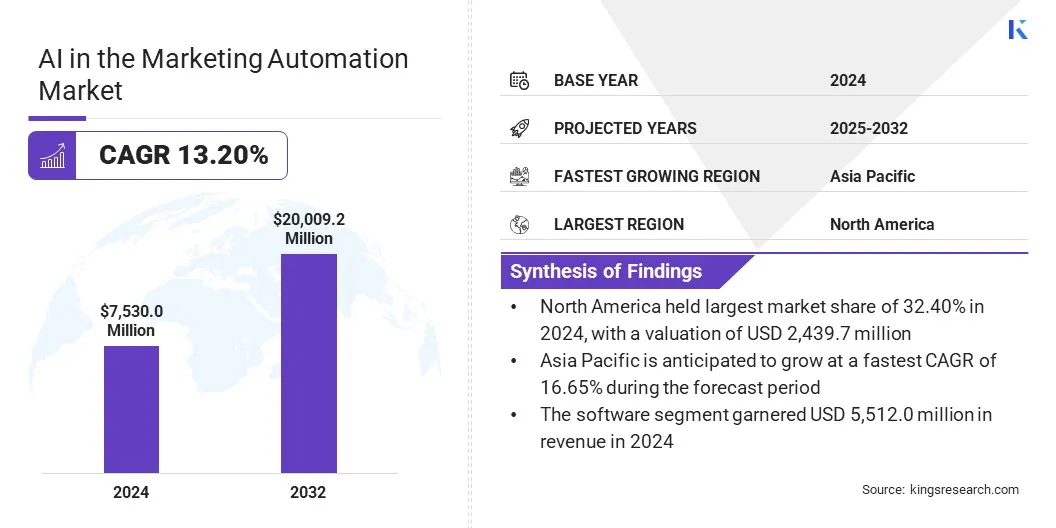
The marketing automation market landscape is being largely propelled by the increasing need to utilize AI-driven hyper-personalization. With the increasing demand for personalized experiences among consumers, companies are turning to artificial intelligence to improve communication with customers and streamline their business and marketing purposes.
AI algorithms process large volumes of data, allowing brands to comprehend individual preferences and behavior, thereby providing users with personalized content and suggestions in real-time. Such customization enhances customer satisfaction and conversion rates, in addition to strengthening brand loyalty.
Furthermore, AI-powered solutions can be scaled to enable small and large companies to adopt sophisticated marketing strategies that were previously used only by big businesses. Consequently, organizations are spending their budgets on AI-based technologies to remain competitive and fulfill the growing demands of their audience, eventually generating a more proactive and responsive marketing landscape.
One of the major challenges in this market is the growing regulatory focus on AI-based consumer profiling and automated decision-making. With the advancement of AI technologies used to analyze user data and predict consumer behavior, regulatory bodies across the globe are raising issues of privacy, transparency, and the possibility of biases in automated marketing systems.
Besides, the suggested regulations are supposed to increase the transparency of algorithms and require organizations to provide effective explanations of automated decisions regarding consumers. This changing regulatory environment has compelled marketing automation firms to invest in a robust compliance system, become more transparent, and seek ethical AI usage, which can increase complexity and limit innovation in operations.
To mitigate these obstacles, firms must focus on the development of transparent and ethical AI systems. Compliance can be retained through the implementation of strong data governance frameworks, clear documentation of the AI decision-making processes, and regular audits for bias and privacy to maintain compliance.
Proactive consultation with regulators and the provision of consumers with easily comprehensible information regarding the use of data further enhances trust and lessens the risks of regulation.
This implementation of generative AI in marketing automation systems is transforming marketing content and campaign creation by automating the development of marketing content at scale with high quality and in a customized manner.
Generative AI models can create individualized emails, social media messages, ads, and landing page text by accessing customer data and campaign objectives, and significantly reducing the amount of time and resources needed to create them. Marketing agility can be improved using this technology that allows testing and optimizing numerous variations of content quickly and contributes to increased engagement and conversion rates.
Moreover, generative AI facilitates the use of regular brand messaging and responds to a variety of audiences, which makes the campaigns more meaningful and effective. With marketers under more and more pressure to provide personalized experiences faster, the use of generative AI in creating automated content is becoming a very important trend in the AI in the marketing automation market that is pushing marketing automation to new levels of innovation and efficiency.
|
Segmentation |
Details |
|
By Component |
Software, and Services |
|
By Deployment |
On-Premise, Cloud-Based, and Hybrid |
|
By Enterprise |
Large Enterprise, and Small & Medium Enterprise (SME) |
|
By Customer |
Business-to-Business (B2B), and Business-to-Consumer (B2C) |
|
By Marketing Channel |
Email Marketing, Social Media Marketing, Search & SEO Marketing, Smart Phone Marketing, and Others |
|
By Technology |
Machine Learning, Natural Language Processing, Generative AI (GenAI), Computer Vision, and Others |
|
By End Use |
Banking, Financial Services, and Insurance (BFSI), Healthcare, Media & Entertainment, Retail & E-Commerce, Travel & Hospitality, and Others |
|
By Region |
North America: U.S., Canada, Mexico |
|
Europe: France, UK, Spain, Germany, Italy, Russia, Rest of Europe |
|
|
Asia-Pacific: China, Japan, India, Australia, ASEAN, South Korea, Rest of Asia-Pacific |
|
|
Middle East & Africa: Turkey, U.A.E., Saudi Arabia, South Africa, Rest of Middle East & Africa |
|
|
South America: Brazil, Argentina, Rest of South America |
Based on region, the AI in the marketing automation market has been classified into North America, Europe, Asia Pacific, Middle East & Africa, and South America.
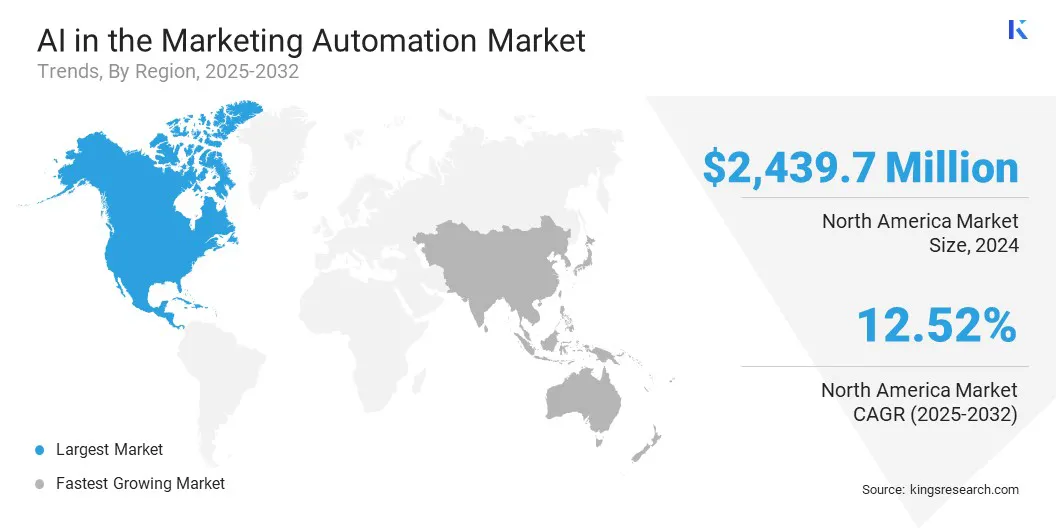
North America's AI in the marketing automation market share stood at 32.40% in 2024, valued at USD 2,439.7 million. The region leads due to its highly developed technological basis, growing adoption of AI solutions, and the presence of leading industry players.
The intensive research and development in AI, coupled with favorable regulatory frameworks, have stimulated innovation and implementation across most industries. Moreover, companies within the North American market focus on improving customer experience and operational performance, which promotes the need for advanced AI-enabled marketing solutions.
Additionally, the strong development of the e-commerce segment and the growing digital promotion budgets are helping to drive the rapid expansion of AI-based marketing automation tools across North America.
The Asia-Pacific AI in the marketing automation industry is set to grow at a CAGR of 16.65% over the forecast period. This growth is mainly influenced by the surge in growth of the e-commerce industry and the growing adoption of digital marketing techniques by companies with large online customer bases. Firms are deploying AI-based marketing technologies at an increasing rate to handle a high number of customer touchpoints across social media, mobile applications, and online stores.
Moreover, the proliferation of smartphones and the increasing influence of social commerce are prompting organizations to leverage smart marketing tools to personalize promotions and increase the rate of conversion. The existence of a fast-growing digital economy and the rising investments in technology-based marketing strategies among companies are also likely to fuel the rapid growth of the regional market.
The AI in the marketing automation industry is highly competitive and is stimulated by constant development in artificial intelligence, data processing, and customer interaction technologies. Market participants are focusing on integrating AI capabilities such as predictive analytics, machine learning based customer segmentation, and automated content generation into marketing automation platforms.
Such technologies can help businesses provide customers with personalized marketing campaigns, streamline customer journeys, and enhance customer engagement on various digital channels. The firms in the market are also investing in developing generative AI tools and intelligent workflow automation to facilitate campaign efficiency and minimize marketing tasks performed by humans.
Furthermore, platforms are being extended by providers, with additions in the form of marketing automation solutions coupled with customer relationship management systems and customer data platforms, where providers can unify customer insights.
Strategic partnerships, the development of new products, and investing in AI-based personalization solutions are among the key approaches adopted by the market players to improve their competitive stance and respond to the increasing demand for AI-powered marketing solutions.
Frequently Asked Questions

Aswathi holds cross-domain expertise, translating market trends and competitive intelligence into decision-ready insights. Her work helps clients interpret evolving market conditions and identify growth opportunities. She brings a focused, insight-led approach to research execution. She translates these findings into clear, prioritized action plans that align with client capabilities. Her research often includes scenario modeling to test growth strategies under varying economic conditions. She maintains a rigorous validation process, cross-checking primary and secondary sources to ensure reliability. Clients value her ability to synthesize noisy data into concise executive summaries that drive board-level discussions. Her sector-specific lens, combined with a pragmatic focus on execution, consistently delivers high-impact, commercially sound recommendations. Her structured yet flexible research frameworks adapt to client timelines without compromising depth. She is known for distilling complex trade-offs into straightforward, defensible positions that facilitate confident decision-making.
Habi is a seasoned research and consulting leader with renowned experience in guiding clients on strategic growth and transformation initiatives across global markets. He has led high-performing research teams that deliver actionable insights on market expansion, M&A strategies, opportunity assessment, new business development, and product launches. His project portfolio spans large petrochemical producers, electronic device manufacturers, lubricants companies, and other leading enterprises across diverse industrial and consumer sectors. He currently heads the research department at Kings Research, where he is responsible for setting the research agenda, mentoring analysts, and ensuring client-ready deliverables that support executive decision-making. With extensive experience in market intelligence, strategic research, and consulting, Habi brings a strong understanding of evolving industry dynamics, competitive landscapes, emerging opportunities, and business growth challenges. His expertise includes developing research frameworks, translating complex market data into actionable strategic recommendations, and working closely with senior stakeholders to address critical business questions. He has also contributed to building research capabilities, strengthening analytical methodologies, and driving a culture of quality and insight-led decision-making within research teams. His cross-industry exposure enables him to connect market trends with broader business implications and provide perspectives that help organizations identify opportunities, mitigate risks, and make informed strategic decisions.