
Inquire Now
Key Strategic Points
The market involves software platforms, algorithms, and AI-enabled systems designed to analyze medical data and support disease detection, classification, and clinical decision-making. These solutions apply machine learning, deep learning, natural language processing, and computer vision techniques to interpret diagnostic inputs such as medical images, pathology slides, laboratory results, physiological signals, and clinical records.
AI-based diagnostic tools transform complex clinical data into actionable insights by identifying patterns, anomalies, and predictive markers with high accuracy and consistency. They support early disease detection, risk stratification, workflow prioritization, and diagnostic standardization across radiology, pathology, cardiology, neurology, and other clinical specialties.
This enables improved efficiency, diagnostic confidence, and patient outcomes in hospitals, diagnostic centers, and healthcare systems.
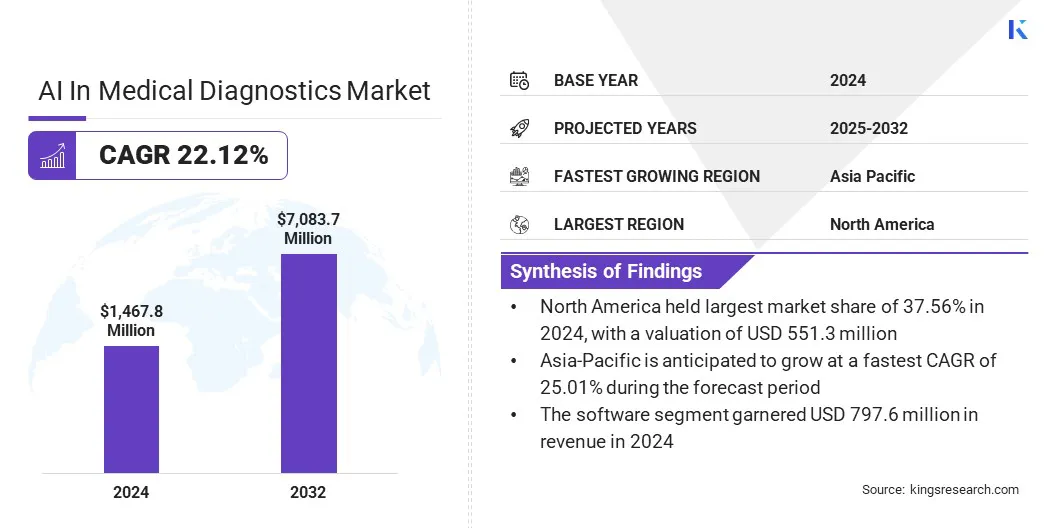
According to Kings Research, global AI in Medical Diagnostics market size was valued at USD 1,467.8 million in 2024 and is projected to grow from USD 1,749.2 million in 2025 to USD 7,083.7 million by 2032, exhibiting a CAGR of 22.12% over the forecast period.
The market is expanding due to the increasing demand for tools that enhance diagnostic accuracy, workflow efficiency, and early disease detection. Market growth is supported by rising imaging volumes, clinician shortages, expanding clinical validation, and broader integration of AI-driven analysis across healthcare settings.
Major companies operating in the global AI in Medical Diagnostics industry are Aidoc, Olympus, Akoya Biosciences, Inc., Siemens Healthineers AG, Zebra Technologies Corp., Imagen, AliveCor, Inc., GE HealthCare, Cleerly, Inc., Heartflow, Inc., Ibex Medical Analytics, Nano-X Imaging Ltd, Lunit Inc., EchoNous Inc., and NVIDIA Corporation.
Market growth in the AI in medical diagnostics sector is supported by regulatory progress and expanding clinical validation of AI-based diagnostic tools. Regulatory agencies are approving an increasing volume of AI-powered imaging, pathology, and screening software under Software as a Medical Device (SaMD) frameworks, providing clearer pathways for commercialization.
These approvals reduce adoption risk for healthcare providers and encourage broader clinical evaluation across diagnostic workflows. In response, technology providers are increasing investments in clinical validation studies, post-market performance monitoring, and explainable AI features to meet regulatory and clinician requirements.
These developments are strengthening trust in AI-enabled diagnostics and supporting wider deployment across hospitals and diagnostic centers.
A key driver supporting the growth of the AI in medical diagnostics market is the increasing focus on early and accurate disease detection by healthcare providers, hospital networks, and diagnostic laboratories across major therapeutic areas.
Healthcare providers are prioritizing earlier identification of conditions such as cancer, cardiovascular disease, and neurological disorders to improve treatment outcomes and reduce long-term care costs. This shift is reinforced by the rising volume and complexity of diagnostic data, including high-resolution imaging and multimodal clinical information that can be difficult to interpret through manual analysis.
AI-enabled diagnostic algorithms are increasingly adopted to enhance sensitivity and specificity by detecting early-stage abnormalities and supporting consistent clinical interpretation. Hospitals and diagnostic centers are integrating these tools to enable earlier intervention, reduce diagnostic variability, and improve clinical confidence, thereby strengthening the clinical and economic value proposition of AI-driven diagnostic solutions.
A key challenge restraining the growth of the AI in medical diagnostics market is the high cost and technical complexity associated with deploying and maintaining advanced AI-enabled diagnostic solutions. Developing, validating, and integrating clinically compliant AI software, imaging platforms, and data infrastructure requires substantial investment.
In addition, the need for high-quality annotated datasets, skilled data science expertise, and ongoing model monitoring increases operational complexity for healthcare providers. These factors may limit adoption, particularly among smaller hospitals, diagnostic centers, and resource-constrained healthcare systems.
To address this challenge, market participants are focusing on scalable cloud-based deployment models, standardized integrations, and user-friendly interfaces, while expanding training, support services, and strategic partnerships to improve accessibility and drive broader clinical adoption.
A key trend influencing the AI in medical diagnostics market is the increasing integration of AI technologies directly into routine clinical workflows. Healthcare providers are moving beyond standalone AI tools toward solutions embedded within PACS, LIS, and EHR systems to support seamless diagnostic decision-making.
This integration allows AI algorithms to operate alongside existing imaging and reporting processes, enabling real-time case prioritization, automated annotations, and structured report generation. Embedding AI within familiar clinical environments improves clinician adoption, reduces workflow disruption, and supports consistent use across departments.
These advancements strengthen operational efficiency, enhance diagnostic standardization, and accelerate the transition from pilot deployments to enterprise-scale implementation, thereby driving sustained market demand.
|
Segmentation |
Details |
|
By Component |
Software, Hardware, Services |
|
By Application |
Radiology, Pathology, Cardiology, Neurology, Others |
|
By End User |
Hospitals & Clinics, Diagnostic Imaging Centers, Pathology Laboratories, Others |
|
By Region |
North America: U.S., Canada, Mexico |
|
Europe: France, UK, Spain, Germany, Italy, Russia, Rest of Europe |
|
|
Asia-Pacific: China, Japan, India, Australia, ASEAN, South Korea, Rest of Asia-Pacific |
|
|
Middle East & Africa: Turkey, U.A.E., Saudi Arabia, South Africa, Rest of Middle East & Africa |
|
|
South America: Brazil, Argentina, Rest of South America |
Based on region, the global market has been classified into North America, Europe, Asia Pacific, Middle East & Africa, and South America.
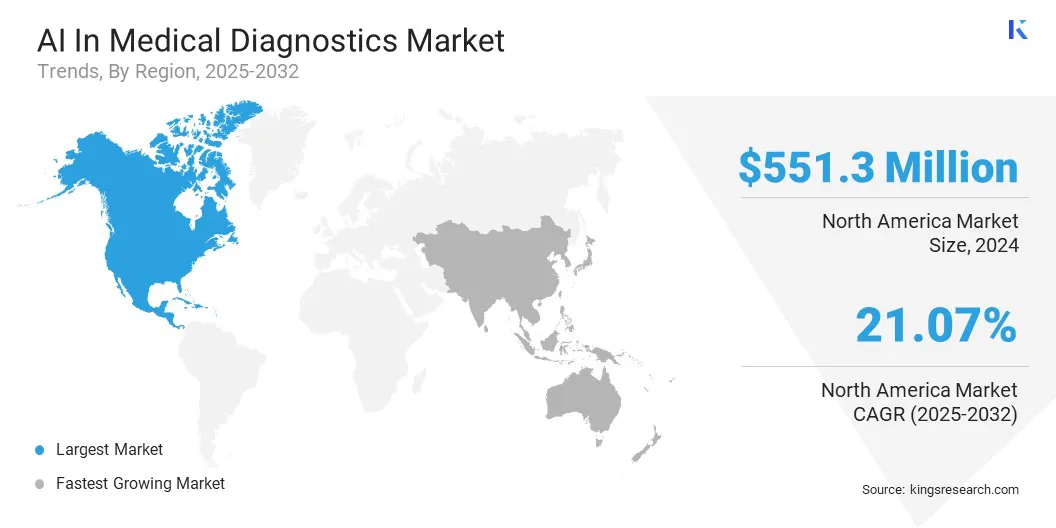
North America AI in medical diagnostics market share stood around 37.56% in 2024 in the global market, with a valuation of USD 551.3 million. This dominance is attributed to the advanced healthcare infrastructure in this region, high adoption of digital health technologies, and increasing deployment of AI across hospitals and diagnostic centers.
The market growth is further supported by the presence of imaging OEMs, and cloud technology providers that accelerate innovation and commercialization. Increasing diagnostic imaging volumes, clinician shortages, and demand for early and accurate disease detection are driving the adoption of AI-enabled solutions across radiology, pathology, and cardiology workflows.
In addition, supportive regulatory frameworks and sustained healthcare IT investments by government agencies are further increasing the demand for AI-enabled medical diagnostic solutions across the region.
Asia-Pacific is poised for significant growth at a robust CAGR of 25.01% over the forecast period, driven by rapidly expanding healthcare infrastructure and increasing government initiatives to digitize healthcare systems.
Rising healthcare expenditure, growing private hospital networks, and the adoption of telemedicine are accelerating demand for AI-based diagnostic solutions. Rising imaging volumes and expanded preventive care programs across oncology, cardiology, and infectious diseases are increasing clinical adoption of AI-based diagnostic solutions.
Leading players in the AI in medical diagnostics market are focusing on technological innovation, strategic collaborations, and portfolio expansion to meet the rising demand for accurate, efficient, and scalable diagnostic solutions.
Companies are developing advanced AI-enabled platforms for radiology, pathology, cardiology, and multimodal diagnostics to enhance detection accuracy, workflow efficiency, and clinical decision support.
These firms are conducting clinical validation studies, pilot deployments, and real-world performance evaluations to demonstrate reliability, reproducibility, and compliance with regulatory standards. Strategic partnerships, cloud integration, and the acquisition of specialized AI startups are further facilitating adoption across hospitals, diagnostic centers, and healthcare networks.
Frequently Asked Questions

Swati is a committed research analyst with a passion for optimizing systems and processes across industries, specializing in healthcare but also bringing valuable expertise to sectors such as consumer goods, life sciences, and more. Her cross-domain research approach allows her to generate clear, actionable reports that inform strategic decisions in a variety of fields. Swati is committed to staying ahead of evolving trends, leveraging her broad understanding of different sectors to provide insights that are relevant to a range of industries. In her personal time, she enjoys music and spending quality time with her family, which inspires her creativity and enriches her professional approach. Her systematic methodology ensures that every report is both thorough and practical. Swati's ability to bridge regulatory frameworks with market realities gives her recommendations a distinct edge. She collaborates seamlessly with cross-functional teams, distilling complex data into straightforward narratives. Her proactive monitoring of policy and technological shifts keeps her analysis forward-looking.

With over a decade of research leadership across global markets, Ganapathy brings sharp judgment, strategic clarity, and deep industry expertise. Known for precision and an unwavering commitment to quality, he guides teams and clients with insights that consistently drive impactful business outcomes.