
Inquire Now
Key Strategic Points
The acoustic insulation market involves the production, distribution, and marketing of materials and solutions that minimize, regulate, and prevent the flow of sound between different environments. Such materials are typically utilized in the construction industry, as well as in the automotive, industrial, and commercial sectors, to increase soundproofing, enhance acoustic comfort, and adhere to noise regulations.
The market includes a wide variety of products such as mineral wool, fiberglass, foam, cellulose, and other specialty insulators, all of which are designed for use in walls, floors, ceilings, automotive cabins, and industrial equipment.
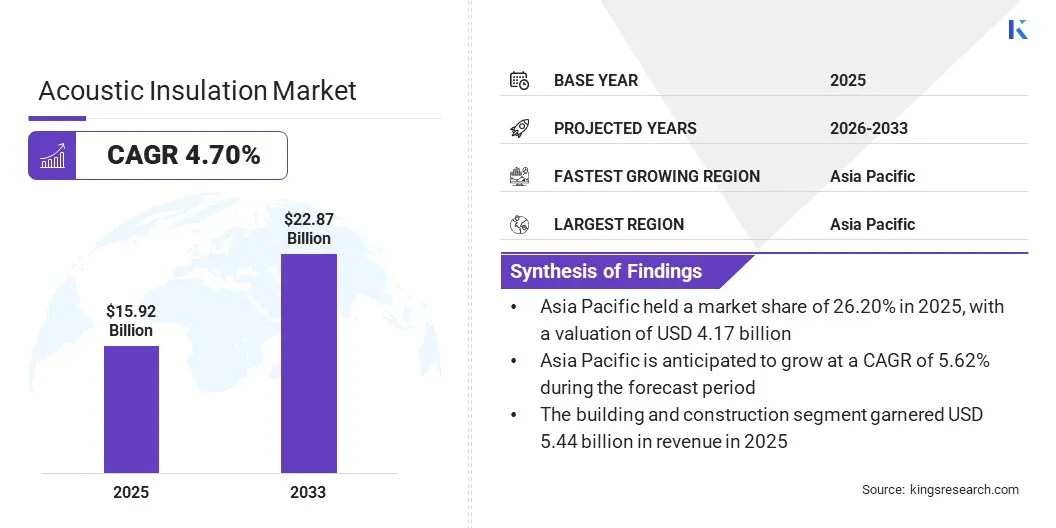
The global acoustic insulation market size was valued at USD 15.92 billion in 2025 and is projected to grow from USD 16.58 billion in 2026 to USD 22.87 billion by 2033, exhibiting a CAGR of 4.70% during the forecast period. This growth is driven by increasing demand for noise control solutions in residential, commercial, and industrial buildings, as well as in the transportation sector.
Major companies operating in the global acoustic insulation industry are Saint-Gobain, ROCKWOOL A/S, Owens Corning, Knauf Group, Armacell, Kingspan Group, SOPREMA, 3M, BASF, Huntsman, K-FLEX S.p.A., Trelleborg, Fletcher Insulation, Johns Manville, and Recticel.
Rising awareness of the health impacts of noise pollution, the implementation of stringent building codes, and advancements in sustainable insulation materials are further supporting market expansion. The stable increase in the market share can be attributed to continuous investments in infrastructure development and urbanization, along with advancements in acoustic insulation technologies.
Governments and regulatory bodies worldwide are increasingly enforcing strict guidelines to address the impact of noise pollution on human health and well-being. Such regulations frequently require effective acoustic insulation to be used in new building construction and renovation projects in residential, commercial, and industrial buildings.
Regulations such as the International Building Code (IBC) in the U.S., EN 12354 in Europe, and Approved Document E in the U.K. frequently require the use of effective acoustic insulation in new construction and renovation projects across residential, commercial, and industrial buildings. These standards mandate the use of high-performance soundproofing materials, which makes acoustic insulation a legal prerequisite in most areas and greatly increases demand and fosters innovation.
Raw material price volatility presents a significant challenge to the expansion of the market. The prices of raw materials like mineral wool, fiberglass, foams, and other special materials may change due to factors such as supply chain disruption, shifts in international demand, and geopolitical risks. These fluctuating price trends have a direct effect on the cost of production and profit margins, making it difficult for companies to predict costs and price their products consistently.
To overcome these obstacles, firms are engaging more in alternative strategies like diversifying their supplier base, signing long-term supply contracts, and investing in material innovations to limit reliance on volatile raw materials. Such actions help stabilize expenses and improve profitability in a volatile market environment.
The adoption of sustainable and bio-based materials is emerging as a significant trend in the market. With the growing environmental concerns and the tightening of green building standards, manufacturers are investing more in the development of insulation products based on renewable resources like mycelium, hemp, and cellulose. These new materials offer effective sound absorption while also having a lower environmental impact by reducing carbon emissions and increasing recyclability.
With growing interest from consumers and the implementation of stricter green building standards, demand for eco-friendly acoustic insulation is set to increase. This trend promotes continuous innovations and allows companies to comply with evolving expectations and obtain certifications such as LEED (Leadership in Energy and Environmental Design) and BREEAM (Building Research Establishment Environmental Assessment Method).
|
Segmentation |
Details |
|
By Product Type |
Sealants, Paints & Sprays, Blankets & Curtains, Foams & Panels, and Others |
|
By Material |
Stone Wool, Glass Wool, Fiberglass, Wood-Fiber Cellulose, Rubber, and Others |
|
By Application |
Walls, Floors & Ceilings, Doors & Windows, Machinery & Equipment Enclosures, HVAC, and Others |
|
By End Use |
Building and Construction, Aerospace & Defense, Automotive & Transportation, Industrial, and Others |
|
By Region |
North America: U.S., Canada, Mexico |
|
Europe: France, UK, Spain, Germany, Italy, Russia, Rest of Europe |
|
|
Asia-Pacific: China, Japan, India, Australia, ASEAN, South Korea, Rest of Asia-Pacific |
|
|
Middle East & Africa: Turkey, U.A.E., Saudi Arabia, South Africa, Rest of Middle East & Africa |
|
|
South America: Brazil, Argentina, Rest of South America |
Based on region, the global market has been classified into North America, Europe, Asia Pacific, Middle East & Africa, and South America.
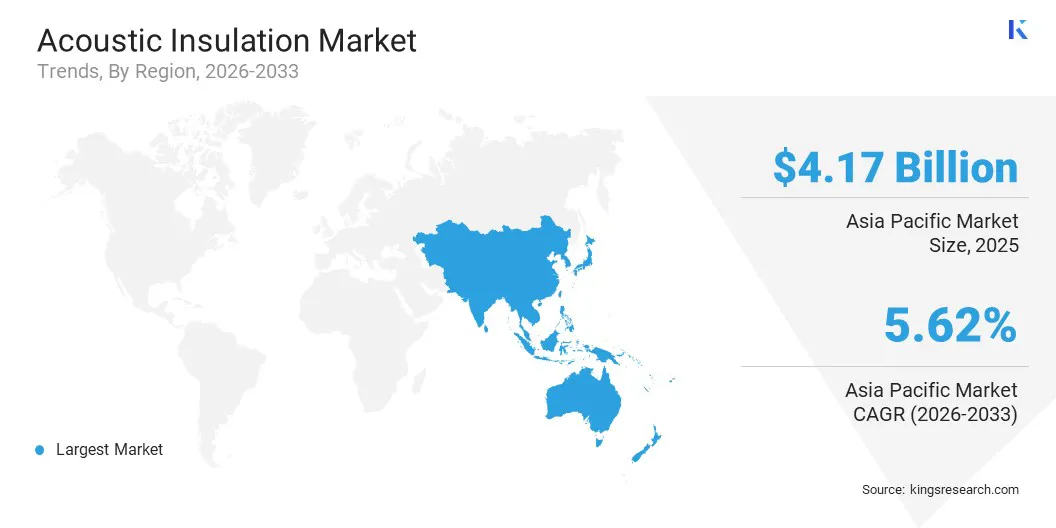
Asia Pacific acoustic insulation market share stood at 26.20% in 2025, with a valuation of USD 4.17 billion. The region’s growth is propelled by rapid urbanization, escalating infrastructure development, and a surge in large-scale residential and commercial building projects. The need to establish high-quality acoustic insulation solutions is also increasing due to government efforts to encourage the use of energy-efficient and sustainable construction.
Additionally, the increasing presence of manufacturing industries and the expansion of the transportation sector are contributing to regional market growth, as both require effective noise control measures.
Strategic business activities are also influencing the landscape; for instance, in June 2024, Armacell expanded its business in Western Australia by integrating the engineering arm of E&M Industries, a leader in thermal and acoustic insulation jacketing systems. The acquisition will enhance the position of Armacell in Asia Pacific and will help it grow further in the industrial insulation and energy solutions industry.
In addition, the increasing public awareness of the negative health impacts and productivity costs of noise pollution is accelerating the implementation of innovative and environmentally friendly acoustic insulation materials across the region.
The North America acoustic insulation market is set to grow at a CAGR of 5.62% over the forecast period. This projected growth is supported by growing investment in the renovation and retrofitting of old infrastructure, especially in high-density urban centers, where noise control is becoming a major concern. The need to develop a higher level of acoustic insulation is also driven by the increased attention to indoor environmental quality in educational institutions, healthcare facilities, and commercial buildings.
The strong automotive and aerospace industries in the region are also embracing new insulation materials that enhance passenger comfort and ensure adherence to evolving regulations on noise emission. Major industry players are also undertaking strategic alliances as demand for high-performance and sustainable insulation materials mounts.
The competitive landscape of the acoustic insulation market is characterized by a mix of established global players and emerging innovators, all striving to enhance product performance and sustainability. Material innovation, energy efficiency, environmental impact, and adherence to ever-tighter building codes are some of the factors that companies compete. There is also heavy investment in research and development in the market to enhance acoustic performance while reducing costs and carbon footprint.
Strategic collaborations, mergers, and acquisitions are common as companies strive to expand their geographic operation and diversify their product portfolios. With the ongoing rise in attention to green building solutions, the ability to offer certified and environmentally friendly products is becoming one of the most significant points of difference in the rapidly growing and competitive industry.
Frequently Asked Questions

Aswathi holds cross-domain expertise, translating market trends and competitive intelligence into decision-ready insights. Her work helps clients interpret evolving market conditions and identify growth opportunities. She brings a focused, insight-led approach to research execution. She translates these findings into clear, prioritized action plans that align with client capabilities. Her research often includes scenario modeling to test growth strategies under varying economic conditions. She maintains a rigorous validation process, cross-checking primary and secondary sources to ensure reliability. Clients value her ability to synthesize noisy data into concise executive summaries that drive board-level discussions. Her sector-specific lens, combined with a pragmatic focus on execution, consistently delivers high-impact, commercially sound recommendations. Her structured yet flexible research frameworks adapt to client timelines without compromising depth. She is known for distilling complex trade-offs into straightforward, defensible positions that facilitate confident decision-making.

With over a decade of research leadership across global markets, Ganapathy brings sharp judgment, strategic clarity, and deep industry expertise. Known for precision and an unwavering commitment to quality, he guides teams and clients with insights that consistently drive impactful business outcomes.