
Inquire Now
Key strategic points
The 3D stacking process integrates multiple semiconductor layers into a single package to enhance device performance and reduce footprint. It combines advanced interconnecting technologies such as 3D hybrid bonding, through-silicon vias, and monolithic 3D integration to achieve higher speed, efficiency, and density.
This process is applied in devices such as memory, logic ICs, imaging components, LEDs, and MEMS sensors, enabling diverse functionality. It serves industries such as consumer electronics, communications, automotive, manufacturing, and healthcare, supporting compact designs, improved performance, and efficient system integration.
The global 3D stacking market size was valued at USD 1,688.3 million in 2024 and is projected to grow from USD 2,008.3 million in 2025 to USD 7,577.1 million by 2032, exhibiting a CAGR of 20.89% over the forecast period.
The growth is driven by the increasing demand for next-generation custom accelerators, which require high-performance and energy-efficient semiconductor solutions. Advancements in layer transfer technology, such as shifting ultra-thin transistor layers onto diverse wafers for heterogeneous integration, are improving interconnect density and device performance.
Major companies operating in the 3D stacking market are Taiwan Semiconductor Manufacturing Company Limited, Intel Corporation, Samsung, Advanced Micro Devices, Inc., SK HYNIX INC., ASE, Amkor Technology, Powertech Technology Inc., Jiangsu Changdian Technology Co., Ltd., XMC, Tezzaron, BroadPak Corporation, X-FAB Silicon Foundries SE, United Microelectronics Corporation, and Texas Instruments Incorporated.
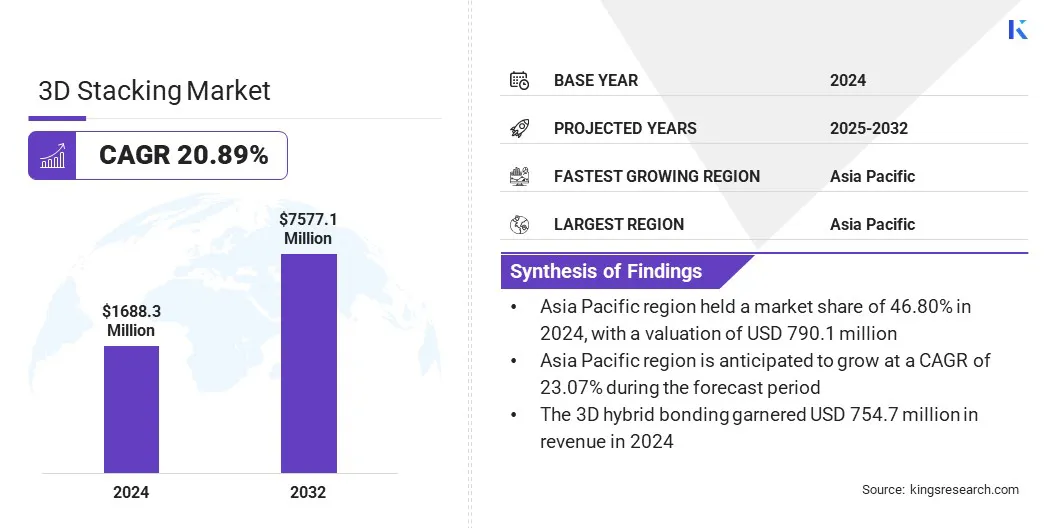
Market growth is propelled by the adoption of advanced multi-die packaging for AI accelerators, which enables the integration of multiple high-performance chips within a single package. This improves processing speed, reduces latency, and enhances energy efficiency for AI and machine learning workloads.
Manufacturers are leveraging innovative interconnects and thermal management solutions to optimize performance and reliability in densely packed architectures. The technology supports scalable and flexible designs, allowing companies to meet the increasing computational demands of next-generation AI applications.
Growing Demand for Next-Generation Custom Accelerators
The 3D stacking market is driven by the growing demand for next-generation custom accelerators, which are essential for high-performance computing, artificial intelligence, and data center applications. 3D stacking enables high-speed processing and energy efficiency by integrating multiple semiconductor layers within a single package, meeting the performance needs of modern accelerators.
This allows manufacturers to achieve higher computational power and reduced latency while maintaining a compact footprint. The demand for enhanced performance in specialized computing applications is accelerating the adoption of 3D stacking technologies across various industries.
Thermal Management Issues in 3D Stacking Devices
A major challenge in the 3D Stacking market is managing heat dissipation in high-density stacked chips. Increased layer density generates more heat, which can reduce device performance and reliability. This limits widespread adoption, especially in high-performance computing and compact electronic devices.
To address this, companies are investing in advanced thermal management solutions, including microfluidic cooling and improved heat-spreading materials. Manufacturers are also optimizing chip architecture and stacking designs to enhance heat dissipation and maintain consistent performance.
Advancements in Layer Transfer Technology
A key trend in the 3D stacking market is the use of ultra-thin transistor layer transfers onto diverse wafers, enabled by advancements in heterogeneous integration. This allows manufacturers to stack diverse semiconductor layers efficiently, improving interconnect density and signal integrity.
It also enables the combination of logic, memory, and specialized chips within a single package, enhancing overall device performance. Companies are adopting this technique to meet the growing demand for compact, high-performance, and energy-efficient electronic devices.
|
Segmentation |
Details |
|
By Method |
Chip-to-Chip, Chip-to-Wafer, Die-to-Die, Die-to-Wafer, Wafer-to-Wafer |
|
By Interconnecting Technology |
3D Hybrid Bonding, 3D TSV (Through-Silicon Via), Monolithic 3D Integration |
|
By Device Type |
Memory Devices, Logic ICs, Imaging & Optoelectronics, LEDs, MEMS/ Sensors, Others |
|
By End-Use Industry |
Consumer Electronics, Communications, Automotive, Manufacturing, Medical Devices & Healthcare, Others |
|
By Region |
North America: U.S., Canada, Mexico |
|
Europe: France, UK, Spain, Germany, Italy, Russia, Rest of Europe |
|
|
Asia-Pacific: China, Japan, India, Australia, ASEAN, South Korea, Rest of Asia-Pacific |
|
|
Middle East & Africa: Turkey, U.A.E., Saudi Arabia, South Africa, Rest of Middle East & Africa |
|
|
South America: Brazil, Argentina, Rest of South America |
Based on region, the market has been classified into North America, Europe, Asia Pacific, Middle East & Africa, and South America.
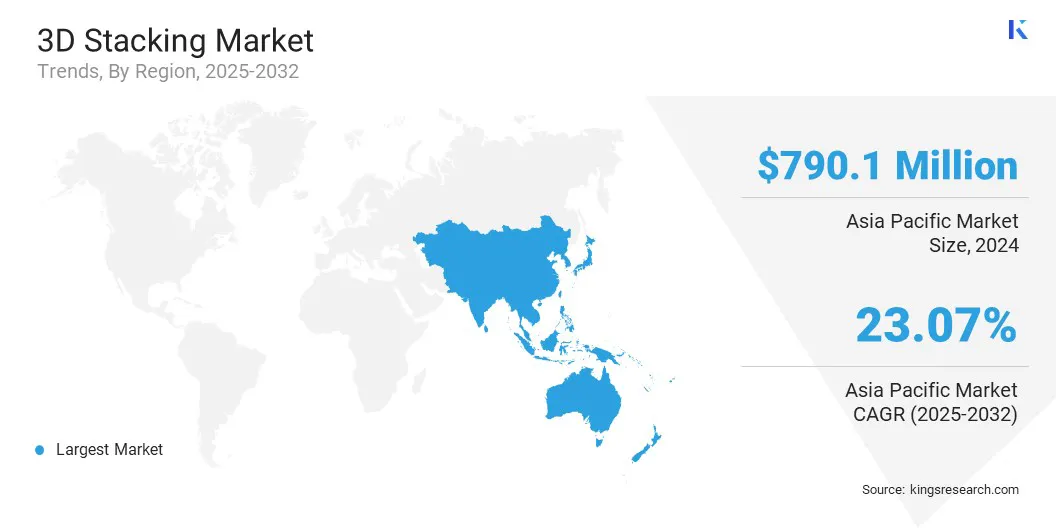
Asia Pacific 3D stacking market share stood at 46.80% in 2024 in the global market, with a valuation of USD 790.1 million. This dominance is due to the presence of large-scale semiconductor manufacturing hubs and high adoption of advanced packaging technologies in countries such as China, Japan, and South Korea.
Semiconductor companies in the region benefit from cost-efficient production, a skilled workforce, and government support for semiconductor infrastructure, driving the broader adoption of 3D stacking solutions.
North America is poised to grow at a CAGR of 19.68% over the forecast period. This growth is driven by strong R&D efforts focused on innovative materials and advanced 3D stacking techniques. Semiconductor companies in the region utilize research facilities and strategic partnerships to improve chip efficiency and density, accelerating adoption in consumer electronics, automotive, and communication sectors.
Key players in the global 3D stacking industry are focusing on enhancing device performance and efficiency through advanced material innovations. Companies are investing in research to develop new materials that reduce chip capacitance, which improves signal integrity and lowers power consumption in stacked logic and DRAM chips.
Manufacturers are implementing complex thermal management solutions to maintain performance stability in high-density 3D structures. Moreover, market players are pursuing strategic collaborations with equipment suppliers and research institutions to accelerate the adoption of these materials and optimize the 3D stacking process for high-performance applications.
Frequently Asked Questions

Over the years, Versha brings over 15 years of experience managing consulting assignments across industries, including Food and Beverage, Consumer Goods, ICT, Aerospace, and more. Her work has spanned diverse sectors. Her cross-domain expertise and adaptability make her a versatile and dependable professional. She is known for her keen business insight and foresight. With sharp analytical skills and a curious mindset, Versha excels at transforming complex data into actionable insights. She has a proven track record of unraveling market dynamics, identifying trends, and delivering tailored solutions to meet client needs. As a skilled leader, Versha has successfully mentored research teams and directed projects with precision, ensuring high-quality outcomes. Her collaborative approach and strategic vision enable her to turn challenges into opportunities and consistently deliver impactful results. Whether analyzing markets, engaging stakeholders, or crafting strategies, Versha draws on her deep expertise and industry knowledge to drive innovation and deliver measurable value.

With over a decade of research leadership across global markets, Ganapathy brings sharp judgment, strategic clarity, and deep industry expertise. Known for precision and an unwavering commitment to quality, he guides teams and clients with insights that consistently drive impactful business outcomes.



.webp&w=128&q=75&dpl=dpl_3pUwJtNgpk6oXgXnK9PBcvvUhHi3)