
Inquire Now
Key Strategic Points
The market involves the development and deployment of devices that convert solar energy into chemical energy through electrochemical reactions. PEC cells use light to trigger processes like water splitting to produce clean fuels such as hydrogen.
Increasing demand for renewable energy solutions, clean fuel production, and sustainable technologies in energy generation is driving the photoelectrochemical (PEC) cell market.
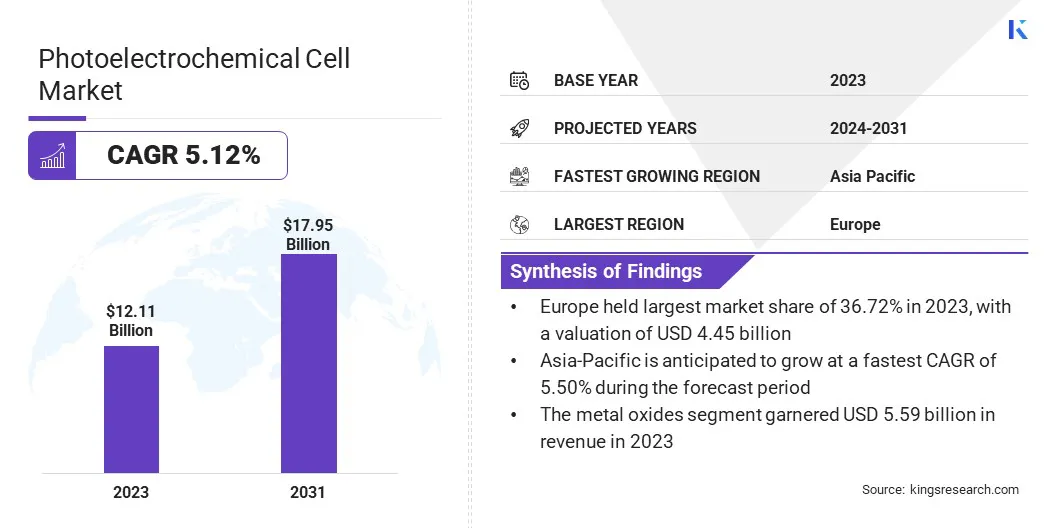
Global photoelectrochemical cell market size was valued at USD 12.11 billion in 2023, which is estimated to be USD 12.65 billion in 2024 and reach USD 17.95 billion by 2031, growing at a CAGR of 5.12% from 2024 to 2031.
The rising demand for clean energy is a key driver for the PEC cell market as nations focus on sustainable energy solutions to combat climate change. PEC cells, which produce hydrogen and solar fuels, are a clean, renewable alternative to traditional energy sources in turn fueling market growth.
Major companies operating in the photoelectrochemical cell industry are Ossila, Binergy Scientific Inc., First Solar, KANOPY, Ascent Solar Technologies, Inc., Panasonic Holdings Corporation, Tandem PV, Inc., Mitsubishi Corporation., TOSHIBA CORPORATION, P3C Technology and Solutions Pvt. Ltd, Oxford Photovoltaics Ltd, Solliance solar research , Saule Technologies, GCL-SI, and Hiking PV Technology Co. Ltd.
The photoelectrochemical (PEC) cell market witnesses advanced energy conversion technologies that utilize sunlight to drive chemical reactions to produce clean energy such as hydrogen.
PEC cells combine solar energy harvesting with electrochemical processes, offering a sustainable solution for renewable fuel production. PEC cells are increasingly recognized for their potential to reduce reliance on fossil fuels and address environmental concerns.
Market Driver
"The Increasing Global Demand for Clean Energy"
The growing emphasis on sustainable energy solutions and reducing carbon emissions is driving the photoelectrochemical cell market. As per the Ministry of New and Renewable Energy, India is advancing toward its 2070 net-zero goal through initiatives like the National Green Hydrogen Mission and PM-KUSUM, fostering a sustainable and inclusive energy future.
The transition to cleaner renewable energy sources has increased interest in PEC cells. as they provide an efficient and sustainable alternative to fossil fuels.
Market Challenge
"Low Durability and Stability of Photoelectrochemical (PEC) Cells"
Enhancing durability and stability of PEC cells remains significant a challenge for PEC cells manufacturers, as they degrade over time, particularly under prolonged sunlight exposure. This affects performance and limits the commercial viability of PEC technology.
However, ongoing research by companies is addressing this by developing more robust materials, such as stable photoelectrodes and protective coatings that can withstand continuous exposure.
Market Trend
"Technological Advancements Driving Growth in the Photoelectrochemical Cell Market"
Technological advancements in the photoelectrochemical (PEC) cell are playing a crucial role in driving market growth. Ongoing research is improving the efficiency of PEC cells with innovations in photoelectrode materials and catalyst development. Additionally, efforts to reduce manufacturing costs by various companies are making PEC technology more commercially viable.
As material science advances, new strategies are enhancing the performance, durability, and scalability of PEC cells. These innovations are driving the broader adoption of PEC technology, accelerating its expansion in the sustainable energy market. .
|
Segmentation |
Details |
|
By Material |
Metal Oxides, Organic Semiconductors, Perovskite-Based Cells |
|
By End-User Industry |
Energy Sector, Environmental Monitoring, Research Institutes, Chemical Industry |
|
By Region |
North America: U.S., Canada, Mexico |
|
Europe: France, UK, Spain, Germany, Italy, Russia, Rest of Europe |
|
|
Asia-Pacific: China, Japan, India, Australia, ASEAN, South Korea, Rest of Asia-Pacific |
|
|
Middle East & Africa: Turkey, UAE, Saudi Arabia, South Africa, Rest of Middle East & Africa |
|
|
South America: Brazil, Argentina, Rest of South America |
Market Segmentation:
Based on region, the global market has been classified into North America, Europe, Asia Pacific, Middle East & Africa, and Latin America.
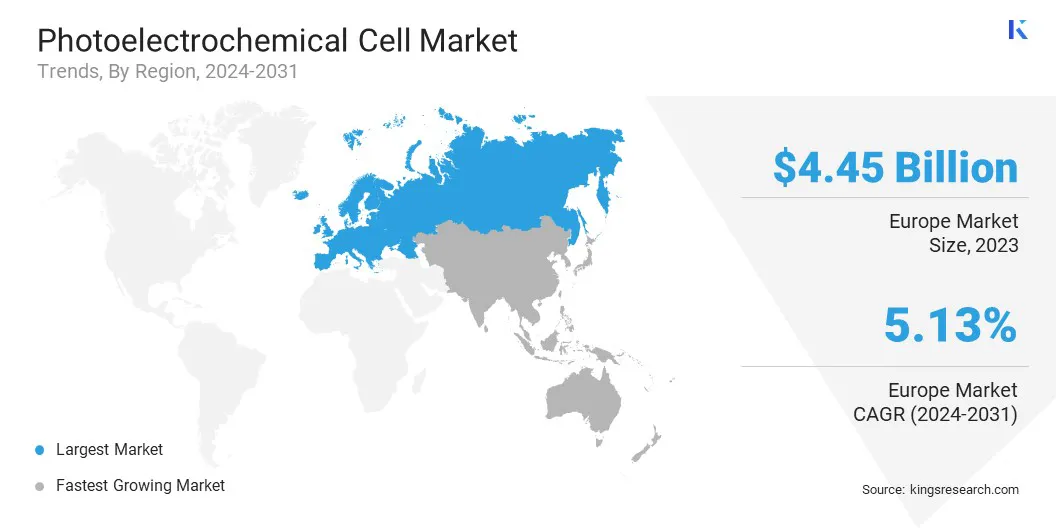
Europe photoelectrochemical cell market share stood around 36.72% in 2023 in the global market, with a valuation of USD 4.45 billion. Europe has established itself as a dominant region in the photoelectrochemical (PEC) cell market, supported by strong government initiatives for renewable energy.
The European Union's focus on reducing carbon emissions and investing in green technologies has led to significant advancements in PEC cell research and development across the region. Countries like Germany, the Netherlands, and France are leading in solar energy utilization and hydrogen production, with PEC cells playing a key role in achieving Europe's renewable energy goals.
Asia Pacific is expected to experience significant growth at a robust CAGR of 5.50% over the forecast period. Asia Pacific is emerging as the fastest-growing region in the photoelectrochemical (PEC) cell market, owing to rapid industrialization, increasing energy demand, and a shift toward sustainable energy solutions.
Countries like China, Japan, and India are heavily investing in PEC technology to enhance solar energy utilization and hydrogen production. The region's manufacturing capabilities along with government policies promoting clean energy, are accelerating the adoption of PEC cells, positioning Asia Pacific as a major player in the global market expansion.
The global photoelectrochemical cell market is characterized by a large number of participants. Innovations in photoelectrochemical cells improve their efficiency, durability, and cost-effectiveness. Companies are developing advanced materials, such as novel semiconductors and enhanced catalysts, to boost energy conversion rates.
Recent launches introduce new, scalable manufacturing techniques, including inkjet printing and advanced coatings, to optimize performance. These developments aim to make solar-driven hydrogen production more viable and accessible for widespread commercial use.
Recent Developments (Expansion/Innovation)
Frequently Asked Questions

Sharmishtha is a budding research analyst with a strong commitment to achieving excellence in her field. She brings a meticulous approach to every project, delving deep into details to ensure comprehensive and insightful outcomes. Passionate about continuous learning, she strives to enhance her expertise and stay ahead in the dynamic world of market research. Beyond work, Sharmishtha enjoys reading books, spending quality time with friends and family, and engaging in activities that foster personal growth. Her dedication to precision ensures that no critical detail is overlooked, and her analytical rigor consistently produces reliable, evidence-based conclusions. Sharmishtha's proactive curiosity drives her to explore emerging research methodologies, which she readily applies to deliver fresh perspectives on complex market questions. Her collaborative nature and openness to constructive feedback make her a dependable team player. She balances technical accuracy with clear communication, ensuring her insights are actionable for clients and stakeholders alike.

Ganapathy Subramaniam Suresh
With over a decade of research leadership across global markets, Ganapathy brings sharp judgment, strategic clarity, and deep industry expertise. Known for precision and an unwavering commitment to quality, he guides teams and clients with insights that consistently drive impactful business outcomes.