
Inquire Now
Key Strategic Points
The market involved the production and sale of organic acids, which are carbon-based compounds with acidic properties. These acids occur naturally in plants and animals, or are synthetically produced through chemical or biological processes.
The report provides a comprehensive analysis of key drivers, emerging trends, and the competitive landscape expected to influence the market over the forecast period.
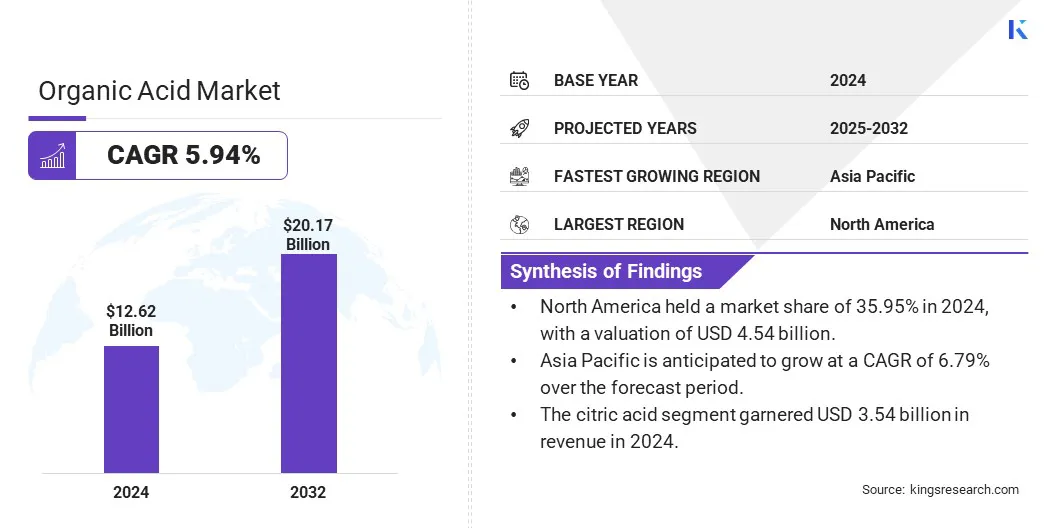
Global organic acid market size was valued at USD 12.62 billion in 2024, which is estimated to USD 13.32 billion in 2025 and reach USD 20.17 billion by 2032, growing at a CAGR of 5.94% from 2025 to 2032.
Growing consumer demand for functional beverages containing antioxidants and antimicrobial compounds is driving market expansion. The associated health benefits are fostering innovation to cater to the needs of wellness-oriented consumers.
Major companies operating in the organic acid industry are Cargill, Incorporated. , BASF, Henan Jindan lactic acid Technology Co., Ltd., ADM , Eastman Chemical Company , Corbion NV, dsm-firmenich, Tate & Lyle , AFYREN, LobaChemie Pvt. Ltd. , Otto Chemie Pvt. Ltd., Showa Kako Corp., Central Drug House, Selko, and KANI OVERSEAS CORPORATION.
The market is experiencing steady growth, mainly due to the increasing demand for sustainable and bio-based chemical alternatives across industries such as food, pharmaceuticals, agriculture, and manufacturing. Rising environmental concerns and regulations are promtping industries to adopt greener production methods, boosting the appeal of biologically derived acids.
Technological advancements in microbial fermentation and metabolic engineering are further enhancing production efficiency and cost-effectiveness. The market is becoming increasingly competitive, with growing investment in research and commercialization of bio-based organic acids.
Market Driver
Rising Consumer Interest in Functional Beverages
Increasing consumer awareness of health and wellness is boosting demand for functional beverages containing natural antioxidants and antimicrobial agents. Organic acids, key to these benefits, enhance the nutritional profile of such drinks.
This trend is prompting manufacturers to innovate and incorporate organic acids into beverages, meeting consumer preferences for products that support immunity and overall health. The market is experiencing significant growth, fueled by the the shift toward natural, bioactive ingredients.
Market Challenge
Raw Material Variability
A major challenge restraining the expansion of the organic acid market is the variability of raw materials, particularly when using agricultural byproducts or renewable feedstocks. This inconsistency affects product quality, purity, and yield, reducing reliability for industrial use.
This challenge can be addressed through the implementation of standardized pre-processing protocols and quality control measures for raw inputs. Additionally, using advanced microbial strains and optimized fermentation conditions can help stabilize output and ensure consistent product performance, thereby strenghthening market confidence in bio-based solutions.
Market Trend
Rising Shift Toward Circular Economy
A key trend influencing the market is the rising shift toward circular economy models, where industrial CO₂ emissions are converted into valuable chemical inputs.
This reduces greenhouse gas emissions and provides a sustainable source for producing high-value organic acids. Through advanced biotechnological and electrochemical methods, industries are reducing reliance on fossil-based feedstocks, supporting environmental goals and enhancing resource efficiency.
|
Segmentation |
Details |
|
By Type |
Citric AcidLactic Acid, Tartaric Acid, Acetic Acid, Others |
|
By Application |
Food & Beverages, Pharmaceutical, Animal Feed, Textile & Adhesive, Others |
|
By Region |
North America: U.S., Canada, Mexico |
|
Europe: France, UK, Spain, Germany, Italy, Russia, Rest of Europe |
|
|
Asia-Pacific: China, Japan, India, Australia, ASEAN, South Korea, Rest of Asia-Pacific |
|
|
Middle East & Africa: Turkey, U.A.E., Saudi Arabia, South Africa, Rest of Middle East & Africa |
|
|
South America: Brazil, Argentina, Rest of South America |
Market Segmentation
Based on region, the global market has been classified into North America, Europe, Asia Pacific, Middle East & Africa, and South America.
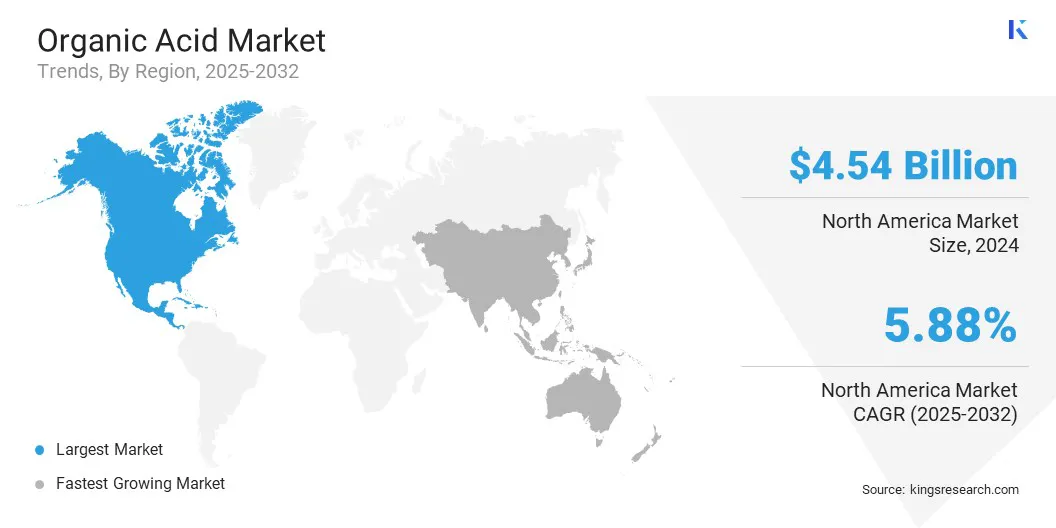
The North America organic acid market share stood at around 35.95% in 2024, valued at USD 4.54 billion. This dominance is reinforced by strong demand from the food, pharmaceutical, and personal care industries. The regional market benefits from advanced biotechnological capabilities, robust R&D infrastructure, and supportive regulatory frameworks promoting sustainable and bio-based products.
Rising health awareness, preference for clean-label ingredients, and increasing adoption of organic acids in packaged foods and beverages further fuel domestic market growth. Additionally, regional investments in green chemistry and circular economy initiatives continue to boost production and innovation in organic acids.
The Asia-Pacific organic acid industry is estimated to grow at a CAGR of 6.79% over the forecast period.This growth is propelled by rapid industrialization, expanding food and beverage sectors, and increasing adoption of sustainable chemical processes. This expansion is further fostered by abundant agricultural resources and government initiatives promoting green technologies.
Rising consumer awareness regarding health and environmentally friendly products is fueling this demand. Additionally, advancements in biotechnology and fermentation technologies across key Asian economies are accelerating the production of bio-based organic acids, supporting regional market expansion.
Companies in the organic acid market are focusing on expanding production capacities and investing in research to develop eco-friendly and sustainable manufacturing processes. Many are adopting green chemistry principles to reduce environmental impact and improve product efficiency.
Strategic collaborations and mergers are enhancing technological capabilities and market reach. Additionally, firms are diversifying product portfolios to cater to growing demand from food, pharmaceuticals, and bio-based industries. Emphasis on recycling and circular economy models is driving innovation and market competitiveness.
Recent Developments (Partnerships)
Frequently Asked Questions

Sharmishtha is a budding research analyst with a strong commitment to achieving excellence in her field. She brings a meticulous approach to every project, delving deep into details to ensure comprehensive and insightful outcomes. Passionate about continuous learning, she strives to enhance her expertise and stay ahead in the dynamic world of market research. Beyond work, Sharmishtha enjoys reading books, spending quality time with friends and family, and engaging in activities that foster personal growth. Her dedication to precision ensures that no critical detail is overlooked, and her analytical rigor consistently produces reliable, evidence-based conclusions. Sharmishtha's proactive curiosity drives her to explore emerging research methodologies, which she readily applies to deliver fresh perspectives on complex market questions. Her collaborative nature and openness to constructive feedback make her a dependable team player. She balances technical accuracy with clear communication, ensuring her insights are actionable for clients and stakeholders alike.

Ganapathy Subramaniam Suresh
With over a decade of research leadership across global markets, Ganapathy brings sharp judgment, strategic clarity, and deep industry expertise. Known for precision and an unwavering commitment to quality, he guides teams and clients with insights that consistently drive impactful business outcomes.