
Inquire Now
Key strategic points
The market focuses on systems and devices that regulate heating, ventilation, and air conditioning to ensure indoor comfort and energy efficiency. These controls include sensors, thermostats, controllers, and actuators that monitor temperature, humidity, airflow, and pressure.
Applications extend to smart buildings, data centers, and manufacturing units, where precise environmental control is critical. The report provides a comprehensive analysis of key drivers, emerging trends, and the competitive landscape expected to influence the market over the forecast period.
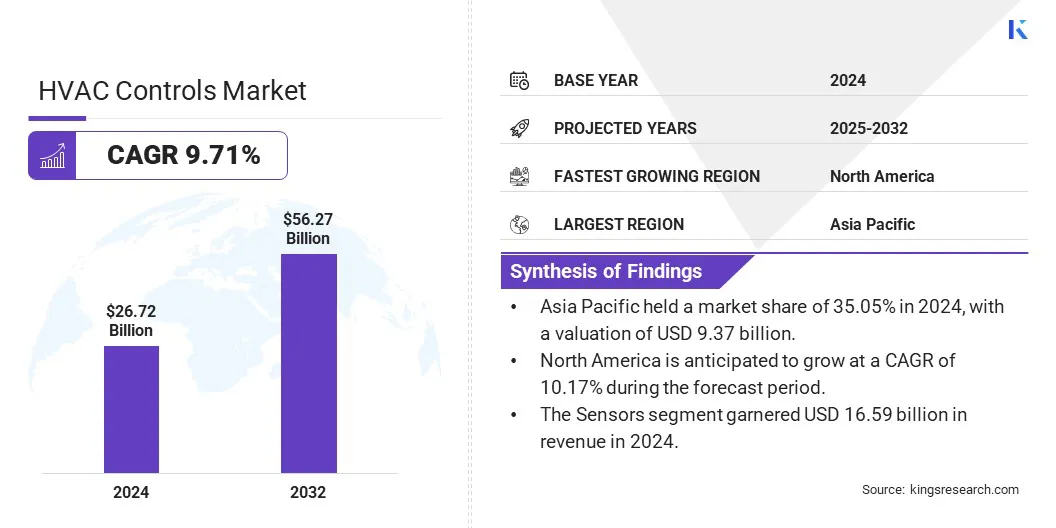
The global HVAC controls market size was valued at USD 26.72 billion in 2024 and is projected to grow from USD 29.26 billion in 2025 to USD 56.27 billion by 2032, exhibiting a CAGR of 9.71% during the forecast period. The growth of the market is driven by the expansion of smart building infrastructure and the integration of Building Automation Systems (BAS). These trends enhance energy efficiency and operational control, making HVAC systems more responsive and cost-effective, which significantly supports overall market growth.
Major companies operating in the HVAC controls industry are Honeywell International Inc., Johnson Controls, Siemens, Schneider Electric, Emerson Electric Co., Lennox International Inc., Trane, Delta Electronics, Inc., Abbott, Robert Bosch GmbH, Danfoss A/S, Eaton, Mitsubishi Electric Corporation, Rheem Manufacturing Company, and BELIMO AIRCONTROLS (USA), Inc.
The growing focus on reducing energy consumption in buildings is fueling the growth of the market. HVAC control systems enable the precise regulation of temperature, humidity, and airflow, optimizing energy usage. Businesses and homeowners are adopting advanced control technologies to cut down their energy bills and meet regulatory standards. The need for sustainable solutions across residential, commercial, and industrial sectors continues to support the expansion of the market.
Market Driver
Expansion of Smart Building Infrastructure
The rapid development of smart buildings is contributing significantly to the growth of the market. These buildings rely on automated systems to improve energy management and occupant comfort. HVAC controls play a crucial role in these environments by integrating with IoT platforms and building management systems.
With governments and developers investing in intelligent infrastructure, the demand for responsive and connected HVAC control solutions is growing steadily across global markets.
Market Challenge
High Initial Investment and Integration Complexity
A significant challenge limiting the HVAC controls market is the high upfront cost and complexity involved in integrating advanced control systems into existing buildings. Several facility owners hesitate to invest due to concerns regarding installation expenses and disruptions.
To address this, key players are developing scalable and modular solutions that simplify installation and reduce costs. Additionally, providers offer flexible financing options and comprehensive support services to ease the transition. These efforts help in increasing adoption by making advanced HVAC controls more accessible and manageable for new constructions and retrofits.
Market Trend
Integration of Building Automation Systems (BAS)
The widespread implementation of building automation systems is advancing the growth of the market. HVAC controls are critical components of BAS, which allow the centralized management of heating, ventilation, and air conditioning across large facilities.
Facility managers are prioritizing automated controls to improve energy efficiency, streamline maintenance, and meet compliance targets. This increasing reliance on automation in commercial and institutional buildings is fueling demand for intelligent HVAC control solutions.
|
Segmentation |
Details |
|
By Component |
Sensors, Controllers & Controlled Equipment |
|
By Type |
Manual, Smart & Automated |
|
By Implementation |
New Construction, Retrofit |
|
By Application |
Residential, Commercial, Industrial |
|
By Region |
North America: U.S., Canada, Mexico |
|
Europe: France, UK, Spain, Germany, Italy, Russia, Rest of Europe |
|
|
Asia-Pacific: China, Japan, India, Australia, ASEAN, South Korea, Rest of Asia-Pacific |
|
|
Middle East & Africa: Turkey, U.A.E., Saudi Arabia, South Africa, Rest of Middle East & Africa |
|
|
South America: Brazil, Argentina, Rest of South America |
Market Segmentation
Based on region, the global market has been classified into North America, Europe, Asia Pacific, Middle East & Africa, and South America.
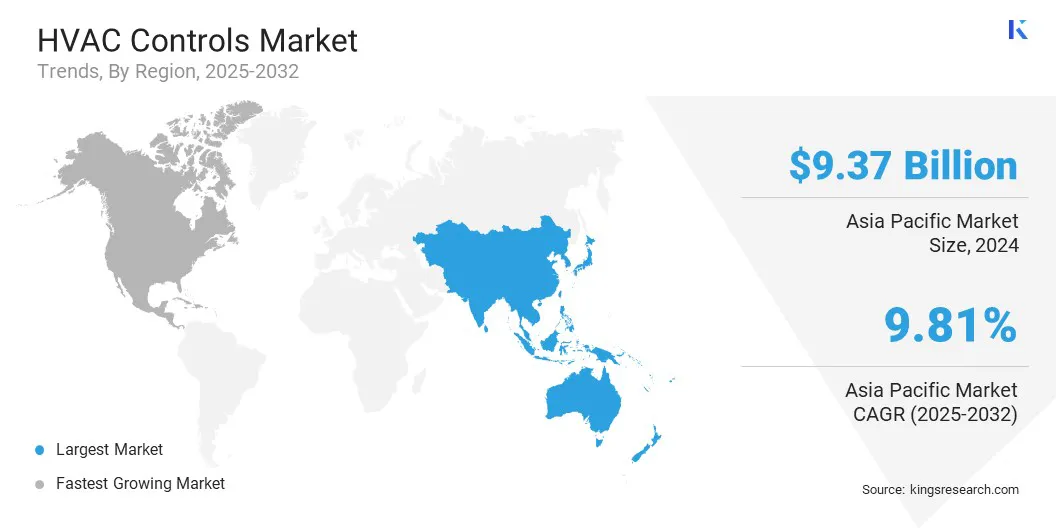
The Asia Pacific HVAC controls market share stood at around 35.05% in 2024 in the global market, with a valuation of USD 9.37 billion. Major cities across Asia Pacific are experiencing the accelerated development of urban infrastructure, including high-rise buildings, airports, shopping centers, and industrial parks.
These projects demand integrated HVAC control systems to ensure energy efficiency and indoor comfort, contributing to the growth of the regional market.
Moreover, several companies in the region are investing in the local development and manufacturing of HVAC controls, offering cost-effective and customized solutions. The availability of region-specific technologies and scalable systems is improving adoption among small and mid-sized facilities, expanding the reach of the market.
The North America HVAC controls industry is poised for significant growth at a robust CAGR of 10.17% over the forecast period. North America has implemented strict building energy codes and environmental standards, including ASHRAE guidelines and ENERGY STAR certifications.
These frameworks require advanced HVAC systems that are capable of optimizing energy use. To meet compliance and avoid penalties, building owners are investing in smart HVAC control solutions, driving the growth of the market in the region. Furthermore, the rise in cloud services and data-driven operations has led to rapid growth in data center construction across North America.
These facilities need precise temperature and humidity control, supported by advanced HVAC systems with automated control features. The growing demand for thermal management in digital infrastructure is boosting the market.
Major HVAC controls market players are focusing on strategies like launching innovative product lines and forming strategic partnerships to strengthen their position and drive growth. Introducing advanced solutions that comply with evolving environmental regulations helps companies meet customer demands for efficiency and sustainability.
These efforts support the transition to greener technologies, enhancing product portfolios while addressing regulatory requirements. Such proactive moves contribute significantly to expanding the market by offering more efficient and environmentally friendly HVAC control options.
Recent Developments (Product Launches)
Frequently Asked Questions

Sunanda is a proficient research analyst with strong cross-domain expertise, excelling in identifying market trends and delivering insightful analyses across various industries, including consumer goods, food & beverages, healthcare, and more. Her ability to connect insights from diverse sectors enables her to offer actionable recommendations that support strategic decision-making in a range of business contexts. Sunanda's research is driven by thorough data analysis and her commitment to providing relevant, data-driven insights. Her keen eye for patterns allows her to spot emerging opportunities before they become mainstream. Sunanda's synthesis of cross-sector learnings often reveals unconventional solutions that clients find invaluable. She adapts her analytical frameworks to suit each industry's unique nuances, ensuring reports are both accurate and contextually relevant. Clients appreciate her ability to deliver crisp, actionable findings under tight deadlines, consistently exceeding expectations with her thoroughness and insight.

With over a decade of research leadership across global markets, Ganapathy brings sharp judgment, strategic clarity, and deep industry expertise. Known for precision and an unwavering commitment to quality, he guides teams and clients with insights that consistently drive impactful business outcomes.