
Inquire Now
Key Strategic Points
The market refers to the development and production, of vehicles powered by fuel cells. A fuel cell vehicle (FCV) uses a hydrogen fuel cell to generate electricity, which powers an electric motor.
FCVs generate their own electricity on the go by combining hydrogen from the fuel tank and oxygen from the air contrary to battery electric vehicles (BEVs), which store electricity in batteries. The report provides a comprehensive analysis of key drivers, emerging trends, and the competitive landscape expected to influence the market over the forecast period.
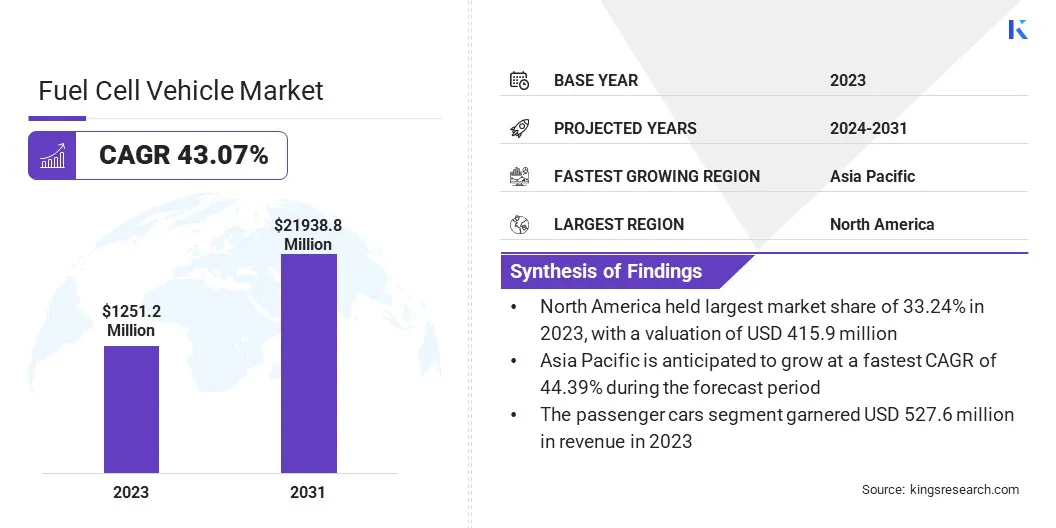
Global fuel cell vehicle Market size was valued at USD 1251.2 million in 2023, which is estimated to be valued at USD 1788.4 million in 2024 and reach USD 21938.8 million by 2031, growing at a CAGR of 43.07% from 2024 to 2031.
Decarbonizing long-haul transport is a key driver for the market, as hydrogen-powered trucks offer high range, fast refueling, and low emissions, ideal for heavy-duty operations.
Major companies operating in the fuel cell vehicle industry are Mercedes-Benz Group, Honda Motor Co., Ltd., Nikola Corporation, TOYOTA MOTOR CORPORATION, Hyundai Motor Company, Ballard Power Systems, AB Volvo, General Motors, BMW AG, RIVERSIMPLE, Tata Motors Limited, Stellantis NV, Symbio, Hyzon, and Hyperion Motors.
Increasing environmental regulations, advancements in hydrogen technology, and supportive government policies are driving the expansion of the market. As infrastructure and production scale improve, FCVs are emerging as a viable solution for sustainable mobility, particularly in long-range and heavy-duty applications.
Market Driver
"Decarbonization of Long-Haul Transport"
The push to decarbonize long-haul and heavy-duty transport is a significant growth driver for the fuel cell vehicle market. Traditional battery-electric vehicles often face limitations in range and charging time, making them less practical for long-distance logistics.
In contrast fuel cell vehicles provide extended range, fast refueling, and strong performance under heavy loads. These advantages position hydrogen solutions as an ideal fit for fleet operators and logistics companies aiming to meet strict emission targets without compromising operational efficiency.
Market Challenge
"Public Awareness and Acceptance"
Public awareness and acceptance pose a significant challenge for the fuel cell vehicle market. Many consumers and fleet operators remain unfamiliar with hydrogen technology, leading to hesitation in adoption. Concerns about the safety of hydrogen, its reliability, and the long-term viability of the technology are common.
To overcome this, educational campaigns, demonstrations, and transparent communication about the technology's benefits and safety measures are essential. Increasing visibility through pilot programs, real-world case studies, and government incentives can help build trust and drive wider acceptance.
Market Trend
"Automaker Commitments"
Automaker commitments to sustainability have emerged as a prominent trend in the fuel cell vehicle market. Major automotive manufacturers are actively expanding their portfolios to include fuel cell electric vehicles (FCEVs) in response to tightening global emission norms and long-term climate goals.
Companies are investing heavily in R&D, pilot programs, and partnerships to advance fuel cell technology and infrastructure. This strategic shift reflects a growing recognition of hydrogen's role in achieving zero-emission transportation, especially for commercial and long-haul applications where battery solutions are less practical.
|
Segmentation |
Details |
|
By Range |
0-250 Miles, 251-500 Miles, Above 500 Miles |
|
By Vehicle |
Passenger Cars, Light Commercial Vehicle, Heavy Commercial Vehicle |
|
By Region |
North America: U.S., Canada, Mexico |
|
Europe: France, UK, Spain, Germany, Italy, Russia, Rest of Europe |
|
|
Asia-Pacific: China, Japan, India, Australia, ASEAN, South Korea, Rest of Asia-Pacific |
|
|
Middle East & Africa: Turkey, U.A.E., Saudi Arabia, South Africa, Rest of Middle East & Africa |
|
|
South America: Brazil, Argentina, Rest of South America |
Market Segmentation:
Based on region, the market has been classified into North America, Europe, Asia Pacific, Middle East & Africa, and South America.
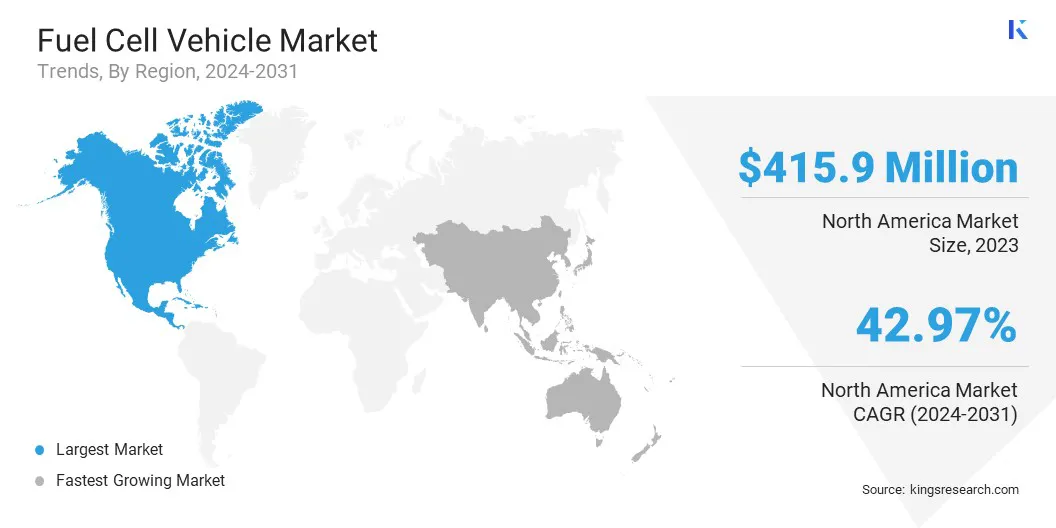
North America fuel cell vehicle market share stood at around 33.24% in 2023 in the global market, with a valuation of USD 415.9 million. This leadership is attributed to strong government support through incentives, infrastructure investments, and emission regulations promoting clean energy transportation.
The presence of key industry players, advancements in hydrogen production, and growing adoption of zero-emission vehicles further drive regional growth. Additionally, rising demand for sustainable mobility solutions in passenger and commercial segments drives the market growth in North America.
Asia Pacific fuel cell vehicle industry is poised for significant growth at a robust CAGR of 44.39% over the forecast period. The Asia-Pacific region is emerging as the fastest-growing market for fuel cell vehicles, driven by strong government support, increasing investments in hydrogen infrastructure, and rising environmental concerns.
Rapid urbanization, coupled with a growing demand for clean mobility solutions, is accelerating the adoption of alternative fuel technologies in this region. Governments in this region are actively implementing policies that promote hydrogen production and distribution, and boosting public-private partnerships to scale up fuel cell vehicle deployment. This ecosystem is driving the growth of the market in Asia Pacific.
Companies in the fuel cell vehicle industry are focusing on advancing fuel cell technology to improve efficiency, reduce costs, and expand their product offerings. Automakers are investing heavily in research and development to enhance the performance and scalability of fuel cell systems.
Additionally, market players are collaborating with governments and industry stakeholders to build the necessary infrastructure for hydrogen refueling stations, enabling broader adoption of fuel cell electric vehicles (FCEVs).
Recent Developments (Testing & Development)
Frequently Asked Questions

Sharmishtha is a budding research analyst with a strong commitment to achieving excellence in her field. She brings a meticulous approach to every project, delving deep into details to ensure comprehensive and insightful outcomes. Passionate about continuous learning, she strives to enhance her expertise and stay ahead in the dynamic world of market research. Beyond work, Sharmishtha enjoys reading books, spending quality time with friends and family, and engaging in activities that foster personal growth. Her dedication to precision ensures that no critical detail is overlooked, and her analytical rigor consistently produces reliable, evidence-based conclusions. Sharmishtha's proactive curiosity drives her to explore emerging research methodologies, which she readily applies to deliver fresh perspectives on complex market questions. Her collaborative nature and openness to constructive feedback make her a dependable team player. She balances technical accuracy with clear communication, ensuring her insights are actionable for clients and stakeholders alike.

Ganapathy Subramaniam Suresh
With over a decade of research leadership across global markets, Ganapathy brings sharp judgment, strategic clarity, and deep industry expertise. Known for precision and an unwavering commitment to quality, he guides teams and clients with insights that consistently drive impactful business outcomes.