
Inquire Now
Key Strategic Points
The electric tractor market involves manufacturing, selling, and adopting electric-powered tractors for agricultural use. These tractors are powered by batteries or other electric energy sources, offering environmentally friendly alternatives to traditional diesel-powered tractors. The market is driven by the demand for sustainable farming, reduced emissions, and lower operational costs in agriculture.
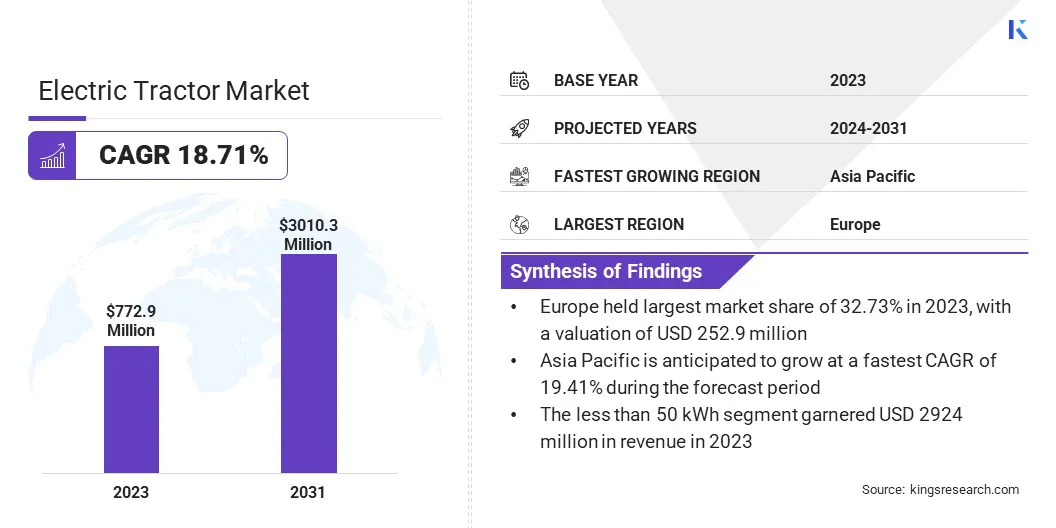
The global electric tractor market size was valued at USD 772.9 million in 2023, which is estimated to be valued at USD 906.0 million in 2024 and reach USD 3010.3 million by 2031, growing at a CAGR of 18.71% from 2024 to 2031.
Environmental concerns are driving the shift toward electric tractors, as they help reduce carbon emissions and reliance on fossil fuels. Growing awareness of climate change and the need to adopt sustainable farming practices are encouraging eco-friendly alternatives, like electric-powered machinery.
Major companies operating in the global electric tractor industry are Kubota Corporation, CNH Industrial N.V., Motivo Engineering, SOLECTRAC, Tractors and Farm Equipment Limited, TADUS GmbH, AGCO Corporation, Monarch Tractor, Murugappa Group, AutoNXT Automation Pvt. Ltd., VST TRACTORS, ZY Elektrik Traktör Sanayi ve Ticaret A.Ş, Sonalika, Alke, and BULLWORK MOBILITY.
The market is evolving as agriculture shifts toward more sustainable, energy-efficient machinery. Electric tractors are gaining traction, due to their lower environmental impact.
The market offers a diverse range of products, including small, medium, and large tractors. These machines are increasingly being adopted in various farming sectors, such as crop production, livestock, and horticulture. The market spans both developed and emerging economies, with manufacturers focusing on improving battery performance, charging infrastructure, and cost efficiency to meet evolving demand.
Market Driver
Sustainability
Sustainability is a key driver of the electric tractor market as farmers and companies increasingly prioritize eco-friendly practices. The rising demand for sustainable farming solutions aligns with the need to reduce greenhouse gas emissions, minimize environmental impact, and conserve resources.
Electric tractors, with their zero-emission engines and lower operational costs, provide an effective way to achieve sustainability in farming. Electric tractors are seen as an essential tool in promoting greener, more efficient agricultural practices globally as environmental awareness grows.
Market Challenge
Battery Range Challenge
A major challenge faced by the electric tractor market is the limited battery range, which affects the tractor's operational hours, particularly for larger agricultural operations. Extended use in the field can require frequent recharging, impacting productivity.
A solution lies in the development of more efficient and higher-capacity batteries, as well as the implementation of fast-charging systems. Additionally, creating a robust charging infrastructure in rural areas can ensure seamless operation and reduced downtime, enhancing overall efficiency and reliability in the market.
Market Trend
Technological Advancements
Technological advancements in battery efficiency and electric power systems are transforming the electric tractor market. With innovations such as longer-lasting batteries, faster charging capabilities, and improved energy management systems, electric tractors are becoming more practical for daily agricultural use. These advancements not only extend the operational range of electric tractors but also enhance their overall performance and reliability.
As manufacturers continue to refine these technologies, electric tractors are poised to offer farmers more efficient, cost-effective, and sustainable alternatives to traditional fuel-powered machinery.
|
Segmentation |
Details |
|
By Propulsion |
Battery, Hybrid, Hydrogen |
|
By Capacity |
Less than 50 kWh, 51-100 kWh, Above 100 kWh |
|
By Application |
Agriculture, Utility, Industrial |
|
By Region |
North America: U.S., Canada, Mexico |
|
Europe: France, UK, Spain, Germany, Italy, Russia, Rest of Europe |
|
|
Asia Pacific: China, Japan, India, Australia, ASEAN, South Korea, Rest of Asia Pacific |
|
|
Middle East & Africa: Turkey, UAE, Saudi Arabia, South Africa, Rest of Middle East & Africa |
|
|
South America: Brazil, Argentina, Rest of South America |
Market Segmentation:
Based on region, the global market has been classified into North America, Europe, Asia Pacific, Middle East & Africa, and Latin America.
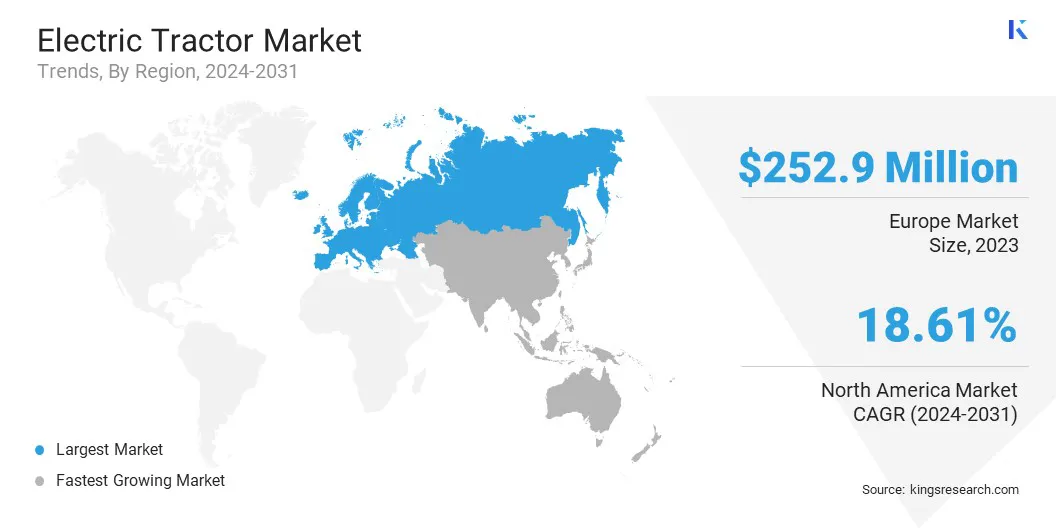
Europe accounted for a electric tractor market share of around 32.73% in 2023, with a valuation of USD 252.9 million. Europe continues to lead the market, due to the strong regulatory push for sustainability and carbon-neutral farming practices.
The European Union's commitment to reducing greenhouse gas emissions and promoting eco-friendly agriculture has driven the demand for electric tractors in the region.
Several European countries offer incentives for adopting green technologies, further enhancing the appeal of electric tractors for both small and large-scale farmers. The shift toward clean energy and precision farming is expected to maintain Europe’s dominance in the market.
The electric tractor industry in Asia Pacific is poised for significant growth at a robust CAGR of 19.41% over the forecast period. Asia Pacific is expected to register the highest growth rate in the market, due to rapid technological advancements, increasing agricultural mechanization, and rising environmental concerns.
Countries like China and India are investing in sustainable farming solutions, offering significant opportunities for the adoption of electric tractors. The need to reduce emissions in densely populated agricultural sectors and improve farm productivity will drive the market, positioning Asia Pacific as the fastest-growing region globally.
The global electric tractor market is characterized by a large number of participants, including established corporations and rising organizations. Companies have introduced smart electric tractors equipped with advanced technologies like autonomous driving, IoT integration, and enhanced battery efficiency.
These tractors offer zero emissions, reduced operational costs, and improved productivity, aligning with the growing demand for sustainable farming practices. With innovations like real-time monitoring and autonomous capabilities, these tractors are revolutionizing the agricultural sector, enhancing both efficiency and environmental sustainability.
Recent Developments (Launch/Partnership)
Frequently Asked Questions

Sharmishtha is a budding research analyst with a strong commitment to achieving excellence in her field. She brings a meticulous approach to every project, delving deep into details to ensure comprehensive and insightful outcomes. Passionate about continuous learning, she strives to enhance her expertise and stay ahead in the dynamic world of market research. Beyond work, Sharmishtha enjoys reading books, spending quality time with friends and family, and engaging in activities that foster personal growth. Her dedication to precision ensures that no critical detail is overlooked, and her analytical rigor consistently produces reliable, evidence-based conclusions. Sharmishtha's proactive curiosity drives her to explore emerging research methodologies, which she readily applies to deliver fresh perspectives on complex market questions. Her collaborative nature and openness to constructive feedback make her a dependable team player. She balances technical accuracy with clear communication, ensuring her insights are actionable for clients and stakeholders alike.

With over a decade of research leadership across global markets, Ganapathy brings sharp judgment, strategic clarity, and deep industry expertise. Known for precision and an unwavering commitment to quality, he guides teams and clients with insights that consistently drive impactful business outcomes.