
Inquire Now
Key Strategic Points
The market encompasses the production and use of positive displacement pumps that utilize a flexible diaphragm to transfer fluids. These pumps are engineered to handle a wide range of viscosities, aggressive chemicals, slurries, and abrasive materials, making them vital in industries such as pharmaceuticals, water treatment, oil and gas, food processing, and chemicals.
Their compact build and capacity to handle solids make them suitable for both stationary and mobile operations. The report outlines the primary drivers of market growth, along with an in-depth analysis of emerging trends and evolving regulatory frameworks shaping the industry's trajectory.
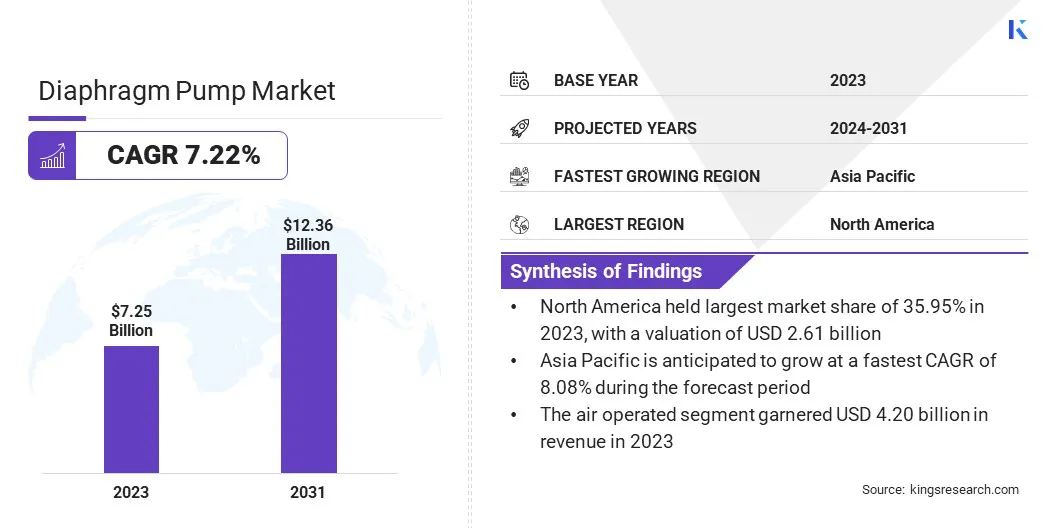
The global diaphragm pump market size was valued at USD 7.25 billion in 2023 and is projected to grow from USD 7.59 billion in 2024 to USD 12.36 billion by 2031, exhibiting a CAGR of 7.22% during the forecast period.
Market growth is primarily supported by rising demand across chemical processing industries, where precise fluid handling and resistance to aggressive media are essential.
Additionally, advancements in pumping technologies and materials, such as the integration of corrosion-resistant polymers and smart control systems, are enhancing efficiency and expanding industrial applicability.
Major companies operating in the diaphragm pump ndustry are IDEX, Yamada Corporation, PSG Dover, Graco, Sandpiper Group Parent Company Inc., Xylem Inc., Wanner Engineering, Inc., Flowserve Corporation, Ingersoll Rand (ARO), Wastecorp Pumps, Timmer GmbH, LIGAO PUMP TECHNOLOGY, Verder Liquids, Atlas Copco, and Grundfos Holding A/S.
The adoption of automation and smart factory infrastructure is highlighting the need for digitally controlled pumping solutions, boosting market growth. Modern diaphragm pumps integrated with IoT sensors, flow monitoring systems, and real-time diagnostics offer improved operational visibility and predictive maintenance.
These smart capabilities enable seamless integration with PLCs and SCADA systems, enhancing plant productivity and reducing downtime. The shift toward digital transformation in manufacturing is accelerating the growth of the market.
Market Driver
"Rising Demand Across Chemical Processing Industries"
Diaphragm pumps are widely used in chemical manufacturing and processing due to their compatibility with aggressive chemicals, acids, and solvents. Their leak-free and explosion-proof design meets safety standards in hazardous environments.
Growing investments in chemical plants and the rising production of specialty chemicals, polymers, and industrial coatings are creating strong demand for reliable, high-performance pumping systems, thereby fueling the growth of diaphragm pump market.
Market Challenge
"Operational Downtime and Maintenance Complexity"
A significant challenge hindering the growth of the diaphragm pump market is the operational downtime caused by frequent maintenance and component wear, particularly in abrasive or chemically aggressive environments. This impacts productivity and increases long-term operational costs for end users.
To address this challenge, companies are developing diaphragm pumps with improved wear-resistant materials, modular designs for faster servicing, and predictive maintenance features integrated with smart monitoring systems.
These efforts aim to reduce unscheduled downtime, enhance pump reliability, and ensure efficient long-term performance, supporting broader adoption across demanding industrial applications.
Market Trend
"Advancement in Pumping Technologies and Materials"
Technological improvements in pump design, such as electrically-operated double diaphragm (EODD) systems and smart pump controls, are contributing to the growth of the diaphragm pump market. The use of corrosion-resistant thermoplastics and elastomers enhances durability and reduces operational downtime.
Manufacturers are focusing on developing energy-efficient and compact models to meet space constraints in process facilities. These innovations enhance product appeal by supporting operational efficiency and cost optimization across industries.
|
Segmentation |
Details |
|
By Operation |
Single Acting, Double Acting |
|
By Mechanism |
Air Operated, Electrical Operated |
|
By End Use |
Water & Wastewater, Oil & Gas, Chemicals, Pharmaceuticals, Food & Beverages, Others |
|
By Region |
North America: U.S., Canada, Mexico |
|
Europe: France, UK, Spain, Germany, Italy, Russia, Rest of Europe |
|
|
Asia-Pacific: China, Japan, India, Australia, ASEAN, South Korea, Rest of Asia-Pacific |
|
|
Middle East & Africa: Turkey, U.A.E., Saudi Arabia, South Africa, Rest of Middle East & Africa |
|
|
South America: Brazil, Argentina, Rest of South America |
Market Segmentation
Based on region, the diaphragm pump industry has been classified into North America, Europe, Asia Pacific, Middle East & Africa, and South America.
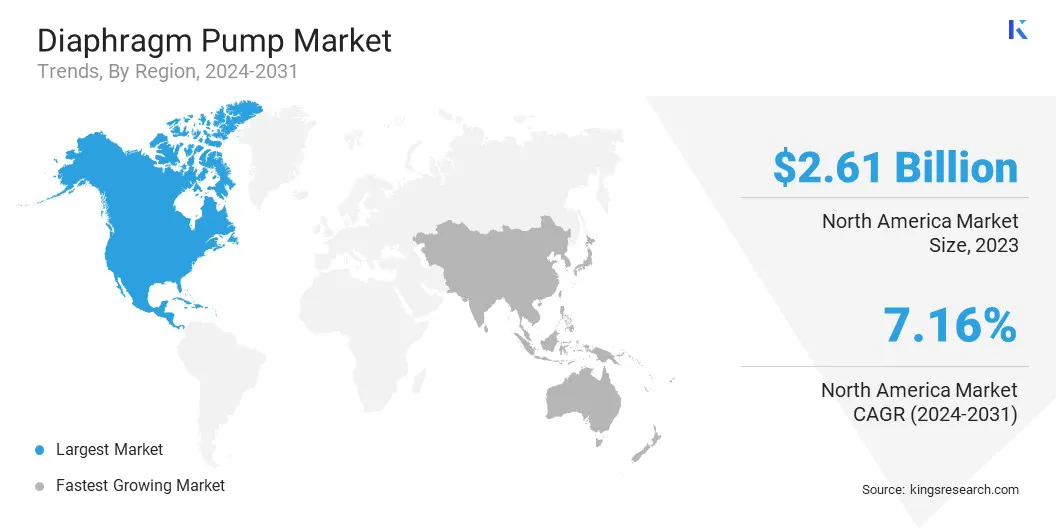
The North America diaphragm pump market share stood at around 35.95% in 2023, valued at USD 2.61 billion. This dominance is reinforced by the growth of smart manufacturing and industrial automation.
Electrically operated diaphragm pumps (EODD) with smart diagnostics and real-time flow monitoring features are being adopted by manufacturers to optimize energy consumption and minimize manual intervention. Their integration into Industry 4.0 workflows is contributing to steady market expansion in high-precision industrial environments.
Additionally, the advanced food and beverage manufacturing sector is increasingly adopting diaphragm pumps to maintain product purity and comply with stringent FDA and 3-A sanitary standards.
Rising production of clean-label, plant-based, and specialty food production is further increasing demand for hygienic diaphragm pump tailored to high-viscosity and temperature-sensitive formulations.
Asia Pacific diaphragm pump industry is poised to grow at a CAGR of 8.08% over the forecast period. Asia Pacific is witnessing significant growth in chemical production, particularly within industrial corridors focused on petrochemicals, paints, and specialty chemicals.
Diaphragm pumps are widely utilized in these environments for transferring corrosive, viscous, and abrasive fluids under strict safety and reliability standards. The increasing rising adoption of closed-loop systems and modular chemical processing units is propelling regional market growth.
Key players operating in the diaphragm pump industry are increasingly focusing on expanding their product portfolios to strengthen their position. By introducing technologically advanced and energy-efficient pump solutions tailored to diverse industrial needs, companies are addressing evolving customer demands and operational challenges.
This strategic emphasis on portfolio enhancement is enabling manufacturers to cater to a broader application base, drive product differentiation, and reinforce customer retention. These initiatives support performance-driven solutions aligned with modern industrial requirements.
Recent Developments (Product Launch)
Frequently Asked Questions

Sunanda is a proficient research analyst with strong cross-domain expertise, excelling in identifying market trends and delivering insightful analyses across various industries, including consumer goods, food & beverages, healthcare, and more. Her ability to connect insights from diverse sectors enables her to offer actionable recommendations that support strategic decision-making in a range of business contexts. Sunanda's research is driven by thorough data analysis and her commitment to providing relevant, data-driven insights. Her keen eye for patterns allows her to spot emerging opportunities before they become mainstream. Sunanda's synthesis of cross-sector learnings often reveals unconventional solutions that clients find invaluable. She adapts her analytical frameworks to suit each industry's unique nuances, ensuring reports are both accurate and contextually relevant. Clients appreciate her ability to deliver crisp, actionable findings under tight deadlines, consistently exceeding expectations with her thoroughness and insight.

Ganapathy Subramaniam Suresh
With over a decade of research leadership across global markets, Ganapathy brings sharp judgment, strategic clarity, and deep industry expertise. Known for precision and an unwavering commitment to quality, he guides teams and clients with insights that consistently drive impactful business outcomes.