
Inquire Now
Key Strategic Points
Building and construction plastics refer to a broad category of synthetic materials that are widely used in the construction industry, due to their durability, versatility, and cost-effectiveness. These plastics, typically made from polymers like polyvinyl chloride (PVC), polyethylene (PE), polypropylene (PP), and polystyrene (PS), serve various functions, including insulation, piping, flooring, roofing, and cladding.
They are valued for their lightweight nature, resistance to corrosion, ease of installation, and ability to withstand environmental factors such as moisture and temperature variations. Building and construction plastics play a critical role in enhancing the efficiency, sustainability, and longevity of modern construction projects.
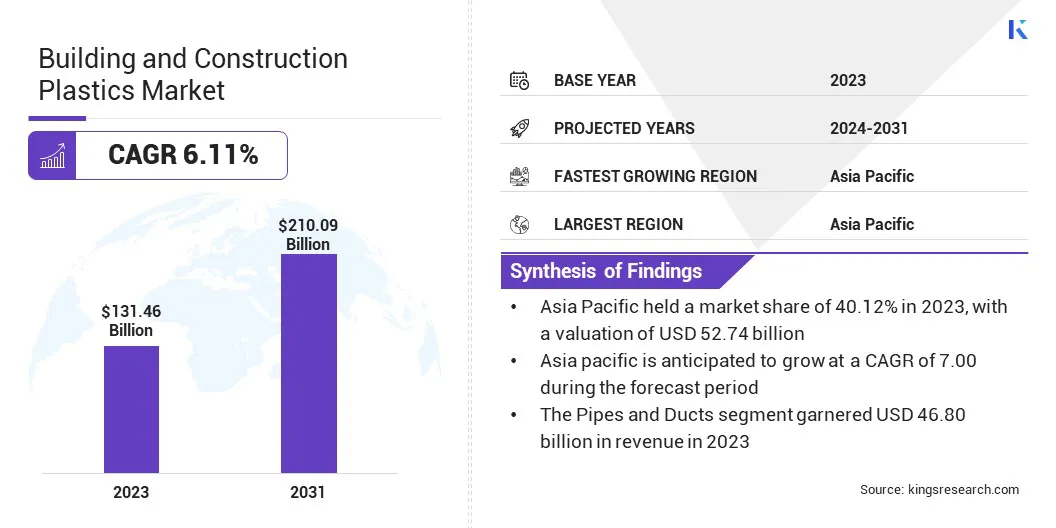
The global building and construction plastics market size was valued at USD 131.46 billion in 2023, which is estimated to be valued at USD 138.72 billion in 2024 and reach USD 210.09 billion by 2031, growing at a CAGR of 6.11% from 2024 to 2031.
The market is driven by rapid urbanization and the increasing demand for durable, cost-effective materials. Technological advancements in plastic manufacturing have led to enhanced product performance, while growing government investments in infrastructure further boost demand.
Additionally, the shift to energy-efficient and sustainable building practices, along with the rising adoption of prefabricated construction methods, are significantly contributing to the market's expansion.
Major companies operating in the global building and construction plastics market are BASF, DuPont, Dow, SABIC, Arkema, LyondellBasell Industries Holdings B.V., Evonik, Covestro AG, Clariant, Huntsman International LLC., Borealis AG, Avient Corporation, Solvay, LG Chem, and INEOS.
The rapid pace of urbanization, particularly in emerging economies, is significantly driving the market. Expanding urban populations are increasing the demand for residential, commercial, and industrial infrastructure.
Governments are heavily investing in large-scale infrastructure projects, including smart cities, roads, and housing developments, which require lightweight and durable construction materials.
Market Driver
"Rising Demand for Sustainable Solutions"
The growing emphasis on sustainable and energy-efficient construction practices is bolstering the building and construction plastics market. Recyclable and bio-based plastics are gaining traction as eco-friendly alternatives in construction projects.
Additionally, their use in insulation materials and energy-efficient designs supports efforts to reduce carbon emissions, aligning with global sustainability goals.
Market Challenge
"Limited Recycling Infrastructure"
A significant challenge for the growth of the building and construction plastics market is the limited recycling infrastructure in many regions, leading to improper disposal and environmental concerns. This issue hampers the adoption of sustainable practices and increases scrutiny on the industry regarding its environmental impact.
Companies are addressing this challenge by investing in advanced recycling technologies, such as chemical recycling and AI-based sorting systems, to improve plastic waste management.
Collaborative efforts with governments and research institutions to establish efficient recycling networks and develop bio-based, recyclable plastic materials are further driving the shift toward sustainability in the market.
Market Trend
"Technological Advancements in High-performance Plastics"
Innovations in polymer technology and manufacturing processes are enhancing the quality and functionality of building plastics. High-performance plastics with improved strength, flexibility, and environmental resistance are increasingly replacing conventional materials in construction.
These advancements are expanding the scope of plastics in diverse applications, thereby driving the building and construction plastics market globally.
| Segmentation | Details |
| By Product | Polyvinyl Chloride (PVC), Polystyrene (PS), Polyethylene (PE), Polyurethanes (PU), Acrylics, Polypropylene (PP ), Others |
| By Application | Roofing, Insulation, Pipes & Ducts, Doors, Windows, Others |
| By Region | North America: U.S., Canada, Mexico |
| Europe: France, UK, Spain, Germany, Italy, Russia, Rest of Europe | |
| Asia Pacific: China, Japan, India, Australia, ASEAN, South Korea, Rest of Asia Pacific | |
| Middle East & Africa: Turkey, UAE, Saudi Arabia, South Africa, Rest of Middle East & Africa | |
| South America: Brazil, Argentina, Rest of South America |
Market Segmentation:
Based on region, the global market has been classified into North America, Europe, Asia Pacific, Middle East & Africa, and Latin America.
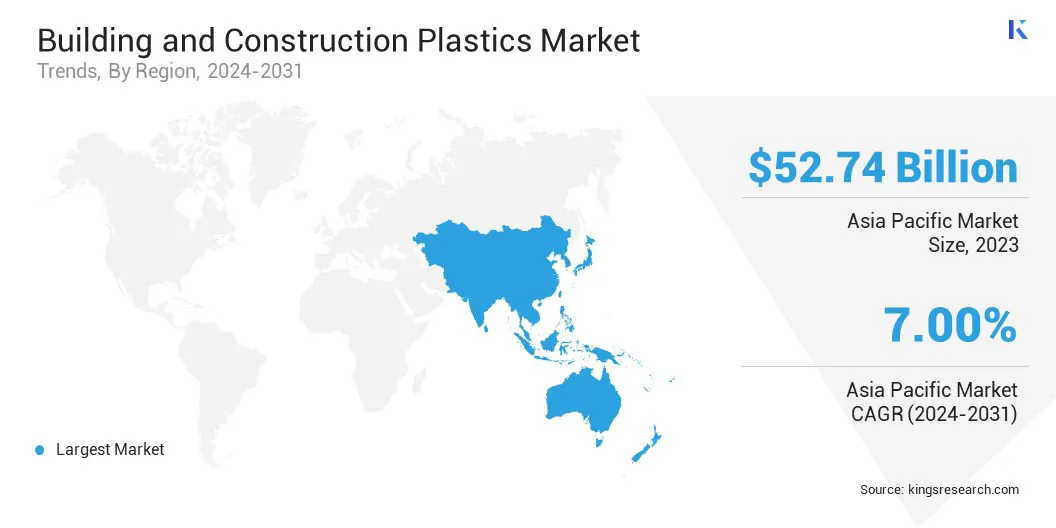
Asia Pacific accounted for around 40.12% share of the building and construction plastics market in 2023, with a valuation of USD 52.74 billion. Countries in Asia Pacific are increasingly focusing on sustainable construction solutions to address environmental concerns.
The increasing integration of green building practices into construction projects, coupled with the adoption of recyclable and bio-based plastics, aligns with government policies promoting green building initiatives, boosting the market's growth.
The building and construction plastics industry in Europe is poised for significant growth at a robust CAGR of 5.84% over the forecast period. The European Union's (EU) stringent energy efficiency regulations and sustainability goals are driving the adoption of building and construction plastics.
These materials, widely used in insulation, windows, and roofing, enhance energy performance in residential and commercial buildings, aligning with directives such as the Energy Performance of Buildings Directive (EPBD).
The global building and construction plastics industry is characterized by a number of participants, including both established corporations and rising organizations. Companies in the market are increasingly adopting strategies such as collaboration agreements to position themselves as sustainability leaders, contributing to the growth of the market.
By partnering with other industry players, companies can combine expertise and resources to develop innovative, eco-friendly solutions that reduce the environmental impact of construction processes. These collaborations help to meet regulatory standards while aligning with the growing demand for sustainable construction materials.
Such strategic alliances accelerate the development and adoption of green technologies, enhancing competitive advantage and driving the expansion of the market.
Recent Developments:
Frequently Asked Questions

Sunanda is a proficient research analyst with strong cross-domain expertise, excelling in identifying market trends and delivering insightful analyses across various industries, including consumer goods, food & beverages, healthcare, and more. Her ability to connect insights from diverse sectors enables her to offer actionable recommendations that support strategic decision-making in a range of business contexts. Sunanda's research is driven by thorough data analysis and her commitment to providing relevant, data-driven insights. Her keen eye for patterns allows her to spot emerging opportunities before they become mainstream. Sunanda's synthesis of cross-sector learnings often reveals unconventional solutions that clients find invaluable. She adapts her analytical frameworks to suit each industry's unique nuances, ensuring reports are both accurate and contextually relevant. Clients appreciate her ability to deliver crisp, actionable findings under tight deadlines, consistently exceeding expectations with her thoroughness and insight.

With over a decade of research leadership across global markets, Ganapathy brings sharp judgment, strategic clarity, and deep industry expertise. Known for precision and an unwavering commitment to quality, he guides teams and clients with insights that consistently drive impactful business outcomes.