
Inquire Now
Key Strategic Points
The market encompasses AI-powered virtual assistants designed to provide personalized support, automation, and engagement across various industries.
These companions leverage natural language processing (NLP), machine learning (ML), and contextual awareness to assist users in tasks like communication, productivity, and entertainment. The market spans consumer, enterprise, and healthcare sectors, driving innovation in human-AI interaction and digital transformation.
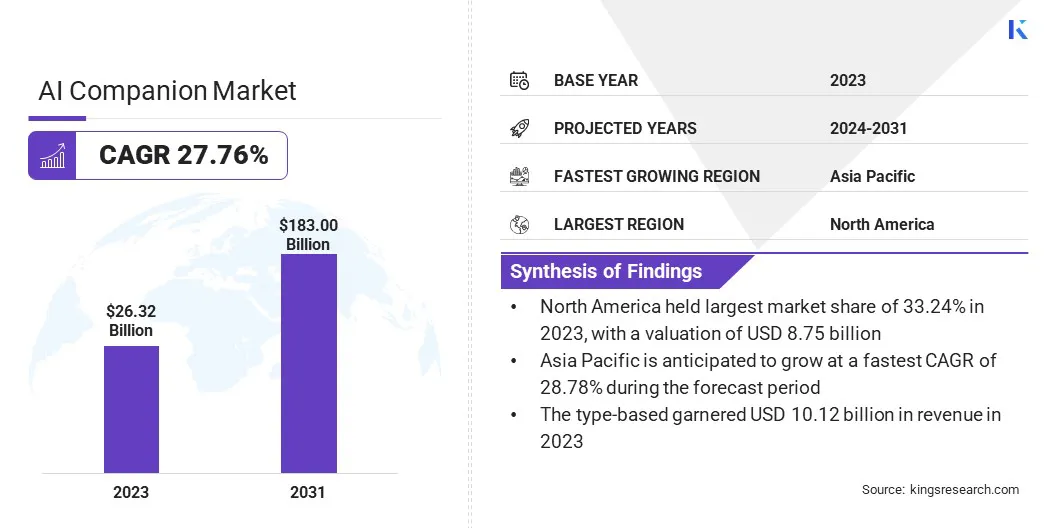
The global AI companion market size was valued at USD 26.32 billion in 2023 and is projected to grow from USD 32.94 billion in 2024 to USD 183.00 billion by 2031, exhibiting a CAGR of 27.76% during the forecast period.
The market is expanding rapidly, driven by the increasing adoption of AI-powered virtual assistants across various industries, including healthcare, customer service, education, and personal productivity.
The rise of conversational AI, enhanced by deep learning and NLP, is enabling AI companions to provide more human-like interactions, making them valuable for both businesses and individual users. Integration with IoT devices, wearables, and smart home systems is enhancing the capabilities of AI companions, making them more intuitive and responsive.
Additionally, the growing popularity of AI-powered chatbots, virtual friends, and mental wellness assistants is reshaping digital interactions, offering users emotional support and companionship.
Major companies operating in the AI companion industry are Luka, Inc., Character Technologies, Inc., Talkie, Labane Corp. Ltd., Zoom Communications, Inc., SAMSUNG, Microsoft, SimSimi Inc., Nomi.ai, Wysa Ltd, Huma AI, H2O.ai, International Business Machines Corporation, Adobe, and KNIME.
Enterprises are leveraging AI companions to streamline workflows, improve customer engagement, and automate repetitive tasks, leading to increased efficiency and cost savings. Furthermore, ongoing advancements in multimodal AI, real-time language translation, and personalized recommendations are making AI companions more sophisticated and adaptable to diverse user needs. Continuous investments and innovations in AI technology are leading to the sustained growth of the market, shaping the future of human-AI interaction.
NLP and Generative AI have significantly enhanced the ability of AI companions to engage in more human-like conversations, understand context, and respond with empathy and relevance.
Cutting-edge deep learning models now allow AI companions to process complex language structures, detect emotions, and tailor responses based on user behavior and preferences. These improvements enable AI companions to serve in diverse roles, from mental health support and personal coaching to virtual customer service and digital assistants, making them more effective and widely adopted.
AI companions are increasingly being embedded into productivity and collaboration platforms such as virtual meeting software, email clients, and task management applications. AI companions help streamline workflows and reduce administrative burdens by automating note-taking, summarizing discussions, and proactively suggesting next steps.
Their integration with enterprise tools like Microsoft Teams, Zoom, and Slack allows users to seamlessly transition from communication to task execution, enhancing efficiency in both personal and professional settings. This growing interconnectivity makes AI companions indispensable for improving time management, collaboration, and overall workplace productivity.
One of the most significant challenges in the AI companion market is ensuring data privacy and addressing ethical concerns surrounding user interactions. AI companions interact with users on a deeply personal level, handling sensitive information such as emotional states, mental health discussions, behavioral patterns, and private conversations.
This raises critical concerns about data security, unauthorized access, and potential misuse of personal data, leading to fears of surveillance, breaches, or unethical exploitation of user information. Users need to ensure that their conversations remain private and are not used for unintended purposes, such as targeted advertising or third-party data sharing.
AI models can sometimes exhibit biases, provide misleading information, or reinforce unhealthy behaviors if not carefully designed. Over-reliance on AI companions for emotional support can also lead to unintended psychological effects, such as reduced human interaction and dependency on AI for validation or companionship.
AI developers must implement stringent data protection measures, including end-to-end encryption, secure cloud storage, and strict compliance with global privacy regulations. Providing users with transparency about data collection, allowing them to control or delete their data and ensuring that AI companions operate with clear ethical guidelines can help build trust.
The AI companion market is registering significant growth, due to the rising demand for personalized digital assistance and expansion into mental health and emotional support. Consumers increasingly seek AI companions that adapt to their preferences, behaviors, and communication styles, creating a more intuitive and user-centric experience.
Advances in ML and contextual understanding enable AI companions to offer tailored recommendations, proactive assistance, and dynamic interactions that enhance user engagement. Additionally, AI companions are increasingly being designed to support mental health and emotional well-being.
AI-powered solutions are being integrated into therapeutic settings, due to the growing awareness of mental health challenges. They offer guided mindfulness exercises, stress management techniques, and empathetic conversations. These capabilities make AI companions valuable tools for emotional resilience, providing users with accessible, always-available support systems.
|
Segmentation |
Details |
|
By Type |
Text-based, Voice-based |
|
By Application |
Mental Health Support, Social Interaction & Companionship, Education & Learning Aid, Personal Assistance |
|
By Region |
North America: U.S., Canada, Mexico |
|
Europe: France, UK, Spain, Germany, Italy, Russia, Rest of Europe |
|
|
Asia-Pacific: China, Japan, India, Australia, ASEAN, South Korea, Rest of Asia-Pacific |
|
|
Middle East & Africa: Turkey, UAE, Saudi Arabia, South Africa, Rest of Middle East & Africa |
|
|
South America: Brazil, Argentina, Rest of South America |
Based on region, the market has been classified into North America, Europe, Asia Pacific, Middle East & Africa, and Latin America.
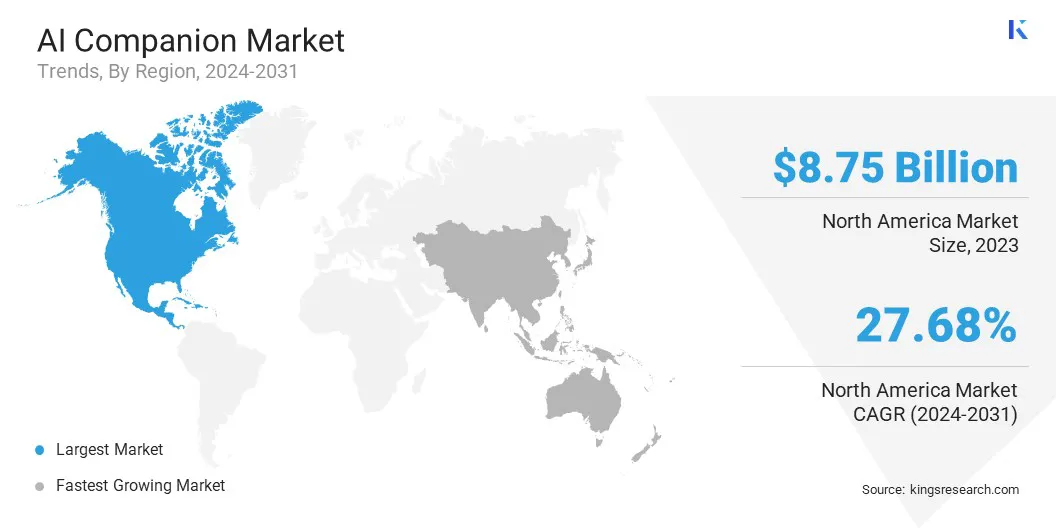
North America AI companion market accounted for a substantial share of 33.24% in 2023, with a valuation of USD 8.75 billion. This dominance is attributed to the strong technological infrastructure, high AI adoption rates, and the presence of leading AI companies such as Google, Microsoft, and OpenAI in the region.
This leadership is further strengthened by a mature AI ecosystem, a well-established consumer base, and widespread integration of AI-driven solutions across industries. The region has registered the increasing adoption of AI companions in sectors like healthcare, where virtual assistants support mental health therapy and chronic disease management.
Additionally, the growing demand for AI-powered chatbots in customer service and enterprise applications is fueling the market. The presence of a highly developed startup ecosystem, along with collaborations between tech giants and AI research institutions, continues to drive innovation in AI companion technology. The AI companion industry in Asia Pacific is expected to register the fastest growth, with a projected CAGR of 28.78% over the forecast period. This rapid expansion is fueled by increasing digitalization, a growing tech-savvy population, and strong government initiatives supporting AI development in countries such as China, Japan, and South Korea.
The widespread adoption of smartphones and smart devices has accelerated the use of AI companions in personal assistance, social interaction, and mental wellness applications. Additionally, rising investments from both private and public sectors, along with advancements in NLP for regional languages, are boosting market penetration. The popularity of AI-driven chatbots and virtual influencers in social media and entertainment has also contributed to the region’s dynamic growth, positioning Asia Pacific as a key driver of the market.
The AI companion market is characterized by rapid technological advancements, increasing integration across industries, and continuous innovation in NLP and ML. Key market players focus on enhancing conversational abilities, emotional intelligence, and contextual understanding to improve user engagement. Companies are investing heavily in AI personalization, enabling companions to adapt to user preferences, emotions, and behaviors. Strategic collaborations with tech firms, healthcare providers, and consumer electronics manufacturers are helping expand AI companion functionalities into diverse sectors such as mental health support, education, and personal productivity.
Another key strategy involves integrating AI companions with smart devices, IoT ecosystems, and virtual reality platforms to provide seamless and interactive experiences. Cross-platform compatibility is also a priority, ensuring that AI companions can function across multiple devices, including smartphones, wearables, and smart home assistants. Partnerships and collaborations are playing a crucial role in market expansion, with companies joining forces with research institutions, healthcare providers, and educational platforms to enhance AI capabilities and reach wider audiences. Additionally, several firms are focusing on localization, refining AI companions to support multiple languages and cultural nuances to cater to a global user base.
Frequently Asked Questions

Over the years, Versha brings over 15 years of experience managing consulting assignments across industries, including Food and Beverage, Consumer Goods, ICT, Aerospace, and more. Her work has spanned diverse sectors. Her cross-domain expertise and adaptability make her a versatile and dependable professional. She is known for her keen business insight and foresight. With sharp analytical skills and a curious mindset, Versha excels at transforming complex data into actionable insights. She has a proven track record of unraveling market dynamics, identifying trends, and delivering tailored solutions to meet client needs. As a skilled leader, Versha has successfully mentored research teams and directed projects with precision, ensuring high-quality outcomes. Her collaborative approach and strategic vision enable her to turn challenges into opportunities and consistently deliver impactful results. Whether analyzing markets, engaging stakeholders, or crafting strategies, Versha draws on her deep expertise and industry knowledge to drive innovation and deliver measurable value.
Habi is a seasoned research and consulting leader with renowned experience in guiding clients on strategic growth and transformation initiatives across global markets. He has led high-performing research teams that deliver actionable insights on market expansion, M&A strategies, opportunity assessment, new business development, and product launches. His project portfolio spans large petrochemical producers, electronic device manufacturers, lubricants companies, and other leading enterprises across diverse industrial and consumer sectors. He currently heads the research department at Kings Research, where he is responsible for setting the research agenda, mentoring analysts, and ensuring client-ready deliverables that support executive decision-making. With extensive experience in market intelligence, strategic research, and consulting, Habi brings a strong understanding of evolving industry dynamics, competitive landscapes, emerging opportunities, and business growth challenges. His expertise includes developing research frameworks, translating complex market data into actionable strategic recommendations, and working closely with senior stakeholders to address critical business questions. He has also contributed to building research capabilities, strengthening analytical methodologies, and driving a culture of quality and insight-led decision-making within research teams. His cross-industry exposure enables him to connect market trends with broader business implications and provide perspectives that help organizations identify opportunities, mitigate risks, and make informed strategic decisions.



.webp&w=128&q=75&dpl=dpl_DPva2LrvfsBdTJm1XZj67UTrvMHL)
