
Inquire Now
Key Strategic Points
The market utilizes additive manufacturing to create structures layer by layer using materials such as concrete, metal, or polymers.
The process, guided by digital models, enables precise, customized construction, while reducing time, costs, and material waste. This market is growing due to advancements in technology, sustainability initiaitves, and the need for affordable housing solutions.
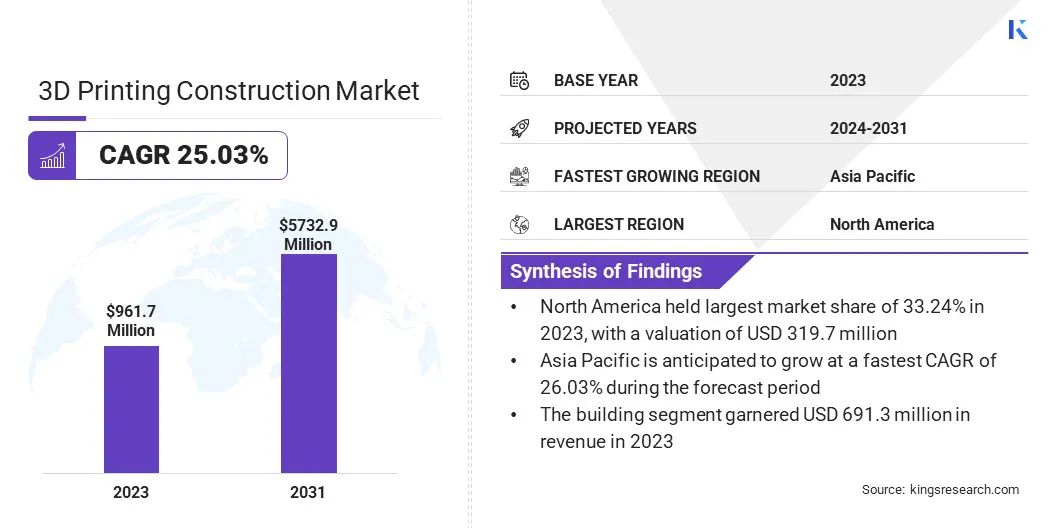
Global 3D printing construction market size was USD 961.7 million in 2023, which is estimated to be valued at USD 1200.0 million in 2024 and reach USD 5732.9 million by 2031, growing at a CAGR of 25.03% from 2024 to 2031.
The rising demand for affordable housing is contributing to the growth of the market. This technology enables fast, cost-effective solutions to address housing shortages while enabling scalable and customizable developments in urban areas.
Major companies operating in the 3D printing construction industry are Apis Cor Inc., COBOD INTERNATIONAL A/S, Contour Crafting Corporation, CyBe Construction, ICON Technology, Inc., Sika AG, WASP S.r.l., XtreeE, Yingchuang Building Technique (Shanghai) Co.,Ltd. (WINSUN), D-Shape, voxeljet AG, HOLCIM, Bemore3D, Black Buffalo 3D Corporation, Branch Technology, and others.
The market is transforming the industry by enabling efficient, customized building solutions through additive manufacturing.
This innovation enhances precision, supports complex architectural designs, and fosters the use of eco-friendly materials, ultimately contributing to sustainable construction practices. With growing investment and advancements in technology, 3D printing is set to redefine construction practices and stimulate market growth.
Market Driver
Surging Demand for Affordable Housing
Rapid urbanization is increasing the demand for affordable housing, propelling the expansion of the 3D printing construction market. According to the World Bank Group, approximately 56% of the global population currently resides in cities, a figure projected to exceed 70% by 2050 as urbanization continues.
3D printing enables faster, cost-effective construction with reduced labor requirements, reducing overall costs. Additionally, the technology allows for highly customizable designs, catering to varying housing needs in urban areas. With traditional construction struggling to meet growing demands, 3D printing is emerging as a viable, sustainable solution to housing shortages and affordability challenges.
Market Challenge
Skilled Workforce Shortage
The shortage of skilled workers to operate advanced 3D printing systems present a significant challenge to the expansion of the 3D printing construction market. As the adoption of 3D printing technology in construction rises, there is a growing demand for specialized expertise to manage and operate these machines.
To address this, companies can invest in training programs, form partnerships with educational institutions, and foster on-the-job skill development. Additionally, automation and AI-driven systems can help reduce the reliance on manual labor, improving efficiency while mitigating skilled labor shortages.
Market Trend
Sustainable Construction Innovation
A key trend in the market is the development of sustainable, innovative building materials. These materials offer enhanced durability, reusability, and environmental benefits, supporting eco-friendly construction practices.
The focus is shifting toward reducing carbon footprints and improving the efficiency of building processes, with new technologies enabling more sustainable and versatile construction methods. This trend reflects the growing emphasis on creating resource-efficient, long-lasting, and environmentally responsible solutions within the industry.
|
Segmentation |
Details |
|
By Material |
Mortar & Concrete, Metal, Composite, Others |
|
By Method |
Extrusion, Powder Bonding, Spray |
|
By End Use |
Building, Infrastructure |
|
By Region |
North America: U.S., Canada, Mexico |
|
Europe: France, UK, Spain, Germany, Italy, Russia, Rest of Europe |
|
|
Asia-Pacific: China, Japan, India, Australia, ASEAN, South Korea, Rest of Asia-Pacific |
|
|
Middle East & Africa: Turkey, UAE, Saudi Arabia, South Africa, Rest of Middle East & Africa |
|
|
South America: Brazil, Argentina, Rest of South America |
Market Segmentation
Based on region, the global market has been classified into North America, Europe, Asia Pacific, Middle East & Africa, and Latin America.
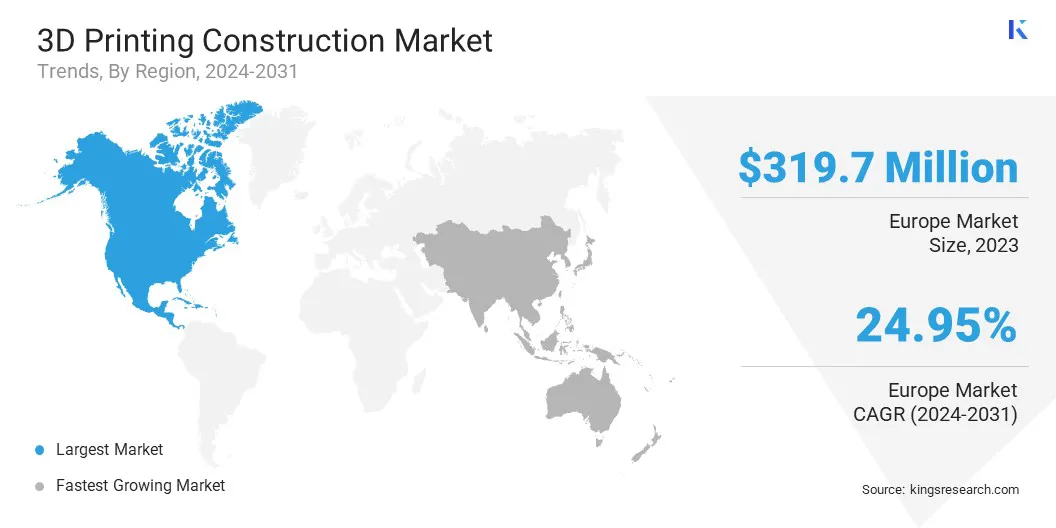
North America 3D printing construction industry share stood at around 33.24% in 2023, valued at USD 319.7 million. This dominance is marked by technological advancements, strong industry adoption, and substantial investments. The United States, in particular, leads in construction startups, particularly in 3D printed homes and infrastructure.
Government support, research funding, and partnerships between private companies and universities foster innovation. Additionally, the region's advanced infrastructure and construction sectors facilitate the rapid implementation and scalability of 3D printing in construction.
Asia Pacific 3D printing construction market is set to grow at a staggering CAGR of 26.03% over the forecast period. This growth is propelled by rapid urbanization, increasing infrastructure projects, and a growing focus on affordable housing.
Countries such as China, India, and Japan are experiencing favorable government initiatives and increased investments in 3D printing technologies.
The region’s adoption of sustainable and cost-effective construction methods, coupled with the demand for innovative building solutions, is fueling domestic market expansion. Furthermore, advancements in local manufacturing capabilities contribute to regional market growth.
The 3D printing construction industry has attracted significant investments, with companies advancing printing technology, improving material efficiency, and scaling operations.
These efforts foster innovation, enhance sustainability, reduce construction time, and address labor shortages, highlighting the sector’s potential to transform traditional construction with cost-effective, eco-friendly solutions.
Recent Developments (Partnerships/Expansion/New Product Launch)
Frequently Asked Questions

Sharmishtha is a budding research analyst with a strong commitment to achieving excellence in her field. She brings a meticulous approach to every project, delving deep into details to ensure comprehensive and insightful outcomes. Passionate about continuous learning, she strives to enhance her expertise and stay ahead in the dynamic world of market research. Beyond work, Sharmishtha enjoys reading books, spending quality time with friends and family, and engaging in activities that foster personal growth. Her dedication to precision ensures that no critical detail is overlooked, and her analytical rigor consistently produces reliable, evidence-based conclusions. Sharmishtha's proactive curiosity drives her to explore emerging research methodologies, which she readily applies to deliver fresh perspectives on complex market questions. Her collaborative nature and openness to constructive feedback make her a dependable team player. She balances technical accuracy with clear communication, ensuring her insights are actionable for clients and stakeholders alike.

Ganapathy Subramaniam Suresh
With over a decade of research leadership across global markets, Ganapathy brings sharp judgment, strategic clarity, and deep industry expertise. Known for precision and an unwavering commitment to quality, he guides teams and clients with insights that consistently drive impactful business outcomes.