
Inquire Now
Key Strategic Points
The market encompasses the production and distribution of compressed pellets made primarily from wood-based biomass, including sawdust and wood chips. These pellets serve as a renewable energy source, used mainly for heating and power generation.
The market is expanding due to the growing demand for sustainable energy solutions and the increasing shift toward eco-friendly alternatives in both residential and industrial sectors.
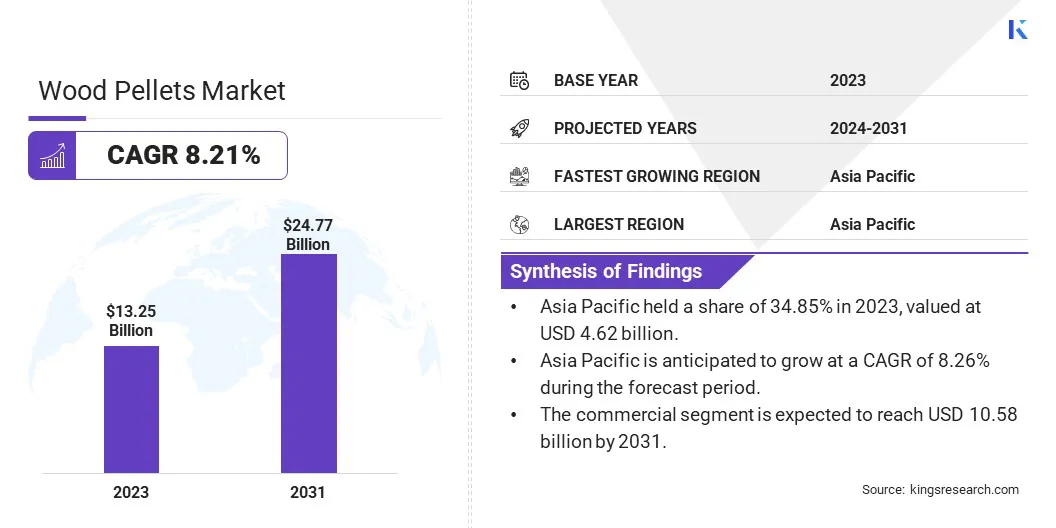
The global wood pellets market size was valued at USD 13.25 billion in 2023 and is projected to grow from USD 14.26 billion in 2024 to USD 24.77 billion by 2031, exhibiting a CAGR of 8.21% during the forecast period.
The global market is growing due to rising demand for renewable energy and emissions reduction. Made from compressed biomass, wood pellets offer a sustainable alternative to fossil fuels for heating and power. Market growth is fueled by environmental awareness, government incentives, and increasing adoption across sectors.
Major companies operating in the wood pellets industry are Wood Pellet Energy UK (LTD), Premium Pellets Ltd, Graanul Invest, Highland Pellets, LLC, Savoie, I.C.S. (Lacroix) Lumber Inc., Vermont Wood Pellet Company, Enviva, Drax Global, Energex, Sinclar Group Forest Products, WismarPellets GmbH, The United Company, Wood & Sons, Valfei Products Inc. and other.
 Key Highlights:
Market Driver
“Government Policies and Incentives”
Government Policies and Incentives are contributing significantly to the expansion of the wood pellets market. Subsidies, tax credits, and renewable energy mandates enhance the economic viability of biomass energy, encouraging adoption across industries, utilities, and households.
Several countries and regions have implemented regulatory frameworks, financial incentives, and renewable energy targets to support this transition as part of carbon reduction strategies.
Market Challenge
“Concerns Pertaining to Prices of Raw Materials”
A major challenge hampering the growth of the wood pellets market is raw material price volatility. The cost of feedstock, such as sawdust and wood shavings, fluctuates due to factors including deforestation regulations, competition with other wood-based industries, and supply chain disruptions.
Furthermore, the growing demand for biomass energy has raised concerns about resource sustainability, impacting both availability and pricing. These uncertainties pose financial risks for producers and may hinder market growth by reducing the cost competitiveness of wood pellets compared to other renewable energy sources.
To mitigate these challenges, companies can adopt strategic measures such as diversifying feedstock sources by incorporating agricultural residues and alternative biomass materials. Establishing long-term supply agreements with multiple suppliers can enhance price stability and supply security.
Investing in sustainable forestry and reforestation initiatives ensures a consistent raw material supply while complying with environmental regulations. Optimizing logistics, transportation, and storage infrastructure further helps reduce costs and mitigate disruptions, strengthening market resilience against price fluctuations.
Market Trend
“Rising Demand for Biomass Energy”
A major trend in the wood pellets market is the increasing demand for biomass energy as a sustainable alternative to fossil fuels. Governments globally are implementing incentives and policies to support biomass-based power generation, particularly in Europe, North America, and Asia.
Power plants are increasingly co-firing wood pellets with coal to reduce carbon emissions, while residential heating systems are shifting toward biomass solutions. This growing reliance on wood pellets aligns with global decarbonization goals, fostering market expansion and advancements in biomass energy technology.
|
Segmentation |
Details |
|
By Application |
Heating, Power Generation, Combined Heat & Power |
|
By End User |
Residential, Commercial, Industrial |
|
By Region |
North America: U.S., Canada, Mexico |
|
Europe: France, U.K., Spain, Germany, Italy, Russia, Rest of Europe |
|
|
Asia-Pacific: China, Japan, India, Australia, ASEAN, South Korea, Rest of Asia-Pacific |
|
|
Middle East & Africa: Turkey, UAE, Saudi Arabia, South Africa, Rest of Middle East & Africa |
|
|
South America: Brazil, Argentina, Rest of South America |
Market Segmentation:
Based on region, the global market has been classified into North America, Europe, Asia Pacific, Middle East & Africa, and Latin America.
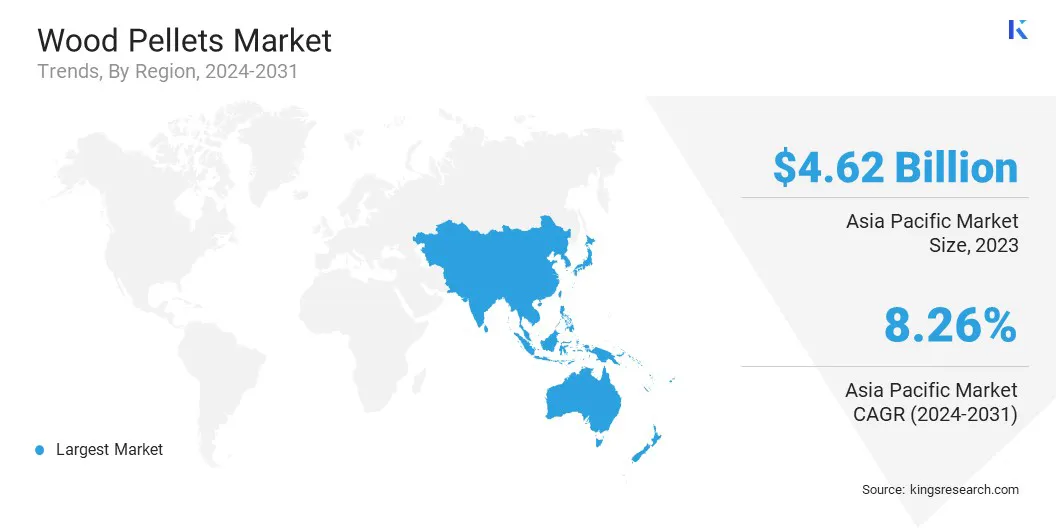
Asia Pacific wood pellets market captured a share of around 34.85% in 2023, valued at USD 4.62 billion. This growth is attributed to the region's increasing adoption of renewable energy sources, with a focus on sustainable heating solutions in both residential and commercial sectors.
 The expanding shift toward eco-friendly alternatives, coupled with favorable government policies and environmental awareness, has fueled this expansion.
North America wood pellets industry is set to grow at a robust CAGR of 8.20% over the forecast period. This rapid growth is stimulated by the rising demand for renewable energy, particularly in residential and industrial heating applications.
Government incentives, including renewable energy policies and carbon reduction initiatives, further support this expansion. The region's abundant biomass resources, coupled with advancements in pellet production technology, contribute significantly to this growth.
The wood pellets industry is characterized by a number of participants, including both established corporations and emerging players. To gain a competitive edge, companies are focusing on several key strategies, including expansion of production capacity, technological advancements, strategic partnerships, and sustainability initiatives.
Leading players are investing in new production facilities or upgrading existing ones to meet the growing demand, particularly in Europe and Asia. Technological innovations in pellet processing and quality improvement are helping companies enhance efficiency and product performance.
Recent Developments (M&A/Partnerships/Agreements/New Product Launch)
Frequently Asked Questions

Siddhi is an accomplished professional with deep expertise in research and analysis, excelling in delivering customized reports across a wide range of industries. With a focus on extracting actionable insights, Siddhi's ability to navigate through various sectors demonstrates her cross-domain expertise. She approaches each assignment with a meticulous and data-driven mindset, translating complex market trends into clear recommendations that guide decision-making. Beyond her professional work, Siddhi is passionate about tracking B2B growth opportunities, staying ahead of industry trends, and continually expanding her knowledge through reading and research. Her dedication to precision ensures every report is comprehensive and actionable. Siddhi's ability to synthesize disparate data into cohesive narratives makes her a valuable asset in strategic planning. She tailors her analyses to client-specific contexts, enhancing relevance. Her proactive monitoring of emerging shifts keeps recommendations timely, while her intellectual curiosity drives her to explore adjacent sectors, further broadening her analytical scope and strengthening the insights she delivers.
Habi is a seasoned research and consulting leader with renowned experience in guiding clients on strategic growth and transformation initiatives across global markets. He has led high-performing research teams that deliver actionable insights on market expansion, M&A strategies, opportunity assessment, new business development, and product launches. His project portfolio spans large petrochemical producers, electronic device manufacturers, lubricants companies, and other leading enterprises across diverse industrial and consumer sectors. He currently heads the research department at Kings Research, where he is responsible for setting the research agenda, mentoring analysts, and ensuring client-ready deliverables that support executive decision-making. With extensive experience in market intelligence, strategic research, and consulting, Habi brings a strong understanding of evolving industry dynamics, competitive landscapes, emerging opportunities, and business growth challenges. His expertise includes developing research frameworks, translating complex market data into actionable strategic recommendations, and working closely with senior stakeholders to address critical business questions. He has also contributed to building research capabilities, strengthening analytical methodologies, and driving a culture of quality and insight-led decision-making within research teams. His cross-industry exposure enables him to connect market trends with broader business implications and provide perspectives that help organizations identify opportunities, mitigate risks, and make informed strategic decisions.