
Inquire Now
Key Strategic Points
Process mining software refers to tools that help organizations analyze and visualize their business processes. These tools work by extracting data from IT systems and then mapping, modeling, and analyzing the actual flow of business activities.
Process mining software allows businesses to get insights into their existing workflows; identify inefficiencies, bottlenecks, and opportunities for improvement; and ensure that processes are being followed as designed.
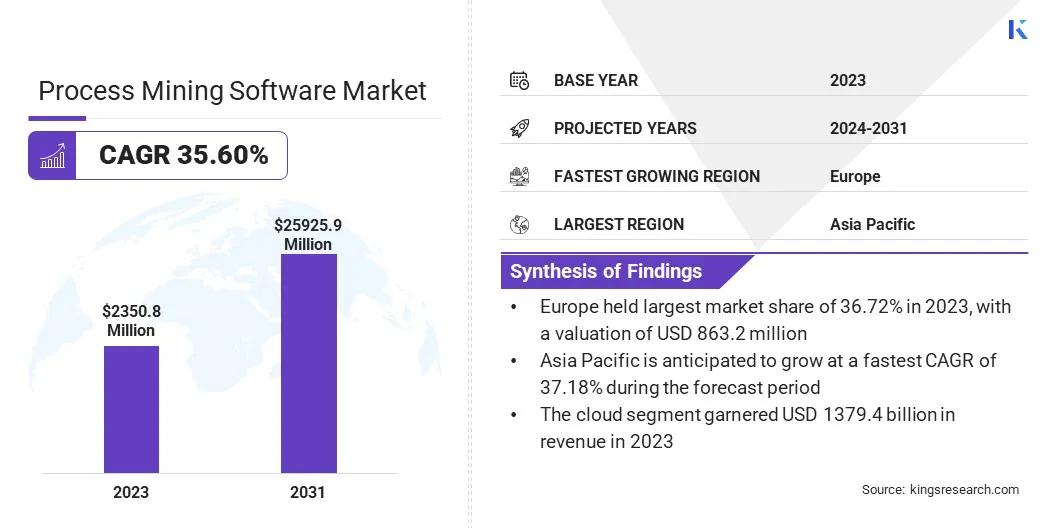
The global process mining software market size was valued at USD 2,350.8 million in 2023, which is estimated to be valued at USD 3,074.9 million in 2024 and reach USD 25,925.9 million by 2031, growing at a CAGR of 35.60% from 2024 to 2031.
The growing need for improved process visibility and transparency drives the market. Organizations seek tools that reveal hidden inefficiencies, optimize workflows, and ensure better performance management and compliance.
Major companies operating in the process mining software industry are UiPath, Celonis, IBM, Fluxicon BV, Fujitsu, Hyland Software, Inc., Appian Corporation, QPR Software, Software GmbH, ABBYY, mindzie, Inverbis, Apromore Pty Ltd, Pegasystems Inc., and SAP SE.
The growing demand for data-driven decision-making and operational efficiency is significantly driving the market. Businesses are increasingly relying on process mining tools to gain actionable insights from event data, optimize workflows, and improve performance.
Furthermore, organizations can identify inefficiencies, reduce costs, and enhance productivity by visualizing and analyzing actual business processes. This shift toward data-centric strategies helps companies streamline operations, ensure better resource allocation, and make more informed decisions to stay competitive in dynamic markets.
Improving process visibility and transparency is a key growth driver of the process mining software market. Businesses require tools that provide clear insights into how processes are executed in real time as they optimize their operations.
Process mining software enables organizations to make informed decisions by identifying inefficiencies, bottlenecks, and deviations from the planned workflow. This transparency enhances accountability, improves performance monitoring, and helps in meeting compliance standards, thereby fostering better resource allocation and driving operational improvements across industries.
A major challenge faced by the process mining software market is the reliance on data quality. The effectiveness of process mining tools depends heavily on the quality and completeness of the data collected. Inaccurate, incomplete, or fragmented data can lead to incorrect insights, hindering process optimization efforts.
Thus, organizations must invest in robust data governance practices, ensuring consistent data capture, cleansing, and integration across systems. Implementing automated data validation and utilizing AI-driven tools can also help enhance data accuracy and completeness.
The integration of process mining software in healthcare has become a notable trend, as organizations increasingly recognize its potential to optimize operations and improve patient care. Process mining helps identify inefficiencies, bottlenecks, and areas for improvement by analyzing data from healthcare management systems.
This technology empowers healthcare providers to streamline workflows, reduce delays, and enhance decision-making, leading to better outcomes and cost savings. Process mining software is emerging as a key tool for driving efficiency and continuous improvement as healthcare systems globally embrace digital transformation.
|
Segmentation |
Details |
|
By Deployment |
On-premise, Cloud |
|
By Enterprise Size |
Large Enterprises, Small and Medium-Sized Enterprises (SMEs) |
|
By Application |
Strategic Sourcing, Contract Management, Category Management, Transactional Procurement, Supplier Management |
|
By End-use Industry |
BFSI, IT and Telecom, Manufacturing, Healthcare, Others |
|
By Region |
North America: U.S., Canada, Mexico |
|
Europe: France, UK, Spain, Germany, Italy, Russia, Rest of Europe |
|
|
Asia-Pacific: China, Japan, India, Australia, ASEAN, South Korea, Rest of Asia-Pacific |
|
|
Middle East & Africa: Turkey, UAE, Saudi Arabia, South Africa, Rest of Middle East & Africa |
|
|
South America: Brazil, Argentina, Rest of South America |
Based on region, the market has been classified into North America, Europe, Asia Pacific, Middle East & Africa, and Latin America.
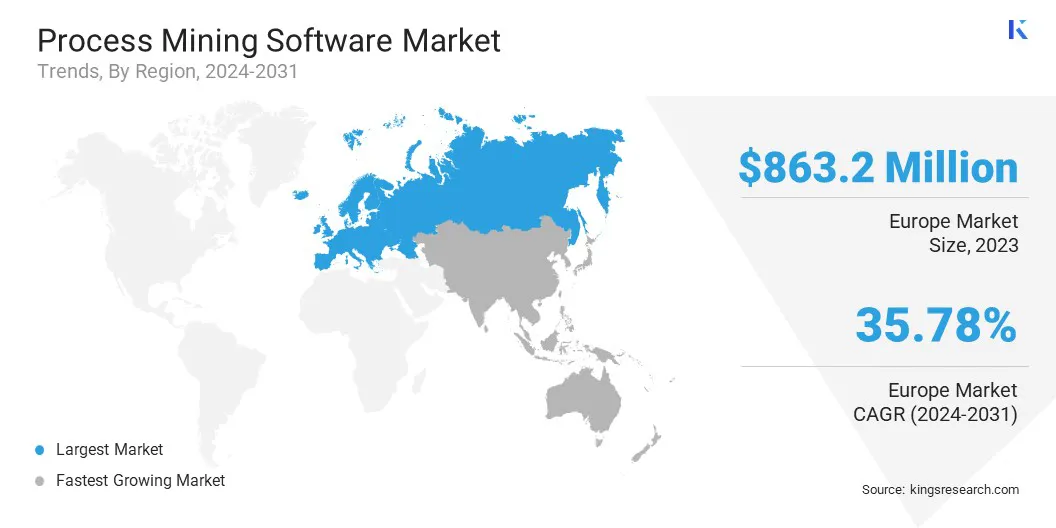
Europe process mining software market accounted for a market share of around 36.72% in 2023, with a valuation of USD 863.2 million. Europe is a dominant region in the market, due to its strong focus on technological innovation and operational efficiency.
Companies across various industries are increasingly adopting process mining solutions to optimize business processes, enhance decision-making, and gain real-time insights. The region’s emphasis on digital transformation, data-driven strategies, and continuous improvement fosters the widespread implementation of process mining tools. These factors, coupled with a favorable regulatory environment, position Europe as a leader in the global market.
The process mining software industry in Asia Pacific is poised for significant growth at a robust CAGR of 37.18% over the forecast period. Asia Pacific is the fastest-growing region in the market, driven by rapid digital transformation and increased adoption of automation technologies.
The region’s expanding industrial sectors, including manufacturing, retail, and finance, are adopting process mining solutions to enhance operational efficiency and streamline workflows.
Rising investments in AI and data analytics, along with growing awareness of process optimization, further accelerate the market growth. Additionally, favorable government initiatives and an increasing number of SMEs are contributing to the swift market expansion in the region.
Companies in the process mining software industry are attracting investments to accelerate product development, expand their market reach, and enhance capabilities.
Funding supports innovation in AI and data analytics, enabling these companies to refine their software, integrate advanced features, and scale operations. It also helps drive the market, improve customer acquisition, and establish partnerships to fuel long-term growth.
Frequently Asked Questions

Sharmishtha is a budding research analyst with a strong commitment to achieving excellence in her field. She brings a meticulous approach to every project, delving deep into details to ensure comprehensive and insightful outcomes. Passionate about continuous learning, she strives to enhance her expertise and stay ahead in the dynamic world of market research. Beyond work, Sharmishtha enjoys reading books, spending quality time with friends and family, and engaging in activities that foster personal growth. Her dedication to precision ensures that no critical detail is overlooked, and her analytical rigor consistently produces reliable, evidence-based conclusions. Sharmishtha's proactive curiosity drives her to explore emerging research methodologies, which she readily applies to deliver fresh perspectives on complex market questions. Her collaborative nature and openness to constructive feedback make her a dependable team player. She balances technical accuracy with clear communication, ensuring her insights are actionable for clients and stakeholders alike.

With over a decade of research leadership across global markets, Ganapathy brings sharp judgment, strategic clarity, and deep industry expertise. Known for precision and an unwavering commitment to quality, he guides teams and clients with insights that consistently drive impactful business outcomes.



