
Inquire Now
Key Strategic Points
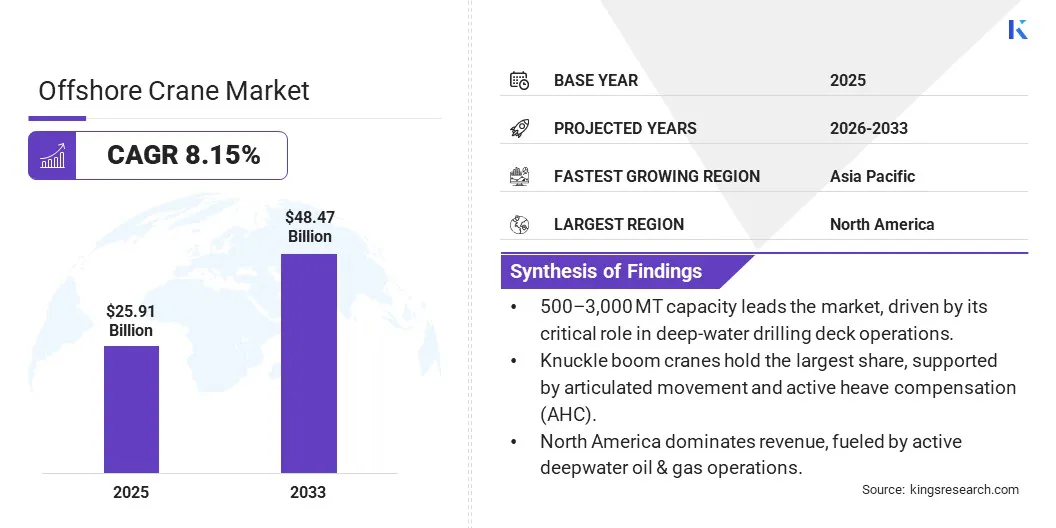
According to Kings Research, the global offshore crane market size was recorded at USD 25.91 billion in 2025 and is projected to reach USD 48.47 billion by 2033, growing at a CAGR of 8.15% from 2026 to 2033. The shift toward offshore wind farm installation and deepwater energy exploration is a significant driver propelling the growth of the offshore crane market. In this study, the report covers companies such as Liebherr-International AG; NOV Inc.; Cargotec Corporation; Palfinger AG; Huisman Equipment B.V.; Seatrax, Inc.; Altrad Sparrows; Kongsberg Maritime; XCMG Group; CSSC South China Marine Machinery Co., Ltd.; Kenz Figee Group B.V.; Heila Cranes S.p.A.; SANY Group; The Manitowoc Company, Inc.; Cormach S.r.l.; DONGAN Marine Crane; SCALDIS Salvage & Marine Contractors; ZPMC (Shanghai Zhenhua Heavy Industries Co., Ltd.); among others.
Offshore energy expansion is accelerating the adoption of specialized marine cranes by offering high-capacity deck handling, extended boom outreach, and dynamic motion compensation without compromising operational safety in severe sea states. Advanced offshore crane platforms enable seamless integration with modern vessel automation systems, facilitating heavy-load transfers across floating production units, subsea structures, and wind turbine installation platforms. Additionally, robust marine safety compliance and active heave compensation (AHC) technologies provided by crane manufacturers help vessel operators meet API Spec 2C and DNV-ST-0378 regulatory requirements. These operational advantages make high-capacity offshore cranes an essential asset for marine operators seeking safe, efficient, and versatile handling systems to perform critical lifts in open-water environments, thereby supporting the growth of the global offshore crane market.
Offshore crane solutions involve the design, fabrication, hydraulic/electric power integration, and maintenance of boom structures equipped with dynamic winch systems and automated motion compensation. The applications of offshore cranes are broad and span across various maritime industries. In the oil and gas sector, offshore cranes handle drill pipes, risers, subsea manifolds, and platform maintenance supplies, maintaining deck logistics in deepwater fields.
In the renewable energy sector, offshore cranes facilitate the transport, assembly, and foundation placement of multi-megawatt wind turbines and heavy offshore converter platforms. Moreover, offshore cranes find extensive application in marine construction and platform decommissioning, where high-capacity lattice and knuckle-boom cranes execute complex heavy lifts and salvage operations. Industries such as naval defense, subsea pipeline construction, and marine infrastructure are deploying advanced offshore cranes to streamline vessel deck space, enhance load accuracy, and expand operational weather windows.
.
The growth in offshore wind energy projects is a significant driver for the offshore crane market, as these projects require specialized lifting equipment for the installation, maintenance, and decommissioning of wind turbines. Offshore wind farms are expanding rapidly, particularly in Europe, Asia, and North America, as countries seek to increase renewable energy capacity and meet climate goals. In June 2025, GWEC reported that global offshore wind capacity had reached 83 GW, with annual offshore wind installations forecast to increase from 8 GW in 2024 to 34 GW by 2030. The rapid expansion of offshore wind projects is expected to increase demand for specialized offshore cranes required for turbine installation, maintenance, and other heavy-lifting activities. The complexity of offshore wind projects, which are often located in deep waters and far from shore, necessitates advanced offshore cranes capable of handling heavy components such as turbine blades, nacelles, and tower sections in challenging marine environments. The demand for such cranes is expected to increase as governments and private investors commit substantial funds to large-scale offshore wind farms. Furthermore, the development of larger turbines that generate more power requires more robust and high-capacity lifting solutions, further increasing demand for offshore cranes. Crane manufacturers are innovating to meet the specific requirements of the growing offshore wind industry, creating opportunities for market expansion and technological advancements.
Stringent regulatory requirements present a significant challenge to the offshore crane market, as companies must comply with numerous international, national, and industry-specific standards to ensure safety, environmental protection, and operational efficiency. These regulations cover various aspects of offshore cranes, including design, manufacturing, and operation, and often require rigorous certification processes. Compliance with these standards is critical, as failure to meet them can result in legal penalties, project delays, and reputational damage. Offshore cranes must adhere to stringent safety regulations governing load handling, stability, and emergency systems, requiring continuous investment in advanced technologies and regular maintenance. Moreover, environmental regulations aimed at reducing emissions and minimizing the ecological impact of offshore activities are becoming increasingly stringent, driving the need for greener technologies such as hybrid and electric cranes. Mitigating these challenges requires continuous monitoring of regulatory changes, investment in research and development to develop compliant technologies, regular maintenance and certification, and collaboration with regulatory bodies to ensure adherence to the latest standards.
The expansion of offshore oil and gas exploration activities is a key trend influencing the offshore crane market, as companies increasingly venture into deep- and ultra-deepwater regions to access new reserves. With onshore and shallow water oil fields maturing, oil and gas operators are moving further offshore, where substantial untapped reserves remain available. This shift is increasing demand for sophisticated, high-capacity offshore cranes capable of handling heavy and complex equipment used in deepwater drilling operations. Rising global energy demand, particularly from emerging economies, is further encouraging investments in offshore exploration projects. In addition, advancements in drilling technologies and the development of floating production, storage, and offloading (FPSO) units are making deepwater exploration increasingly feasible. Offshore cranes are essential for the installation, maintenance, and decommissioning of offshore platforms, rigs, and subsea equipment, making them indispensable to expanding deepwater oil and gas activities.
|
Segmentation |
Details |
|
By Type |
Knuckle Boom Cranes, Telescopic Boom Cranes, Lattice Boom Cranes and Others |
|
By Lifting Capacity |
Up to 500 MT, 500-3000 MT and Above 3000 MT |
|
By Application |
Oil & Gas, Renewable Energy, Marine and Others
|
|
By Region |
North America: U.S., Canada, Mexico |
|
Europe: France, UK, Spain, Germany, Italy, Russia, Rest of Europe |
|
|
Asia-Pacific: China, Japan, India, Australia, ASEAN, South Korea, Rest of Asia-Pacific |
|
|
Middle East & Africa: Turkey, UAE, Saudi Arabia, South Africa, and the Rest of Middle East & Africa |
|
|
South & Central America: Brazil, Argentina, Rest of South & Central America |
The global market has been segmented on the basis of type, lifting capacity, application, and geography.
Based on type, the offshore crane market is categorized into knuckle boom cranes, telescopic boom cranes, lattice boom cranes, and others. According to Kings Research, knuckle boom cranes accounted for the largest share of the offshore crane market, primarily due to their versatility and efficiency in offshore operations. These cranes feature an articulated and foldable boom that enables precise load handling and greater maneuverability in confined spaces. This makes them particularly suitable for offshore platforms and vessels where deck space is limited and operational flexibility is critical. Their ability to operate in harsh marine environments, combined with enhanced safety and precise load-control capabilities, supports their widespread adoption across offshore applications, including oil and gas exploration, offshore wind farm installation, and subsea operations.
Knuckle boom cranes are also favored for their ability to reduce the pendulum effect during lifting by positioning the boom tip closer to the load, thereby improving load stability and safety, particularly when operating in rough sea conditions. This capability is especially valuable for subsea operations, where vessel motion and challenging marine conditions can affect lifting accuracy. Consequently, the growing demand for efficient, reliable, and safe lifting solutions across the expanding offshore energy sector, coupled with continued advancements in knuckle boom crane technology, is strengthening the segment's leading position in the market.
Based on lifting capacity, the offshore crane market is classified into up to 500 MT, 500–3,000 MT, and above 3,000 MT. According to Kings Research, the 500–3,000 MT segment is expected to witness the fastest growth over the forecast period, driven by the increasing need for high-capacity cranes in complex offshore projects. As offshore oil and gas exploration and offshore wind energy installations increasingly move into deeper waters, demand is rising for cranes capable of handling substantially heavier loads. Cranes within the 500–3,000 MT range offer an effective balance between lifting power and operational versatility, making them suitable for a wide range of offshore applications, including the installation of heavy subsea infrastructure and large wind turbine components.
The construction of larger offshore platforms and floating production, storage, and offloading (FPSO) units is further supporting demand for high-capacity cranes capable of handling heavier loads. In addition, advancements in crane technology, including enhanced safety features, automation, and improved operational controls, are increasing the efficiency and reliability of these cranes, making them more attractive to offshore operators. Consequently, the expansion of deepwater offshore projects, increasing component sizes, and technological advancements are expected to strengthen the growth of the 500–3,000 MT segment.
Based on application, the offshore crane market is divided into oil & gas, renewable energy, marine, and others. According to Kings Research, the oil & gas segment held the largest share of the offshore crane market, driven by the continued expansion of offshore exploration and production activities. Rising global energy demand is encouraging oil and gas companies to increase investments in offshore projects, particularly in deep- and ultra-deepwater regions where significant untapped reserves remain. These projects require high-capacity offshore cranes capable of performing heavy lifting and precise load placement for drilling and production operations. The continued development of new offshore platforms, subsea systems, and floating production, storage, and offloading (FPSO) units is further driving demand for reliable crane solutions. In addition, the oil & gas industry's increasing focus on improving operational efficiency and safety is supporting the adoption of advanced crane technologies, thereby contributing to segment growth.
Based on region, the global market has been classified into North America, Europe, Asia-Pacific, MEA, and South and Central America.
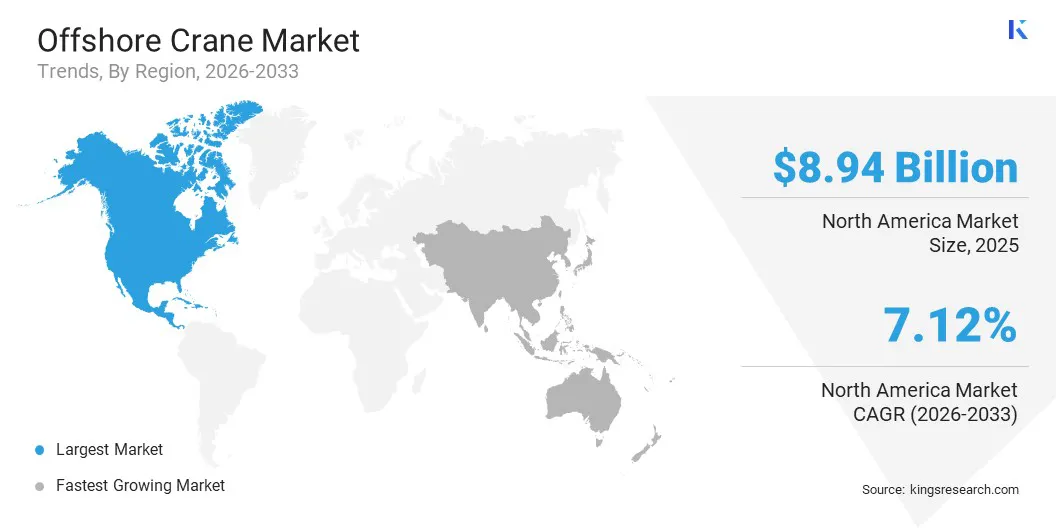
According to Kings Research, North America has the highest market share in the offshore crane market, driven by the region's continued investment in offshore energy infrastructure and technological advancements in offshore crane systems. The U.S. and Canada are key players in the offshore oil and gas industry, with substantial exploration and production activities in the Gulf of Mexico and the Arctic regions.
As these countries seek to enhance their energy security and capitalize on their offshore resources, the demand for high-capacity and technologically advanced offshore cranes is expected to rise. Additionally, North America's growing focus on renewable energy, particularly offshore wind, is contributing to market growth.
The region is witnessing increased investment in offshore wind farms, particularly along the U.S. East Coast, which requires specialized cranes for the installation and maintenance of wind turbines. Furthermore, the adoption of advanced technologies, such as automation and digitalization in offshore cranes, is improving operational efficiency and safety, making them more attractive to operators.
Asia-Pacific offshore crane market has the highest CAGR in the global market for the forecast period. This is attributed to the robust growth in offshore oil and gas exploration and rapid expansion of offshore wind energy projects.
Countries like China, India, Japan, and South Korea are leading the charge in offshore energy development, driven by their increasing energy demands and strategic initiatives to reduce dependence on imported fossil fuels. Significant investments in large-scale offshore projects, particularly in deep and ultra-deepwater drilling, have fueled the demand for advanced offshore cranes capable of handling complex lifting operations in challenging environments.
Moreover, the growing focus on renewable energy, with substantial offshore wind farm installations planned and under development across the region, has further bolstered the market. The presence of major offshore equipment manufacturers and favorable government policies promoting energy security and infrastructure development have also contributed to the global market.
Europe is witnessing steady demand for offshore cranes, driven by offshore wind expansion, subsea development, and port modernization across the North Sea, Baltic Sea, and Atlantic. The MEA region is supported by ongoing offshore oil and gas exploration and expanding deepwater infrastructure, increasing demand for high-capacity lifting equipment. South & Central America is benefiting from Brazil’s strong pre-salt activities and increasing investment in FPSOs, subsea systems, and offshore exploration. Across these regions, growing offshore project activity is encouraging investments in advanced and reliable crane systems. The need for efficient lifting solutions in increasingly complex offshore operations is further driving demand.
The global offshore crane market report provides valuable insights with a specialized emphasis on the fragmented nature of the industry. Key players are pursuing partnerships, mergers and acquisitions, product innovation, and joint ventures to expand their portfolios and strengthen regional positions.
Companies are implementing impactful strategic initiatives, such as expansion of services, investments in research and development (R&D), establishment of new service delivery centers, and optimization of their service delivery processes, which are likely to create new opportunities for market growth.
How We Gather This Information
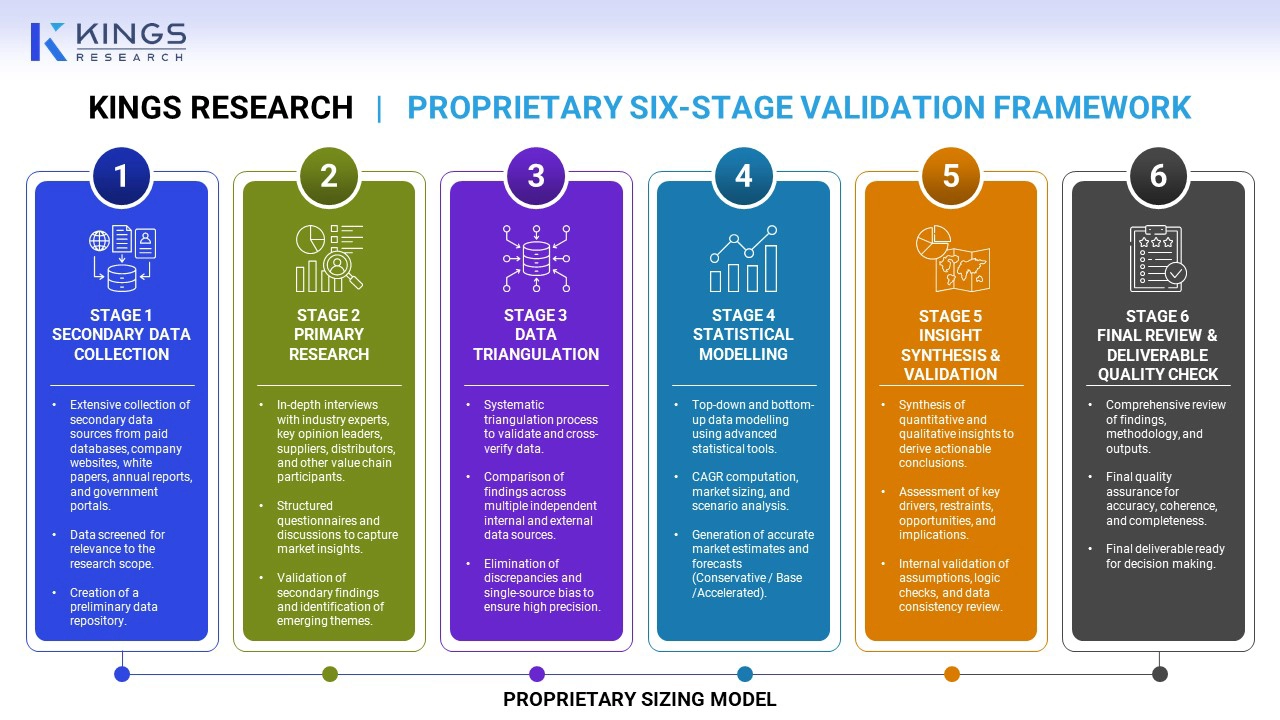
Our methodology triangulates insights from multiple independent and publicly available research databases and is further validated against regulatory filings and public company disclosures. All estimates are cross-verified; no single-source data is presented without validation.
Our custom offerings deliver tailored, data-driven intelligence and strategic guidance to help organizations identify, evaluate, and capitalize on key market opportunities.
Frequently Asked Questions

Antriksh is an experienced analyst specializing in cross-domain research across diverse industries. With a strong foundation in data analysis and statistical interpretation, he delivers insightful market reports that guide strategic decision-making. Antriksh excels in conducting primary research, with a focus on identifying trends and understanding consumer behavior. Thriving in dynamic and high-pressure environments, he combines analytical expertise with a commitment to delivering impactful outcomes. Beyond his professional pursuits, Antriksh's passion for travel fuels his curiosity and broadens his perspectives, enriching his ability to uncover unique insights that enhance his research capabilities. He is equally adept at synthesizing quantitative findings with qualitative context, which allows him to present holistic viewpoints to clients. His disciplined work ethic and intellectual agility make him a trusted partner in navigating market uncertainties. He consistently seeks out new methodologies to refine his analytical toolkit, and his ability to communicate complex insights clearly ensures stakeholders act confidently on his recommendations.
Habi is a seasoned research and consulting leader with renowned experience in guiding clients on strategic growth and transformation initiatives across global markets. He has led high-performing research teams that deliver actionable insights on market expansion, M&A strategies, opportunity assessment, new business development, and product launches. His project portfolio spans large petrochemical producers, electronic device manufacturers, lubricants companies, and other leading enterprises across diverse industrial and consumer sectors. He currently heads the research department at Kings Research, where he is responsible for setting the research agenda, mentoring analysts, and ensuring client-ready deliverables that support executive decision-making. With extensive experience in market intelligence, strategic research, and consulting, Habi brings a strong understanding of evolving industry dynamics, competitive landscapes, emerging opportunities, and business growth challenges. His expertise includes developing research frameworks, translating complex market data into actionable strategic recommendations, and working closely with senior stakeholders to address critical business questions. He has also contributed to building research capabilities, strengthening analytical methodologies, and driving a culture of quality and insight-led decision-making within research teams. His cross-industry exposure enables him to connect market trends with broader business implications and provide perspectives that help organizations identify opportunities, mitigate risks, and make informed strategic decisions.



.webp&w=128&q=75&dpl=dpl_DPva2LrvfsBdTJm1XZj67UTrvMHL)
