


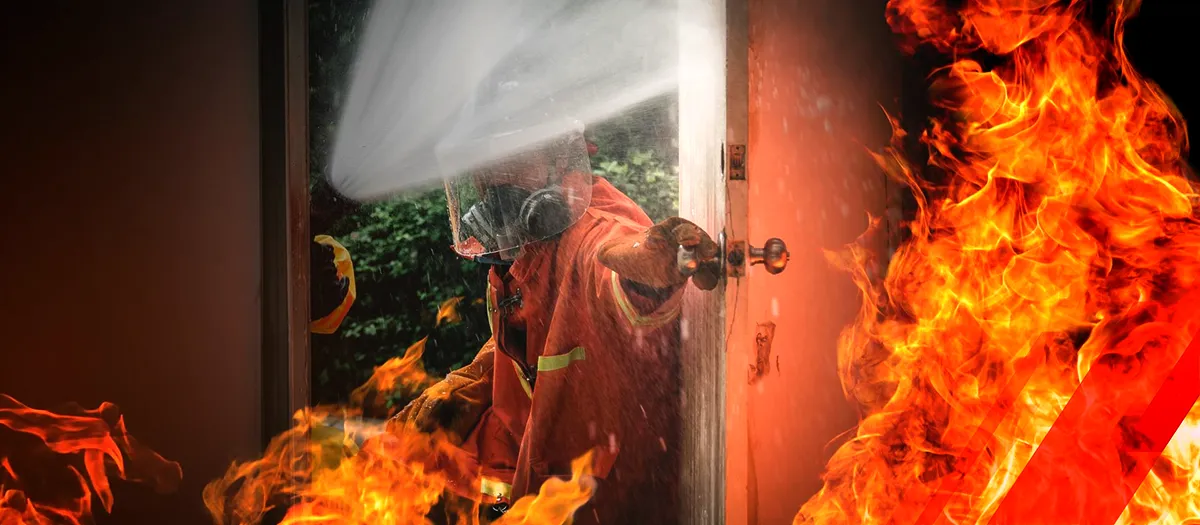
Fire doors can resist fire for up to 90 minutes, creating critical time for occupants to evacuate and firefighters to control a blaze. Testing standards referenced by organizations such as the National Fire Protection Association and Underwriters Laboratories demonstrate how fire-rated door assemblies maintain integrity under extreme heat. They are a complete assembly consisting of the door leaf, frame, hardware, and accessories, which together have been tested and rated for fire resistance under standards such as NFPA 80.
Despite their importance, these critical doors are often overlooked in building design and maintenance. Yet they remain one of the most regulated components of passive fire protection systems in commercial and residential buildings. According to the latest report by Kings Research, the global fire door market is expected to reach $37.08 billion by 2031.
How Does a Fire Door Work?
Certified fire-rated doors are based on the concept of compartmentalization. Modern structures are built with fire-rated compartments or walls, which divide the space into different sections or zones. This minimizes the spread of fire and smoke between these sections or zones. When a fire breaks out, these sections or zones limit the spread of heat and smoke.
A fire-resistant door, when properly installed, acts as a fire barrier. When closed and secured, it restricts the spread of heat and smoke for the period for which it has been rated. The door, along with the frame, works as a single unit, maintaining structural integrity despite the rise in temperature.
Fire-resistant doors are tested by centers such as Underwriters Laboratories, which subject the doors to a furnace test at temperatures up to 900°C or higher. A fire-resistant door must remain closed and structurally sound for the period of the test.
What are the Key Components of a Fire Door Assembly?
The components of a fireproof door include:
Door Leaf
The door leaf is the main panel of the fire-resistant door. The fire-rated door often includes a mineral core, steel composite, or dense timber core, all of which have been specifically designed to resist high temperatures. The inner configuration of the door determines how well stability is maintained during a fire.
Door Frame
The door frame provides support for the door. The door frame should be fire-rated, similar to the door. If a fire-rated door is installed with a non-rated door frame, it loses its rating. Steel frames are used for commercial buildings because of their strength and resistance to fire.
Intumescent Seals
These types of seals expand during exposure to fire. The strips are fixed around the edges of the door. The strips expand when exposed to temperatures of 150-200°C. After expanding, the strips fill the space between the door and frame, hence preventing the movement of smoke and gases through the door.
Self-Closing Device
According to NFPA 80, self-closing devices should be installed so that fireproof doors close and latch after each use. This means that wedges or doorstops cannot be used for fire-resistant doors.
Fire-Rated Glazing
Some fire-resistant doors have small glass panels for visibility. The glass panels should be fire-rated. The panels should be ceramic or treated glass.
Door Hardware
All door hardware, including hinges, locks, and latches, should be fire-rated. The hardware is tested as an assembly and hence provides maximum reliability during exposure to high temperatures.
What Do Fire Door Ratings Mean?
Fire rating varies based on the duration of time for which the fire can be withstood. It measures the amount of time the door can withstand fire before disintegrating. This rating is achieved by carrying out standardized tests in a furnace by certification bodies such as Underwriters Laboratories. The 20-minute rating is usually used for corridors in offices and partitions with low fire risks. The 45-minute fire barrier rating is commonly used for staircases and one-hour fire barriers.
The 60-minute fire door rating, known as FD60, is used for corridors with high fire risks and exit passages. The 90-minute door rating is commonly used in high-rise buildings and separating spaces with different occupancies to slow down the spread of fire. The highest rating of a fire door is the 3-hour door, used in major fire walls where maximum fire rating is required.
It should be noted that the fire rating applies to the entire door assembly and not to the door leaf individually. A door with a 90-minute rating installed in an unrated frame will not offer a 90-minute rating.
Where Are Fire Doors Required?
Building codes specify several locations where fireproof doors must be installed.
Stairwells and Exit Enclosures
These doors protect evacuation paths from smoke and flames during emergencies.
Elevator Lobbies and Shafts
Fire-resistant doors installed in elevator lobbies help prevent flames and smoke from spreading between floors.
Occupancy Separation Areas
The International Code Council requires fire-rated separations when different occupancy types share the same structure, such as retail spaces within residential buildings.
Mechanical and Electrical Rooms
Rooms containing boilers, electrical switchgear, or HVAC equipment carry increased fire risk.
Healthcare and Educational Corridors
Hospitals, care homes, and schools often have stricter fire safety rules because evacuation can be slower.
Fire Door Regulations and Standards
The following regulations and standards monitor fireproof doors:
NFPA 80
NFPA 80 is the primary U.S. standard governing the installation, inspection, and maintenance of fire-resistant door assemblies.
NFPA 101
NFPA 101 establishes life safety requirements for buildings based on occupancy type. It references NFPA 80 for the technical requirements governing the assemblies.
UK Fire Safety Act 2021 and Building Safety Act 2022
Following the Grenfell Tower disaster, the United Kingdom strengthened building fire safety regulations. The Building Safety Act requires responsible persons in multi-occupancy residential buildings to conduct routine inspections.
International Building Code (IBC)
The IBC publishes the International Building Code, which many U.S. jurisdictions adopt. The code specifies where doors are required based on building height, construction type, and occupancy classification.
International Fire Code (IFC)
The IFC governs fire protection systems in buildings already in operation. It includes rules covering inspection and maintenance requirements for assemblies.
Fire Door Inspection and Maintenance Requirements
Fire testing must be completed regularly to ensure they remain compliant with safety standards.
Annual Inspection Mandate
NFPA 80 requires doors to be inspected and tested at least once every year by trained personnel.
Inspection Checklist
Inspectors confirm that the door closes fully and latches automatically, that seals remain intact, and that glazing and hardware are undamaged.
Documentation Requirements
Inspection records must document the location of each door, inspection dates, and any deficiencies discovered during the inspection.
Common Deficiencies
Frequent inspection failures include damaged seals, missing closers, non-rated hardware replacements, and doors that are propped open during normal use.
Conclusion
Fire doors are an essential part of passive fire protection. They are operated without electricity, alarm systems, or human intervention. Their performance depends entirely on proper installation, the use of certified parts, and inspection. Buildings that treat fire-resistant doors as a one-time construction requirement often face failures during inspections and emergency situations. If properly maintained, a fireproof door assembly is one of the most reliable means of containing the spread of fire and smoke in modern structures.