
Inquire Now
Key Strategic Points
According to Kings Research, the global automotive paints market size was valued at USD 9.28 billion in 2025 and is projected to reach USD 12.15 billion by 2033, growing at a CAGR of 3.43% from 2026 to 2033.
The report covers products offered by companies such as 3M, AkzoNobel N.V., Axalta Coating Systems, LLC, BASF SE, Berger Paints India, Hempel A/S, Henkel Corporation, Kansai Paint Co., Ltd., MIPA SE, Nippon Paint Holdings Co., Ltd., PPG Industries, Inc., RPM International Inc., Sika AG, The Sherwin-Williams Company, and TOA Performance Coating Corporation Limited.
The market's growth is driven by the continuous expansion of the automotive industry, particularly in emerging economies, alongside the development of electric and hybrid vehicles, which require specialized coating formulations to cater to weight, conductivity, and aesthetic requirements that are distinct from conventional internal-combustion vehicles. Kings Research finds that consumer demand for customization fuels the market for premium coatings, while regulatory mandates continue to drive adoption of eco-friendly formulations. This dynamic creates opportunities for manufacturers who can align product innovation with evolving consumer preferences and tightening regulatory requirements.
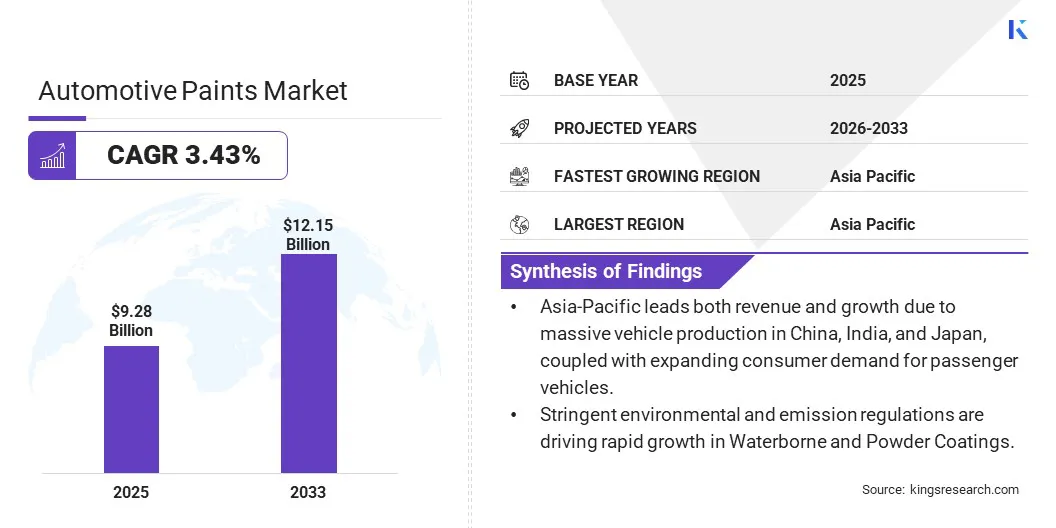
The continuous expansion of the automotive industry, particularly in emerging economies, is a primary driver of automotive paint market growth. According to the International Organization of Motor Vehicle Manufacturers (OICA), the global production of motor vehicles rose from 92.7 million units in 2024 to 96.4 million in 2025, while global sales climbed from 95.3 million to 99.8 million units. Emerging markets such as China and India are experiencing rapid industrialization and urbanization, which is driving vehicle demand and, in turn, automotive paint demand. Consumer preferences for customized vehicle aesthetics, including unique colors, finishes, and textures, are also expanding the addressable market for premium and specialty coatings.
Stringent environmental regulations aimed at reducing volatile organic compound (VOC) emissions pose a significant challenge for automotive paint manufacturers. The EU Directive 2004/42/EC establishes guidelines to reduce air pollution by limiting volatile organic compound (VOC) emissions from certain paints, varnishes, and vehicle refinishing products. The directive promotes the use of lower-VOC formulations, including water-borne coatings, to reduce the formation of ground-level ozone.
Market players are aligning their production strategies to develop products that comply with evolving regulatory standards. Compliance requires sustained investment in research and development, as well as modifications to production processes. The transition to eco-friendly, low-VOC coatings may also result in higher production costs initially, creating a trade-off between regulatory compliance and cost competitiveness that manufacturers must carefully manage.
|
Segmentation |
Details |
|
|
By Paint Type |
Electrocoat (E-Coat), Primer, Basecoat, Clearcoat |
|
|
By Technology |
Waterborne Coatings, Solvent-borne Coatings, Powder Coatings |
|
|
By Resin Type |
Polyurethane, Epoxy, Acrylic, Other Resins |
|
|
By Texture |
Solid, Metallic, Matte Finish, Pearlescent, Solar Reflective |
|
|
By Vehicle Type |
Passenger Cars, Light Commercial Vehicles (LCVs), Trucks and Buses |
|
|
By Region |
North America |
U.S., Canada, Mexico |
|
Europe |
France, UK, Spain, Germany, Italy, Russia, Rest of Europe |
|
|
Asia-Pacific |
China, Japan, India, Australia, ASEAN, South Korea, Rest of Asia-Pacific |
|
|
Middle East and Africa |
Turkey, U.A.E., Saudi Arabia, South Africa, Rest of Middle East & Africa |
|
|
South and Central America |
Brazil, Argentina, Rest of South and Central America |
|
Which paint type captures the largest share in the global automotive paints market in 2025?
Based on paint type, the market is further divided into primer base coat, basecoat, clearcoat, and electrocoat. The growth is primarily driven by its critical role in providing gloss, depth, and protection to vehicle surfaces. The high share of basecoat is attributed to its essential role in providing vehicle color, visual appeal, and customized finishes, while a growing consumer preference for metallic, pearlescent, and premium effects further drives its demand.
Automotive manufacturers prioritize clearcoats to enhance the aesthetic appeal and durability of vehicles, thereby contributing to their significant market share. Additionally, advancements in clearcoat formulations, including UV resistance and scratch resistance properties, are bolstering its demand in the automotive industry.
Which texture type captures the largest market share in the automotive paints market?
Based on texture, the market is categorized into solid, metallic, matte finish, pearlescent, and solar reflective. Metallic finishes accounted for the largest market share in 2025 and are anticipated to maintain their dominance throughout the forecast period, primarily driven by their premium visual appeal and aesthetic sophistication.
Automotive manufacturers widely prioritize metallic finishes due to strong consumer demand, superior light-scattering properties, and their ability to highlight vehicle body contours. Additionally, metallic textures offer excellent durability and weather resistance and enhance overall vehicle resale value, making them a popular choice among vehicle owners. With metallic finishes projected to sustain their market leadership, manufacturers are continuing to invest in advanced color formulation and coating technologies to meet evolving consumer preferences while ensuring consistent quality and long-lasting performance.
Based on region, the global automotive paints market is classified into North America, Europe, Asia-Pacific, Middle East & Africa, and South and Central America.
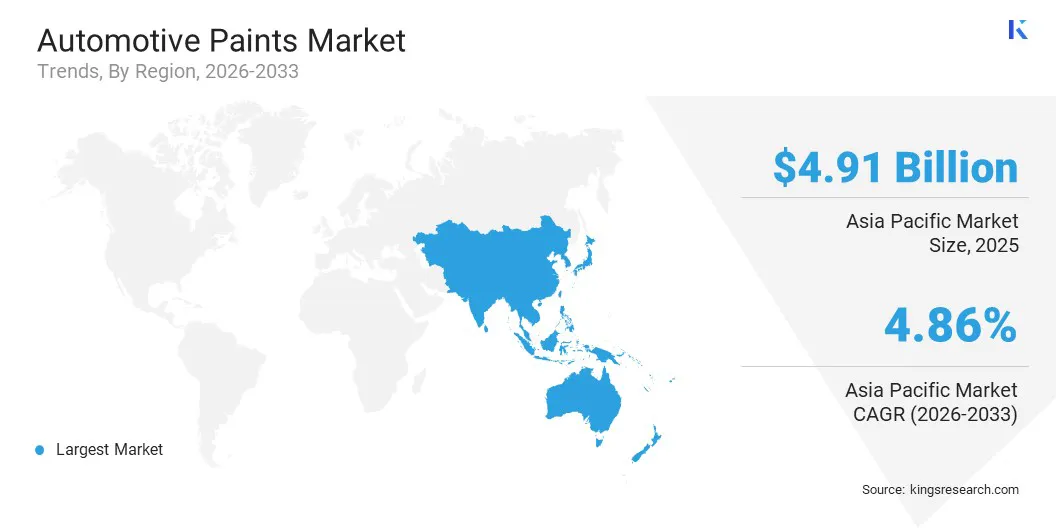
Asia-Pacific accounted for the dominant share of approximately 52.86% of the global market in 2025, valued at USD 4.91 billion. The region is also projected to register the fastest regional CAGR, at 4.86%, over the forecast interval (2026-2033). The high share is driven by rapid industrialization, urbanization, and an expanding automotive manufacturing base. According to the OICA, the Asia-Pacific registered maximum automobile production in 2025, rising to approximately 59.2 million vehicles and accounting for more than 61% of global output. Countries including China captured the dominant share, which is attributed to the addition of nearly 3.25 million vehicles in a single year to reach 34.53 million units produced, with the production of new-energy vehicles reaching 16.626 million units. Additionally, India emerged as the second major automotive producer, with production rising to 6.49 million vehicles and record domestic sales of over 4.6 million passenger vehicles. The high vehicle production and growing adoption of new-energy vehicles act as significant propellers, driving demand for automotive paints across the region.
The global automotive paints market is fragmented, with prominent players focusing on partnerships, mergers and acquisitions, product innovation, and joint ventures to expand their product portfolios and strengthen market positions across regions.
Leading manufacturers such as AkzoNobel, PPG Industries, and BASF offer broad portfolios of waterborne and solvent-borne coatings across OEM and automotive refinish applications. These companies are also investing in R&D, manufacturing capacity, and supply chain optimization to enhance product performance, expand production capabilities, and support growth across key markets.
How We Gather This Information
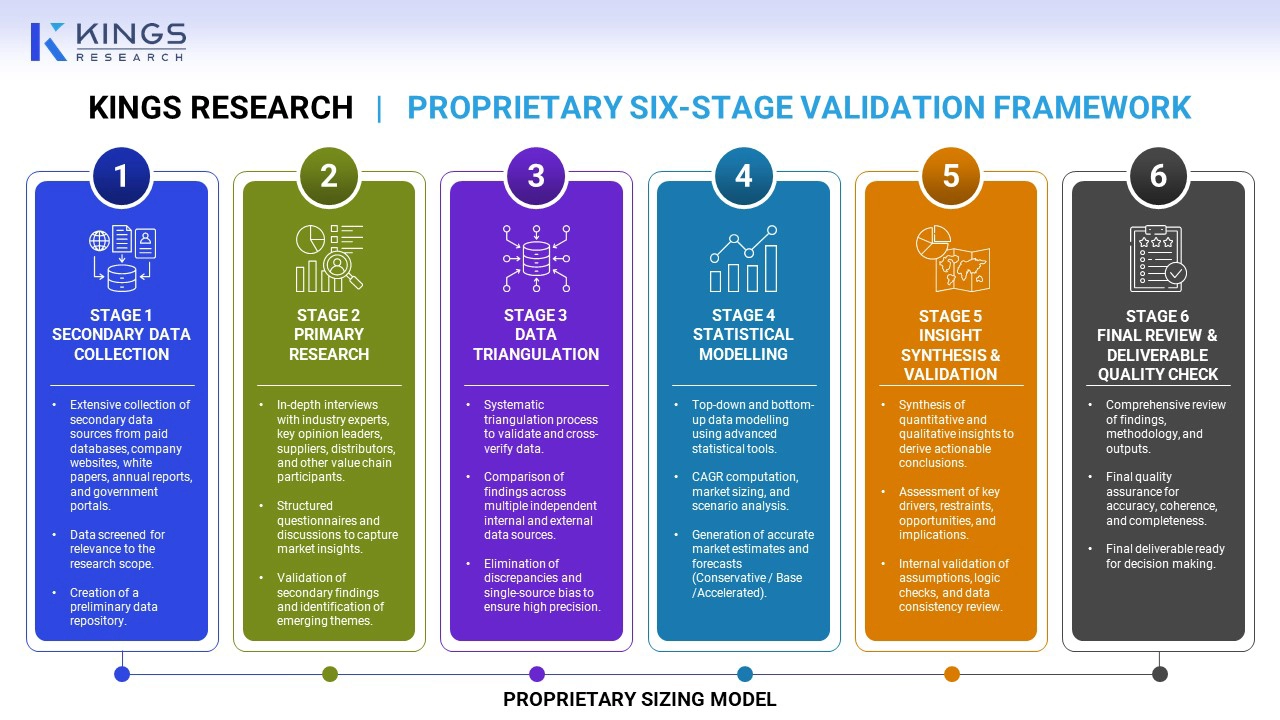
Our methodology triangulates insights from multiple independent and publicly available research databases, which is further validated against regulatory filings and public company disclosures. All estimates are cross-verified; no single-source data is presented without validation.
Our custom offerings deliver tailored, data-driven intelligence and strategic guidance to help organizations identify, evaluate, and capitalize on key market opportunities.
Frequently Asked Questions

Faizy brings over four years of experience in market research and consulting, with a proven ability to support strategic engagements across diverse industries and business environments. His work focuses on understanding complex market structures, identifying emerging opportunities, and translating research findings into clear, commercially relevant insights. With strong analytical capabilities and a structured approach to problem-solving, he evaluates industry trends, competitive landscapes, customer dynamics, and evolving business models. His expertise encompasses market research, competitive intelligence, market sizing and forecasting, industry assessment, company benchmarking, and strategic analysis. Faizy combines technical proficiency with a strong research orientation, enabling him to interpret both qualitative and quantitative information effectively. He has contributed to projects that help organizations assess growth potential, strengthen market positioning, and evaluate strategic priorities. His adaptable approach allows him to work across sectors while maintaining a consistent focus on accuracy, relevance, and delivering insights that support informed decision-making for clients and stakeholders.
Habi is a seasoned research and consulting leader with renowned experience in guiding clients on strategic growth and transformation initiatives across global markets. He has led high-performing research teams that deliver actionable insights on market expansion, M&A strategies, opportunity assessment, new business development, and product launches. His project portfolio spans large petrochemical producers, electronic device manufacturers, lubricants companies, and other leading enterprises across diverse industrial and consumer sectors. He currently heads the research department at Kings Research, where he is responsible for setting the research agenda, mentoring analysts, and ensuring client-ready deliverables that support executive decision-making. With extensive experience in market intelligence, strategic research, and consulting, Habi brings a strong understanding of evolving industry dynamics, competitive landscapes, emerging opportunities, and business growth challenges. His expertise includes developing research frameworks, translating complex market data into actionable strategic recommendations, and working closely with senior stakeholders to address critical business questions. He has also contributed to building research capabilities, strengthening analytical methodologies, and driving a culture of quality and insight-led decision-making within research teams. His cross-industry exposure enables him to connect market trends with broader business implications and provide perspectives that help organizations identify opportunities, mitigate risks, and make informed strategic decisions.




