

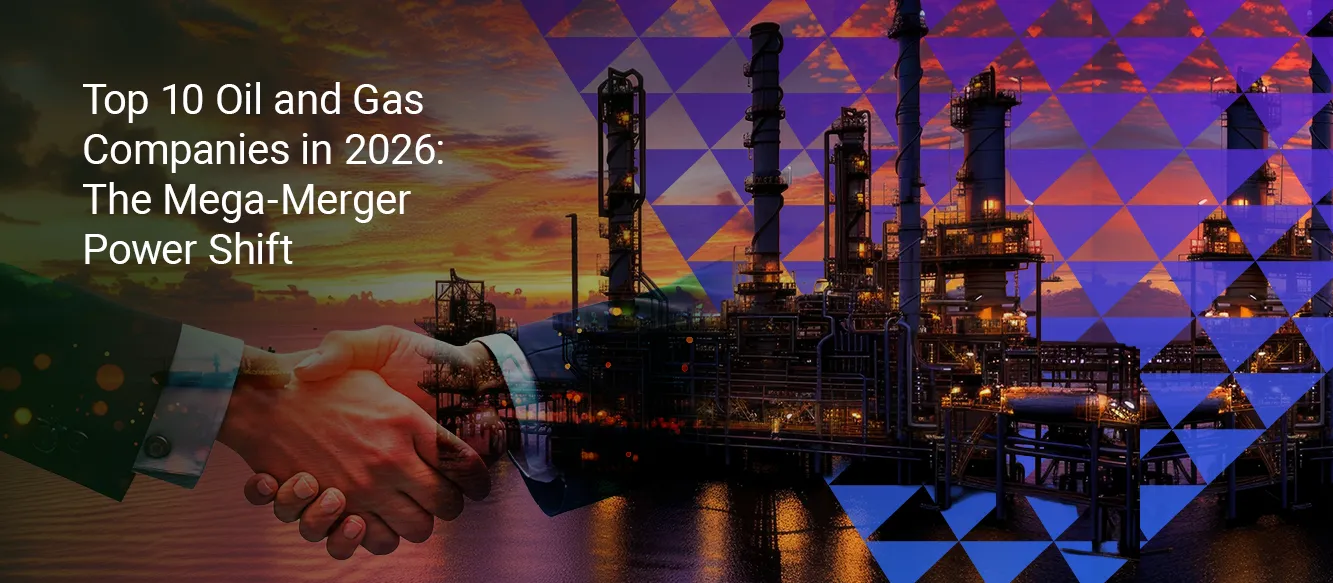
The global oil and gas market size was USD 6.71 trillion in 2023, is estimated at USD 6.92 trillion in 2024, and is projected to reach USD 8.92 trillion by 2031, growing at a CAGR of 3.68% from 2024 to 2031. The consolidation of corporations has changed the industry's capitalization and production capabilities. The biggest players in the market have begun acquiring regional competitors to secure productive resources in the Permian Basin. Additionally, they are expanding their liquefied natural gas infrastructure to meet the global energy demand. Industry leaders focus on increasing production scale to reduce costs. It is vital to note how mergers have affected the 2026 global rankings of oil companies.
As of 2026, the top 10 oil and gas companies leading the global energy market are Saudi Aramco, ExxonMobil, Chevron, ConocoPhillips, Shell plc, TotalEnergies, BP PLC, PetroChina, CNOOC Limited, and Reliance Industries. Driven by unprecedented corporate consolidation, these massive organizations shape global production scale, upstream infrastructure, and liquefied natural gas corridors.
|
Company |
Production Scale |
Core Operational Strength |
Major Growth Catalyst |
Energy Transition Strategy |
Geographic Stronghold |
|
Saudi Aramco |
12 million bpd crude oil capacity |
World’s largest crude oil producer |
Jafurah unconventional gas development; global LNG equity expansion targeting 20 mtpa capacity |
Natural gas and LNG expansion |
Saudi Arabia & Middle East |
|
ExxonMobil |
4.7 million boe/d |
Permian Basin and Guyana production leadership |
USD 59.5 billion Pioneer acquisition |
LNG expansion and low-emission investments |
U.S. Permian Basin & Guyana |
|
Chevron |
Net oil-equivalent production up 286,000 bpd YoY |
Offshore and shale integration |
USD 53 billion Hess acquisition (closed July 2025) |
Natural gas/LNG as AI bridge fuel; selective CCS & hydrogen investments |
Guyana, Permian Basin & Eastern Mediterranean |
|
ConocoPhillips |
2.32 million boe/d (Q4 2025); FY2026 guidance 2.295–2.325 million boe/d |
World's largest independent E&P with pure upstream focus |
USD 22.5 billion Marathon Oil acquisition |
Capital-efficient, low-cost-of-supply upstream model |
North America, Canada, Norway, and Qatar LNG |
|
Shell plc |
~2.71 million boe/d combined output |
Global LNG and deepwater leadership |
Global LNG infrastructure expansion |
LNG-led transition strategy |
Europe, Asia & Global LNG corridors |
|
TotalEnergies |
~4% hydrocarbon production growth from 2024 to 2025 |
Multi-energy operating model |
Brazil and Libya production ramp-ups |
LNG-led growth + Integrated Power targeting 100 TWh electricity by 2030 |
Europe, Africa & Latin America |
|
BP PLC |
Targeting 2.3–2.5 million boe/d by 2030 |
Upstream portfolio reset; $10.5B/year capex (2025–2027) |
6 of 10 targeted major projects delivered in 2025 |
Selective low-carbon investments in bioenergy, EV charging, and CCUS |
U.S. Gulf, U.S. Lower 48 shale, UK North Sea, West Africa, Indonesia, and Azerbaijan |
|
PetroChina |
243.7 million tonnes oil-equivalent total output in 2024 (+2.2% YoY) |
State-backed national champion |
Domestic reserve and infrastructure expansion |
Natural gas scaling and supply diversification |
China |
|
CNOOC Limited |
780–800 million BOE production target |
Offshore deepwater production dominance |
9 South China Sea project startups in 2025 |
Offshore operational efficiency improvements |
Asia-Pacific & South China Sea |
|
Reliance Industries |
1.4 million bpd refining throughput |
World’s largest refining complex at Jamnagar |
USD 9 billion petrochemical expansion |
New energy and downstream integration strategy |
India & Asian export markets |
Methodology Note:
Company selection was based on a comparative assessment of production capacity, upstream and downstream integration, LNG infrastructure expansion, strategic mergers and acquisitions, refining throughput, and regional market influence. Additional evaluation factors included long-term capital deployment strategies, energy transition initiatives, and the companies’ projected ability to shape global oil and gas market dynamics through 2031.*
The Trillion-Dollar Trajectory of the Energy Economy
The global oil and gas market operates on a massive scale. According to Kings Research, the industry reached a valuation of USD 6.92 trillion in 2024. Projections indicate this massive sector will grow to USD 8.92 trillion by 2031. This steady expansion represents a compound annual growth rate of 3.68% over the forecast period. Energy companies must secure their positions within this rapidly growing market. Prominent market leaders are currently directing billions of dollars toward new extraction technologies and liquefied natural gas infrastructure. This financial momentum proves that traditional hydrocarbons remain a central pillar of the global economy. Developing economies in Asia and Europe are spending heavily to diversify their energy sources. This infrastructure expansion supports international trade and provides a highly reliable energy supply for industrial operations.
Consolidation as the Ultimate Growth Strategy
A number of factors are shaping the ranking of the above-mentioned top 10 oil and gas companies in 2026.
The Catalyst of Mega-Deals: The M&A landscape was fundamentally altered by landmark transactions, notably ExxonMobil’s USD 59.5 billion acquisition of Pioneer Natural Resources in 2024 to dominate the Permian Basin and Chevron’s USD 53 billion purchase of Hess in 2025. Together, these deals set a new benchmark for scale and fundamentally shifted the hierarchy of the largest oil and gas producers in the global market.
Targeted Basin Dominance: Consolidation has been strategically driven by the pursuit of concentrated U.S. unconventional assets. This trend is evidenced by Diamondback Energy’s USD 26 billion acquisition of Endeavor Energy Resources and ConocoPhillips’ USD 22.5 billion all-stock takeover of Marathon Oil.
Post-Merger Portfolio Rationalization: The historic wave of mega-mergers has triggered a secondary wave of strategic divestments. As supermajors integrate their massive acquisitions, they are actively shedding noncore, less profitable assets to refine their portfolios, creating a ripple effect of mid-market deals.
Midstream and Global Integration: The push for immense scale extends well beyond upstream producers. Midstream companies are consolidating heavily to achieve wellhead-to-water integration, while Middle Eastern state-owned entities are aggressively acquiring international assets to transform themselves into globally integrated energy conglomerates.
Regulatory Tailwinds Accelerating Activity: The M&A momentum of 2023 and 2024 is expected to be further fueled by a shifting U.S. regulatory environment in 2025. The Trump administration's anticipated return to traditional, more relaxed antitrust enforcement is predicted to reduce deal uncertainty and spur even further consolidation across the sector.
The Uncontested State-Owned Titan
Saudi Aramco
The Saudi Exchange currently lists Aramco at a market capitalization of approximately SAR 6.6 trillion, underscoring that investors continue to assign the company exceptional strategic value rather than pricing it as another cyclical oil name. On output, Aramco confirmed in October 2025 that the company can sustain a maximum crude oil production capacity of 12 million barrels per day for a full year without additional capital investment, a scale that reinforces its position as the world's largest crude oil producer by volume and keeps production capacity central to its market power.
Expanding Unconventional Gas and LNG Infrastructure
The deeper strategic shift, however, is that Aramco is no longer defending leadership through crude alone: its own strategy materials explicitly connect upstream growth to gas expansion and ongoing LNG investment, including international LNG positioning through MidOcean Energy, while the operational centerpiece of that pivot is Jafurah, where Aramco says it expects a ramp-up to 2.0 billion standard cubic feet per day of sales gas once the project reaches full development. Strategically, this makes Jafurah more than a field-development story. It is the mechanism through which Aramco broadens feedstock flexibility, supports domestic gas substitution, and strengthens its long-range LNG optionality.
The US Consolidators: Dominating the Permian and Deepwater
The unprecedented wave of historic M&A activity across 2024 and 2025 has permanently altered the rankings of the largest integrated oil companies in 2026. By acquiring major independent producers, U.S. supermajors have strengthened their portfolios, focusing on high-return, low-cost assets such as the Permian Basin. Analysis from the U.S. Energy Information Administration (EIA) underscores that these targeted megadeals were accelerated by the need to acquire proved reserves, achieve operational scale, and reduce portfolio risk by concentrating on domestic crude oil output.
ExxonMobil: The Pioneer Integration and Guyana Expansion
ExxonMobil announced a USD 59.5 billion all-stock acquisition of Pioneer Natural Resources, marking a significant expansion of its upstream portfolio. The transaction is expected to more than double ExxonMobil’s footprint in the Permian Basin, combining Pioneer’s extensive Midland Basin acreage with ExxonMobil’s existing assets to create a leading high-quality undeveloped U.S. unconventional resource position.
The Pioneer integration, combined with early development project start-ups in Guyana, has driven ExxonMobil’s output to a 40-year record. The company's total production has reached an astounding 4.7 million oil-equivalent barrels per day (boe/d), with the Permian Basin alone accounting for a vast majority of its onshore volume. By locking down these premier, high-margin assets, ExxonMobil has set a formidable benchmark that distances it from its global peers.
Chevron: The Hess Acquisition and Leviathan Focus
Chevron’s strategic acquisition of Hess Corporation (valued at USD 53 billion) has proven to be a transformative catalyst for the firm. By securing Hess’s highly coveted stake in Guyana’s prolific Stabroek Block and expanding its U.S. onshore footprint, Chevron has positioned itself as an unmatched offshore and shale powerhouse.
This consolidation has propelled Chevron to a market capitalization of approximately USD 397 billion as of April 2026. The Hess integration has accelerated Chevron's upstream engine, with worldwide net oil-equivalent production setting an annual record in 2025, driven by 261 MBOED from the Hess acquisition and Permian Basin growth. Beyond the Americas, Chevron made a Final Investment Decision in January 2026 on the Leviathan Gas Expansion offshore Israel, targeting 21 billion cubic meters of gas per year for delivery to Israel, Egypt, and Jordan.
ConocoPhillips: Scaling Through Marathon Oil
ConocoPhillips has firmly secured its rank as the world's largest independent exploration and production company through its USD 22.5 billion all-stock acquisition of Marathon Oil, completed in November 2024. The integration delivered over USD 1 billion in run-rate synergies by early 2026, more than doubling the original target of USD 500 million, while adding over 2 billion barrels of U.S. resource inventory at an average cost of supply below USD 30 per barrel WTI.
The integration has successfully uplifted the company's financial and operational profile. In fourth-quarter 2025, the company reported earnings of USD 1.4 billion and full-year earnings of USD 8.0 billion. Following the Marathon Oil acquisition, the company's output has surged, reaching a robust 2.3 million boe/d. This positions ConocoPhillips as the premier independent consolidator, capable of competing aggressively on the global stage.
The European Majors: Balancing Hydrocarbons and the Energy Transition
Shell PLC: Doubling Down on Deepwater and LNG
Shell remains the clearest LNG-led optimizer among the supermajors, anchoring its massive global valuation to a highly profitable portfolio of gas expansion and disciplined upstream operations. Its updated Q1 2026 production guidance sets integrated gas at 880,000 to 920,000 boe/d and upstream at 1.76 to 1.86 million boe/d, placing the combined midpoint at approximately 2.71 million boe/d. Shell is planning to lean into its LNG offerings, increasing production by 1% and sales by 4-5% annually. The company is also planning to keep its traditional oil production at a steady 1.4 million barrels/day till 2030.
TotalEnergies: The Multi-Energy Transition Strategy
TotalEnergies is balancing hydrocarbon growth with a broader multi-energy buildout, carrying a market capitalization of approximately USD 198.24 billion as of April 2026. Although affected by geopolitical uncertainties, the company forecasts hydrocarbon production growth of around 3%. For Q1 2026, hydrocarbon output is expected to benefit from organic growth above this level, supported by start-ups including Lapa SW in Brazil and Mabruk in Libya, while being partially offset by production losses in the Middle East of around 100 kboe/d. The company’s 2026 capital expenditure plan is approximately USD 15 billion, with annual spending guided at USD 14-16 billion through 2030.
BP PLC: Streamlining Portfolios
BP's strategic reset is the most return-focused of the major European oil companies. Public market data values the company at approximately USD 119.50 billion as of May 2026, and management's official reset centers on growing production to 2.3 to 2.5 million boe/d by 2030, up from a 2024 base of 2.36 million boe/d. The company has redirected capital heavily toward upstream oil and gas to reinforce cash generation for both distributions and selective lower-carbon options, with 10 major upstream projects targeted for delivery by the end of 2027.
The Asian Giants and Emerging Market Heavyweights
As the global energy environment faces geopolitical tensions and evolving trade policies, Asian state-backed enterprises and emerging market powerhouses are prioritizing supply security and downstream integration. In China, energy security remains a critical mandate, driving sustained investment despite the looming threat of a resumption of U.S. sanctions on major Chinese energy companies.
PetroChina & CNOOC: Securing Domestic Energy Security
Parallel to PetroChina's onshore dominance, CNOOC Limited continues to dominate China's offshore sector. The company set a 2026 production target of 780-800 million barrels of oil equivalent, compared with 777.3 million BOE in 2025. This growth is supported by active deep-water project launches, including the Kaiping 18-1 field development in the South China Sea, for which CNOOC awarded SLB OneSubsea an integrated EPC contract in March 2026.
Reliance Industries: Expanding Refining and Petrochemical Margins
India's Reliance Industries is the clearest downstream leader in emerging markets. Operating the world's largest and most complex single-site refinery in Jamnagar, it leverages unparalleled scale. The facility maintains a staggering refining throughput of approximately 1.4 million barrels per day. By optimizing petrochemical margins and aggressively pursuing downstream integration, Reliance continues to capture immense value, ensuring energy resilience while commanding dominance across the Asian markets.
Reliance Industries has announced a broader capital investment program that includes an INR 75,000 crore (~$9 billion) allocation toward its petrochemical expansion and new energy business, bringing the total planned investment to about ₹1.5 trillion. The petrochemical investment is part of the company’s effort to scale and modernize its downstream operations in parallel with its energy transition strategy.
The Boardroom View: CapEx Allocation in 2026
Funding the Global LNG Infrastructure Boom
Major oil producers are rapidly reallocating capital to LNG. For example, the U.S. Energy Information Administration forecasts that net U.S. natural gas exports will rise by about 30% by 2027, reflecting numerous new export terminals (Corpus Christi Stage 3, Golden Pass, Port Arthur, Rio Grande, etc.) coming online, thereby boosting global supply corridors. Globally, the IEA projects roughly 345 bcm/yr of additional LNG liquefaction capacity by 2030, the largest expansion in history. In practical terms, the oil majors (ExxonMobil, Shell, Chevron, TotalEnergies, etc.) are allocating a significant share of their growth CapEx to these LNG projects (new trains, terminals, and carriers). This pivot to gas infrastructure is driven by high-margin demand in Asia and Europe. The scale is staggering: planned capacity additions would almost double today’s global LNG supply by decade’s end.
The True Investment in CCUS and Low-Emission Programs
Independent research finds that heavy industries (including oil & gas) allocate less than 10% of their capital expenditure to low-carbon activities. According to a joint report by the International Energy Forum and S&P Global Commodity Insights, global upstream oil and gas capital expenditure surpassed USD 600 billion for the first time in a decade in 2024, with a cumulative USD 4.3 trillion in upstream investment required between 2025 and 2030 to meet projected demand. Upstream remains the dominant allocation of oil and gas capex, with operators directing the majority of operational spending toward exploration, drilling, and production, even as shareholder distributions increase.
Frequently Asked Questions About the Top Oil and Gas Companies
What are the top 10 oil and gas companies in the world in 2026?
As of 2026, the top 10 oil and gas companies leading the global energy sector are Saudi Aramco, ExxonMobil, Chevron, ConocoPhillips, Shell plc, TotalEnergies, BP PLC, PetroChina, CNOOC Limited, and Reliance Industries. These entities dominate the market through immense operational scale, multi-billion-dollar infrastructure, and massive global supply corridors.
Which is the largest oil and gas company by market cap in 2026?
Saudi Aramco remains the uncontested state-owned titan and the world's largest oil and gas company, with a market capitalization of approximately SAR 6.6 trillion on the Saudi Exchange. Operationally, it leads the industry in sustained maximum crude oil production capacity, at 12 million barrels per day.
How big is the global oil and gas market?
According to data from King's Research, the global oil and gas market size was valued at USD 6.92 trillion in 2024. The industry is on a steady expansion trajectory, projected to reach USD 8.92 trillion by 2031 while growing at a compound annual growth rate (CAGR) of 3.68%.
How are mega-mergers shifting the landscape for integrated oil companies in 2026?
Recent corporate consolidation has fundamentally altered production capabilities and global rankings. Industry leaders are pursuing sheer scale to lower operational costs, as highlighted by historic transactions such as ExxonMobil’s USD 59.5 billion acquisition of Pioneer Natural Resources and Chevron’s USD 53 billion purchase of Hess Corporation.
Get the Complete 2024 to 2031 Global Oil and Gas Market Report
Strategic Intelligence for Energy Executives
The global oil and gas industry is undergoing a historic transformation driven by shifting macroeconomic forces, post-consolidation asset rationalizations, and an evolving regulatory environment. To help your team track these shifts, the complete 2024 to 2031 Global Oil and Gas Market Report delivers proprietary regional segmentations, deep-dive M&A financial analysis, and detailed production forecasts designed for executive capital deployment strategies.
As major integrated oil companies shed noncore assets and midstream operators pursue wellhead-to-water integration, understanding these underlying market undercurrents is absolutely vital for growth. This exclusive report provides extended competitive data, detailing how a return to traditional antitrust enforcement and shifting geopolitical realities will impact capital deployment, joint ventures, and targeted procurement strategies over the next decade. Additionally, it explores the balance between domestic hydrocarbon production and advancing critical energy transition investments, such as carbon capture and sustainable aviation fuels.
Secure Your Corporate Advantage
For corporate strategists and energy executives, maintaining a competitive edge means anticipating major market pivots well in advance. Do not leave your long-term capital strategy to chance in an increasingly volatile global energy market. Equip your team with the primary asset data, regional forecasts, and operational benchmarks required to compete in this post-consolidation environment.
Request a Free Sample of the 2024 to 2031 Global Oil & Gas Market Report.