


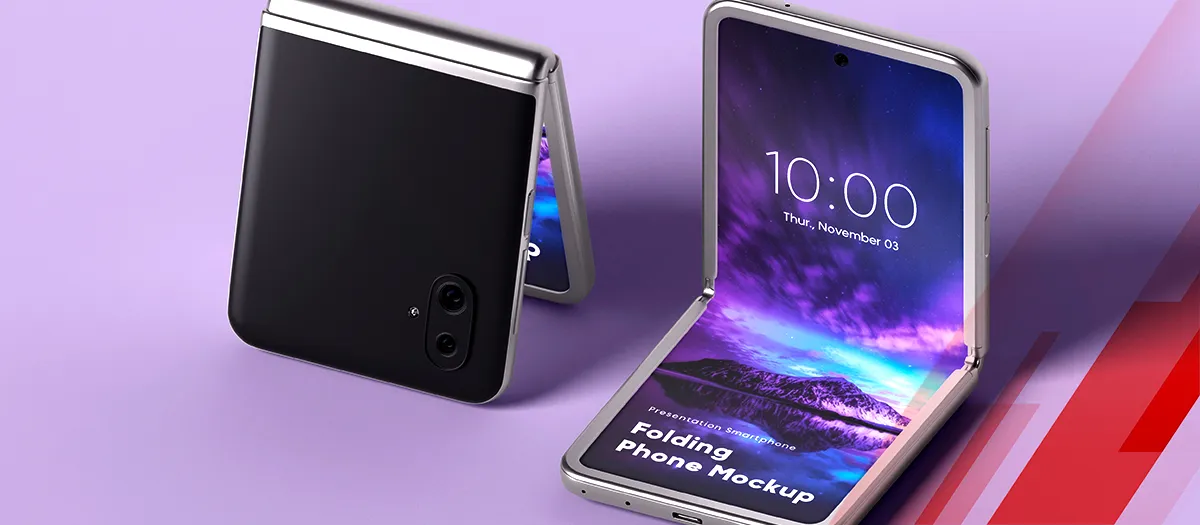
Foldable display technology allows a device smaller than a wallet to unfold into a tablet-sized screen. What appears to be a simple design feature is actually the result of several complex engineering breakthroughs. A foldable device must combine a screen that bends without cracking, a hinge that survives years of repeated folding, and software that adapts to a display that constantly changes shape. Understanding how this technology works requires examining all three systems together.
Foldable display technology is witnessing steady growth within the consumer electronics sector. According to Kings Research, the global foldable display market is likely to reach USD 261.93 billion by 2031. In this context, this blog examines the technology behind foldable displays and discusses the future direction of this emerging segment.
The Science Behind the Foldable Display Technology
Traditional smartphone displays use rigid glass layers and backlit LCD panels. Glass provides clarity and scratch resistance, but breaks when bent. Foldable display replaces this structure with a flexible OLED display built on bendable materials.
An OLED display, or organic light-emitting diode display, produces light through organic compounds placed between two conductive layers. When an electric current passes through the material, it emits light directly. Because OLED pixels generate their own light, the display does not require a separate backlight layer. Removing the backlight allows the entire screen to become much thinner and more flexible.
The challenge lies in the materials used inside OLED panels. Research from the University of Chicago’s Pritzker School of Molecular Engineering explains that many materials used in OLED structures are inherently brittle. Their 2023 research explores stretchable polymers that maintain brightness while bending, highlighting why making displays flexible is fundamentally a materials science problem.
To protect the flexible OLED layer, manufacturers add several supporting layers. One of the most important is ultra-thin glass, often abbreviated as UTG. UTG typically measures between 30 and 100 microns thick, thinner than a human hair, yet it provides a glass-like surface feel. Beneath this sits an optically clear adhesive layer that bonds all materials together while allowing repeated flexing. The outer protective coating reduces glare and protects the display from scratches.
Together, these layers allow the screen to bend thousands of times without breaking.
Glass Feel vs. True Flexibility
Two main material sets are used to create foldable display screens: polyimide and ultra-thin glass. Both sets have their individual advantages, and the most recent foldable display screens use both.
The main advantage of using polyimide is that it is flexible enough to bend without breaking, especially when subjected to small bending radii. Additionally, it is easier to produce on a large scale. The disadvantage is that it is not as smooth as ultra-thin glass. Polyimide has a more plastic feel, and it is more prone to scratches. The recent foldable phone models were criticized because they had a plastic feel and a crease on the display.
Ultra-thin glass is advantageous because it has a smooth feel, just like conventional display screens. The disadvantage is that ultra-thin glass is not as flexible as polyimide because, despite being thin, it cannot bend as tightly as plastic.
Most recent foldable display screens use a combination of both ultra-thin glass and polyimide. The ultra-thin glass is on the outside, while the polyimide is on the inside.
Why the Hinge is the Real Innovation
The hinge mechanism is often the most complex component in foldable display technology. The display may bend, but the hinge determines whether the device survives thousands of folds. A foldable hinge must distribute mechanical stress across the entire fold area while protecting the fragile display layers above it. The mechanism must also remain stable over time, resisting wear that could loosen the structure.
Samsung Display reported in July 2025 that its latest foldable OLED panels passed a durability test of 500,000 folding cycles. This milestone was achieved by increasing the thickness of ultra-thin glass by roughly 50 percent and introducing a high-elastic adhesive that absorbs mechanical stress.
Another important hinge innovation is the free-stop mechanism. Unlike traditional laptop hinges that snap open or closed, foldable phone hinges can hold their position at multiple angles. This allows devices to remain partially open for video calls or tabletop viewing. Achieving this capability requires extremely precise torque calibration.
Hinge geometry also affects the visible crease on the display. Many newer designs use a waterdrop or teardrop hinge shape. Instead of folding sharply in the center, the screen bends around a wider curve. A larger bending radius spreads mechanical stress across the display layers, reducing the depth of the crease.
However, hinge gaps introduce another challenge: water resistance. Because the hinge must move freely, sealing the mechanism against moisture is difficult. Many foldable devices therefore, carry limited water resistance ratings compared with traditional smartphones.
The One Problem Not Yet Fully Solved
The crease at the center of the foldable display screen is one of the more obvious limitations of this display technology. It is due to the differential properties of materials. When a display screen folds inward, one of the sides of the screen is subjected to tension, and the other is subjected to compression. This is an inherent property of all materials. This crease cannot be eliminated completely, although it can be minimized.
Increasing the radius of the fold also helps distribute stress more uniformly. The waterdrop hinge design also prevents extreme bending. The use of thinner OLED panels also helps minimize tension. However, none of the existing foldable display screens available in the market until 2025 is completely free of creases. The crease is visible at certain times, although it is not visible all the time.
Four Form Factors, Four Use Cases
Foldable display technology now appears in several device formats, each designed for a specific use case.
- Book-style foldables open like a notebook, transforming a smartphone into a tablet-sized display. These designs prioritize productivity and video streaming but require complex hinge engineering.
- Clamshell or flip designs fold vertically, creating a compact device that fits easily in a pocket. A small external display provides notifications without opening the phone. This design uses a simpler hinge but offers less screen expansion.
- Multi-fold devices extend the concept further. Some prototypes fold twice, transforming from phone size to tablet size through multiple stages. These systems require advanced hinge mechanisms capable of supporting multiple fold points.
- Rollable or slideable displays use a different approach. Instead of folding, the screen expands from inside the device housing. This design eliminates the crease but introduces new mechanical challenges.
Each form factor depends on a unique hinge architecture, which directly affects durability and crease visibility.
Beyond Smartphones
Although foldable phones receive the most attention, foldable display technology has applications far beyond smartphones.
Researchers are exploring shape-morphing OLED panels that can physically transform while remaining fully functional displays. In March 2025, researchers at POSTECH demonstrated a smartphone-type OLED panel capable of changing its shape while also functioning as a speaker. The work highlights how flexible displays could eventually reshape entire device categories.
Automotive manufacturers are also exploring flexible displays for dashboards and instrument clusters. Curved or foldable panels allow larger screen surfaces to fit into compact vehicle interiors.
Healthcare technology may also benefit from flexible displays. Wearable healthcare devices could use wrap-around displays that conform to the human body, allowing continuous monitoring while remaining comfortable.
Foldable laptops represent another emerging category. These devices replace a traditional keyboard with a large foldable screen that can operate as a laptop or tablet.
Together, these developments suggest that foldable displays represent more than a smartphone feature. They may become a platform technology for future electronics.
The Fold Ahead
The progress of foldable display technology depends on the simultaneous progress of three fields of engineering: material science, mechanical engineering, and device engineering. At the same time, the progress of stretchable OLED materials is constantly improving their flexibility and robustness. The creation of new types of electronic devices is just beginning with the improvement of the robustness of flexible displays. Foldable displays are now entering a new phase of technology where they are becoming a new interface between digital screens and physical objects.