3D Machine Vision Market Size, Share, Growth & Industry Analysis, By Component (Hardware, Software), By Application (Quality Control & Inspection, Measurement, Autonomous Navigation & Guidance, 3D Scanning, Others), By Industry Vertical (Automotive, Electronics & Semiconductors, Pharmaceuticals, Others), and Regional Analysis, 2025-2032
pages: 160 | baseYear: 2024 | release: November 2025 | author: Sunanda G. | lastUpdated: November 2025
The market involves the development and integration of imaging systems that capture three-dimensional data for precise analysis, inspection, and automation. These systems combine advanced cameras, sensors, and software to enable accurate measurement, object recognition, and quality assessment in in factories and production facilities.
The report includes segmentation based on component, application, industry vertical, and region. Key sectors such as automotive, electronics, logistics, and pharmaceuticals utilize 3D machine vision to enhance production accuracy, reduce defects, and improve process efficiency in manufacturing and quality control operations.
3D Machine Vision Market Overview
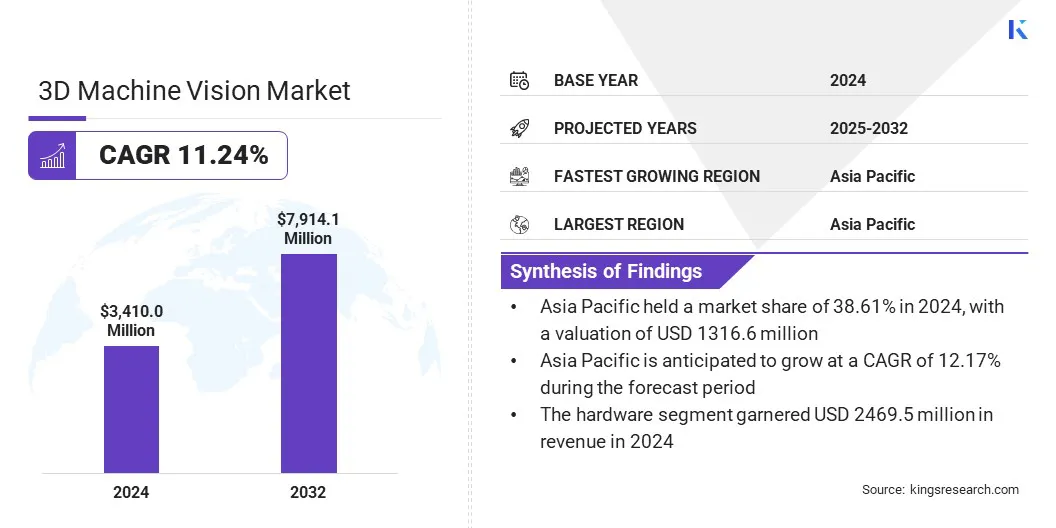
The global 3D machine vision market size was valued at USD 3,410.0 million in 2024 and is projected to grow from USD 3,754.1 million in 2025 to USD 7,914.1 million by 2032, exhibiting a CAGR of 11.24% during the forecast period.
The market is driven by the integration of 3D vision with the Internet of Things (IoT) and digital twin technologies that enable real-time process optimization and predictive analysis. The adoption of AI-driven image processing further enhances inspection accuracy and analytical capabilities across manufacturing and logistics sectors.
Key Highlights
The 3D machine vision industry size was valued at USD 3,410.0 million in 2024.
The market is projected to grow at a CAGR of 11.24% from 2025 to 2032.
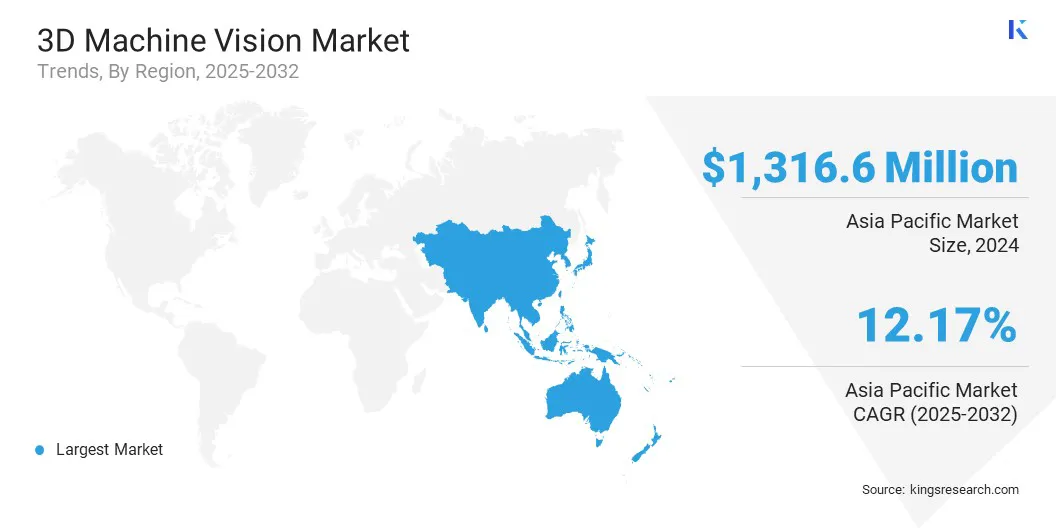
Asia Pacific held a market share of 38.61% in 2024, with a valuation of USD 1,316.6 million.
The hardware segment garnered USD 2,469.5 million in revenue in 2024.
The quality control & inspection segment is expected to reach USD 3,064.4 million by 2032.
The automotive segment secured the largest revenue share of 28.52% in 2024.
North America is anticipated to grow at a CAGR of 11.47% over the forecast period.
Major companies operating in the 3D machine vision market are Cognex Corporation, Keyence Corporation, OMRON Corporation, ISRA Vision, Kron Technologies, Basler AG, ORBBEC, SICK AG, wenglor sensoric GmbH, NATIONAL INSTRUMENTS CORP., MVTec Software GmbH, Stemmer Imaging, LMI TECHNOLOGIES INC., Hermary, and Teledyne Vision Solutions.
Growing adoption of robotics and automated inspection systems in automotive, electronics, and packaging industries is driving the market. Increasing reliance on automated systems is creating demand for technologies that improve accuracy and efficiency in production.
3D machine vision enhances defect detection and precise measurement of components, supporting consistent quality standards. Integrating these vision systems with robotics enables real-time monitoring and rapid corrective actions during manufacturing processes. This integration reduces production errors and lowers operational costs, improving overall factory performance.
In April 2024, Cognex Corporation launched the In‑SightL383D Vision System. The system combines AI, 2D, and 3D vision technologies, enabling reliable inspection and measurement in manufacturing automation.It creates unique projection images that embed 3D information into accessible 2D formats and uses rule‑based algorithms alongside AI tools to detect and measure features.
What factors are driving growth in the 3D machine vision market?
Integration of 3D vision with IoT and digital twins is driving the market. Combining these technologies enables intelligent manufacturing with real-time monitoring of production processes. Implementing 3D machine vision supports accurate defect detection and precise measurement across complex operations.
Linking vision systems with digital twins allows simulation and optimization of manufacturing workflows before execution. This integration improves productivity, reduces errors, and enhances resource utilization in factories. Increasing adoption of Industry 4.0 solutions is accelerating the deployment of 3D machine vision in smart factories globally.
In August 2024, Delta Electronics unveiled its “Digital Green Factory” solution at Automation Taipei 2024.The solution incorporates 3D machine‑vision technology within smart warehouse and logistics modules, coupled with a digital‑twin platform referred to as “”It also leverages AI‑driven analytics and IoT‑connected devices to enable real‑time virtual replicas of production lines and logistics flows.
What challenges are limiting 3D machine vision adoption?
A key challenge in the 3D machine vision market is the high expense associated with advanced cameras, processors, and analytical software. Implementation requires precise calibration, specialized training, and integration with existing automation systems, increasing overall costs. These financial and technical demands limit adoption among small and medium enterprises with constrained budgets.
To address this challenge, market players are developing modular, plug-and-play systems, providing cloud-based software options, and offering training and support services to reduce setup complexity. These measures are making 3D machine vision technology more accessible while maintaining accuracy and performance across applications.
What trends are shaping the 3D machine vision market?
A key trend in the market is the integration of AI-driven image processing to improve inspection and analysis capabilities. Deep learning algorithms are enhancing object detection by identifying complex shapes and features with higher accuracy. These algorithms are also supporting precise defect classification, reducing false positives and improving quality control.
Real-time adaptive decision-making is enabling automated adjustments in manufacturing and sorting processes, optimizing operational efficiency. Industries such as automotive, electronics, and logistics are implementing AI-powered 3D vision systems to reduce downtime and improve throughput.
In May 2024, Zebra Technologies Corporation launched the FS42 fixed industrial scanner and 3S Series 3D sensors.The FS42 scanner incorporates a neural processing unit (NPU) to support AI‑deep‑learning tools for anomaly detection and defect inspection.
3D Machine Vision Market Report Snapshot
Segmentation
Details
By Component
Hardware, Software
By Application
Quality Control & Inspection, Measurement, Autonomous Navigation & Guidance, 3D Scanning, Others
Europe: France, UK, Spain, Germany, Italy, Russia, Rest of Europe
Asia-Pacific: China, Japan, India, Australia, ASEAN, South Korea, Rest of Asia-Pacific
Middle East & Africa: Turkey, U.A.E., Saudi Arabia, South Africa, Rest of Middle East & Africa
South America: Brazil, Argentina, Rest of South America
Market Segmentation
By Component (Hardware, Software): The Hardware segment earned USD 2,469.5 million in 2024 due to the high demand for advanced cameras, sensors, and processors that deliver precise image acquisition and faster data processing in automated inspection and quality control applications.
By Application (Quality Control & Inspection, Measurement, Autonomous Navigation & Guidance, 3D Scanning, and Others): The Quality Control & Inspection segment held 39.81% of the market in 2024, due to the increasing demand for high-precision defect detection, dimensional measurement, and automated quality assurance in manufacturing and production environments.
By Industry Vertical (Automotive, Electronics & Semiconductors, Logistics & Warehousing, Pharmaceuticals, and Others): The Automotive segment is projected to reach USD 2,253.2 million by 2032, owing to the increasing adoption of automated inspection, assembly, and robotic guidance systems that ensure precision and quality control in large-scale vehicle manufacturing.
What is the market scenario in Asia Pacific and North America?
Based on region, the global 3D machine vision market has been classified into North America, Europe, Asia Pacific, Middle East & Africa, and South America.
The Asia Pacific 3D machine vision market share stood around 38.61% in 2024 in the global market, with a valuation of USD 1,316.6 million. This dominance is due to the rapid development of advanced industrial parks and smart factories across the region. Countries such as China, Japan, and South Korea are investing heavily in digitalized production lines that require accurate inspection and monitoring.
Electronics, automotive, and semiconductor manufacturers are increasingly adopting 3D machine vision to maintain high precision. Rising labor costs and skill shortages are further pushing companies to replace manual inspection with automated systems.
In November 2024, TOPPAN Holdings Inc. unveiled a new generation of 3D Time‑of‑Flight (ToF) sensors. The sensors feature a compact form factor and lower power consumption compared to previous models. They are designed for robotics and spatial‑mapping applications and are scheduled for mass production from October 2025.
The market in North America is expected a significant CAGR of 11.47% over the forecast period. This growth is due to the presence of highly advanced automotive and aerospace manufacturing facilities across North America. Manufacturers are integrating 3D machine vision systems for precise inspection of components and assemblies.
These systems help detect defects and ensure quality standards in complex manufacturing processes. Rising demand for electric vehicles and aerospace innovation increases the need for high-precision inspection technologies. This environment is driving consistent adoption of 3D machine vision solutions in manufacturing operations.
In March 2025, Photoneo and Senswork Inc. announced their robot‑based 3D inspection solution for manufacturing environments in North America. The system integrates Photoneo’s high‑precision 3D scanners with senswork’s robotic vision platform for real‑time inline quality control on production lines.
Regulatory Frameworks
In the U.S., industrial machinery and automation systems, including 3D machine vision equipment, must align with the general duty clause under the Occupational Safety and Health Administration (OSHA), which mandates a workplace free from known hazards. American National Standards Institute (ANSI) B11‑series standards such as ANSI B11.0 “Safety of Machinery – General Requirements and Risk Assessment” and ANSI/Robotics Industries Association (RIA) R15.06 “Safety Requirements for Industrial Robots and Robot Systems” provide industry consensus on machinery and robotics safety.
In the European Union, the regulation (EU) 2023/1230 on machinery governs design, construction, and placing on the market of machinery and safety components from 20 January 2027. Machinery, including machine vision systems integrated in wider equipment, must be CE‑marked, undergo conformity assessment, and adhere to harmonised standards (e.g., DIN EN ISO 12100 in Germany).
In Japan, the Industrial Safety and Health Act mandates employer responsibility for the safety of workers and installation of safe equipment and environment in workplaces. Machinery and automation systems deployed in manufacturing must observe these obligations and align with Japanese Industrial Standards (JIS) for design, maintenance and operator safety.
In China, the Compulsory Certification (CCC) mark is a mandatory safety‑assessment system for many electrical/electronic products, affecting components used in machine vision hardware. Further, the “Measures for the Administration of the Restricted Use of Hazardous Substances Contained in Electrical and Electronic Products” (China RoHS) regulates environmental compliance of vision system electronics.
Competitive Landscape
Market players are expanding R&D in 3D imaging and developing compact high-performance vision systems to remain competitive in the market. Companies are increasingly focusing on integrating meta-optics, liquid lenses, diffractive optical elements, and other advanced optical components to achieve smaller form factors without compromising depth accuracy.
Investments in near-infrared sensing and high-precision imaging are enabling reliable operation across diverse industrial and automotive applications. Strategic partnerships between vision hardware developers and semiconductor manufacturers are supporting faster commercialization of compact 3D vision modules.
In January 2025, NIL Technology (NILT) launched the metaCamera product line. The series features ultra‑compact near‑infrared (NIR) cameras designed for distances ranging from 2mm to infinity and utilizes meta‑optics rather than traditional refractive lenses. These cameras are optimized for applications including machine vision, automotive safety, and IoT sensing, enabling 3D‑sensing in space‑constrained smart manufacturing environments.
In April 2025, MVTec Software GmbH launched Version 25.05 of its HALCON machine-vision software, introducing “Deep 3D Matching”, a new feature for detecting and matching objects in 3-D space using deep-learning plus classic methods.
In August 2024, TKH Group NV acquired Liberty Robotics, a company that develops volumetric 3D machine vision solutions for robotic guidance in automotive and logistics sectors. Liberty Robotics’ end-of-arm guidance and coating/part handling vision solutions will be integrated into TKH’s portfolio via its subsidiary LMI Technologies.
In July 2024, Aetina Corporation announced a partnership with Solomon Technology Corporation to deliver customizable edge‑AI and 3D vision solutions. Aetina brings high‑performance edge AI platforms based on NVIDIA Jetson, while Solomon contributes state‑of‑the‑art 3D and AI‑powered machine vision devices.
In June 2024, Basler AG acquired a 25.1 % stake in Roboception GmbH in order to strengthen its 3D vision offering for factory automation, robotics, and logistics. Roboception is a specialist in 3D sensor hardware and software, and Basler intends to expand its 3D solution business via this strategic investment.
In January 2024, Orbbec collaborated with Hiwonder to bring Orbbec’s Astra+ 3D camera technology into educational robotics kits. The collaboration enables Hiwonder’s JetHexa ROS Hexapod Robot Kit and JetAuto ROS Robot Car to integrate 3D depth-vision, mapping and AI features.
freqAskQues
What is the current size and growth outlook of the 3D machine vision market?
Which factors are driving adoption of 3D machine vision systems?
What are the key components of 3D machine vision systems?
Which applications use 3D machine vision the most?
How does integration with IoT and digital twin technologies support market expansion?
What challenges limit adoption of 3D machine vision systems?
Which regions are leading in adoption of 3D machine vision systems?
How does this report help identify investment opportunities in 3D machine vision?
How can businesses select the right 3D machine vision solution?
How does the report assist with regional market insights?
How does the report explain the competitive positions of companies?
Author
Sunanda is a proficient research analyst with strong cross-domain expertise, excelling in identifying market trends and delivering insightful analyses across various industries, including consumer goods, food & beverages, healthcare, and more. Her ability to connect insights from diverse sectors enables her to offer actionable recommendations that support strategic decision-making in a range of business contexts. Sunanda’s research is driven by thorough data analysis and her commitment to providing relevant, data-driven insights. Outside of her professional endeavors, Sunanda's passion for travel, adventure, and music fuels her creativity and broadens her perspective, enriching her approach to both life and work.
With over a decade of research leadership across global markets, Ganapathy brings sharp judgment, strategic clarity, and deep industry expertise. Known for precision and an unwavering commitment to quality, he guides teams and clients with insights that consistently drive impactful business outcomes.



 3D Machine Vision Market