Augmented reality in retail involves integrating interactive digital elements such as images, 3D models, or product information into physical shopping environment through smartphones, tablets, or AR devices. It enhances the consumer experience through virtual try-ons, real-time product visualization, and immersive engagement. Retailers leverage AR to bridge online and offline channels, boost purchase confidence, and improve customer engagement.
Augmented Reality in Retail Market Overview
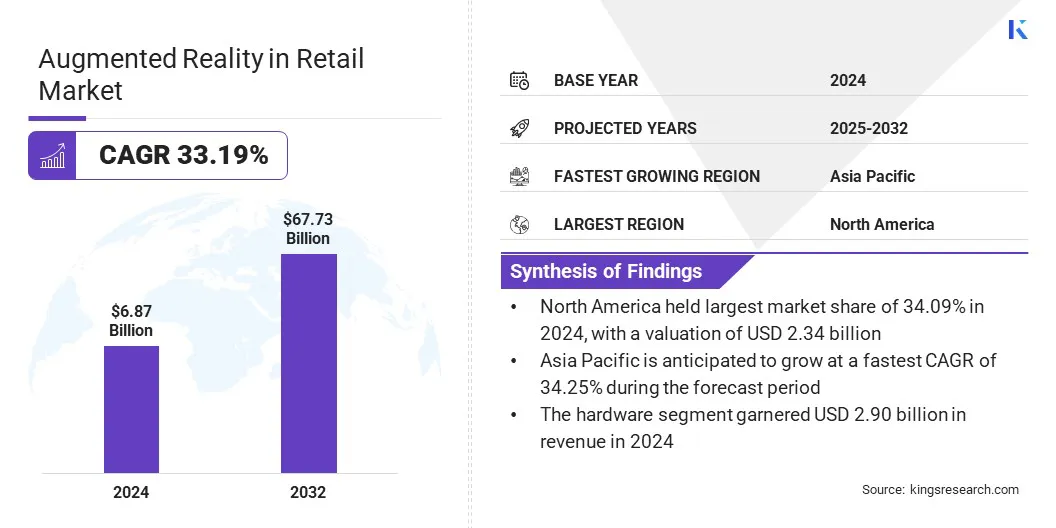
The global augmented reality in retail market size was valued at USD 6.87 billion in 2024 and is projected to grow from USD 9.11 billion in 2025 to USD 67.73 billion by 2032, exhibiting a CAGR of 33.19% during the forecast period.
This growth is attributed to increasing consumer demand for precise product evaluation and informed purchasing across online and physical retail channels. Augmented reality solutions offer immersive product visualization, minimizing purchase uncertainty and improving decision-making.
Key Highlights:
The augmented reality in retail industry size was recorded at USD 6.87 billion in 2024.
The market is projected to grow at a CAGR of 33.19% from 2025 to 2032.
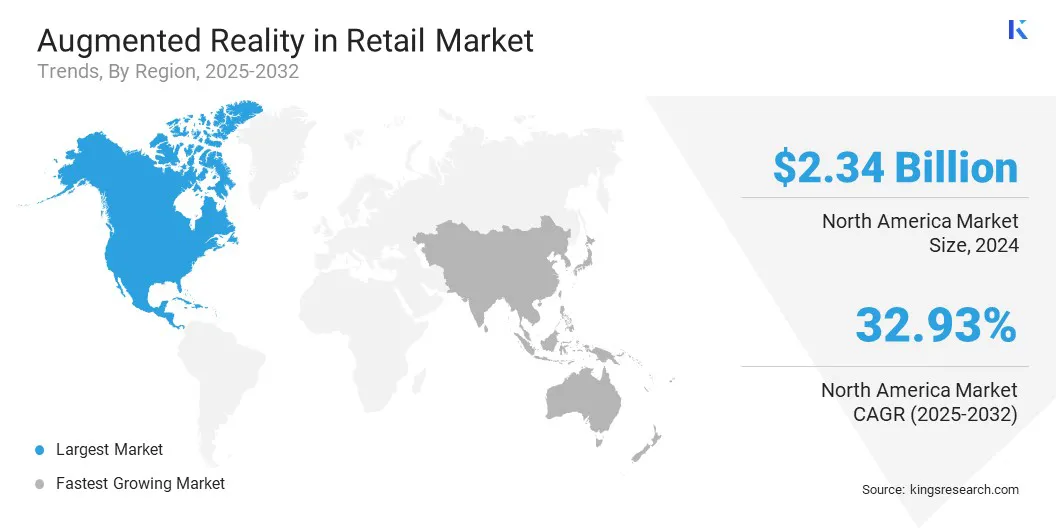
North America held a share of 34.09% in 2024, valued at USD 2.34 billion.
The hardware segment garnered USD 2.90 billion in revenue in 2024.
The head-mounted display segment is expected to reach USD 22.23 billion by 2032.
The digital product information segment is anticipated to witness the fastest CAGR of 33.67% over the forecast period.
Asia Pacific is anticipated to grow at a CAGR of 34.25% through the projection period.
Major companies operating in the augmented reality in retail market are Zebra Technologies Corp., Google LLC, Snap Inc., PTC, Inter IKEA Systems B.V., Engine Creative Agency Ltd (Reydar), Blippar Group Limited, Holition Limited, Zugara, Inc., Amazon.com Services LLC, Salsify, Sony Semiconductor Solutions Corporation, Vuzix Corporation, Magic Leap, Inc., and SAMSUNG.
Market growth is driven by retailers’ growing adoption of omnichannel retail strategies that integrate digital and physical shopping experiences. The approach allows consumers to engage consistently across online platforms, mobile applications, and brick-and-mortar stores.
Augmented reality further enhances this integration through virtual product trials, in-store navigation, and immersive displays, improving consumer engagement and retention. Leveraging AR to connect online and offline touchpoints helps strengthen brand loyalty and boost conversion rates across channels.
What factors are driving the rising accessibility of mobile AR and smartphone penetration and in the retail market?
Increasing device affordability, high-speed connectivity, and improved processing power enable large-scale deployment of AR-based retail applications. Consumers increasingly engage in immersive shopping experiences via mobile devices, influencing purchase behavior and driving higher engagement.
Retailers leverage mobile AR tools for product visualization and virtual trials, supporting the expanding adoption of augmented reality in the retail landscape. Expanding smartphone usage and advancements in mobile AR technology are propelling market growth.
In September 2025, the National Informatics Centre reported that India surpassed China in smartphone exports to the U.S. during Q2 2025. Mobile phone exports increased significantly to USD 24 billion in FY 2024-25, up from USD 0.18 billion in FY 2014-15, underscoring robust growth in manufacturing and exports.
How are data privacy and security concerns impeding the progress of the augmented reality in retail market?
AR applications collect sensitive consumer data, including facial scans, location details, and behavioral patterns, raising data privacy and security concerns. Unauthorized data access or misuse can compromise consumer trust and brand credibility.
Retailers face stringent data protection regulations that require secure handling of user information and transparent privacy policies, making cybersecurity investments essential to maintain consumer confidence and compliance in AR-driven retail operations.
To address this challenge, companies are adopting end-to-end encryption, multi-layer authentication, and anonymized data frameworks. Retailers are increasingly partnering with cybersecurity firms to strengthen AR infrastructure, ensuring user data integrity and regulatory compliance across all retail touchpoints.
What is the impact of AR-powered placement on consumer purchase confidence in home décor retail?
The augmented reality in retail market is influenced by the growing adoption of AR-powered furniture and home décor visualization tools. These technologies allow customers to virtually preview products in real-world settings, improving purchase confidence and decision-making.
Brands such as IKEA use AR applications to demonstrate furniture placement, texture, and scale. These solutions enhance user experience, minimize product returns, and strengthen consumer trust, underscoring the importance of AR-powered furniture visualization.
In February 2024, IKEA Australia introduced IKEA Kreativ, an AI-powered mixed-reality design platform that enables customers to digitally redesign their living spaces. The tool allows users to scan rooms, remove existing furniture, and virtually place IKEA products to visualize different décor configurations in real-world settings.
Augmented Reality in Retail Market Report Snapshot
Digital Product Information, AR Campaigns, Virtual Try-On, AR Layout Planning, Others
By Region
North America: U.S., Canada, Mexico
Europe: France, UK, Spain, Germany, Italy, Russia, Rest of Europe
Asia-Pacific: China, Japan, India, Australia, ASEAN, South Korea, Rest of Asia-Pacific
Middle East & Africa: Turkey, U.A.E., Saudi Arabia, South Africa, Rest of Middle East & Africa
South America: Brazil, Argentina, Rest of South America
Market Segmentation:
By Component (Hardware, Software, and Services): The hardware segment generated USD 2.90 billion in revenue in 2024, mainly due to the rising adoption of AR headsets, smart glasses, and display systems enhancing immersive retail experiences.
By Display (Head-mounted Display, Smart Glass, Head-up Display, and Handheld Devices): The head-up display segment is poised to record a staggering CAGR of 33.26% through the forecast period, propelled by increasing deployment of in-store navigation and customer engagement applications in retail environments.
By Application (Digital Product Information, AR Campaigns, Virtual Try-On, AR Layout Planning, and Others): The digital product information segment is estimated to hold a share of 23.90% by 2032, fueled by retailers’ focus on interactive product visualization and real-time information display through AR interfaces.
What is the market scenario in North America and Asia Pacific region?
Based on region, the global augmented reality in retail market has been classified into North America, Europe, Asia Pacific, Middle East & Africa, and South America.
The North America augmented reality in retail market accounted for a share of 34.09% in 2024, valued at USD 2.34 billion. This dominance is attributed to robust technology infrastructure, widespread adoption of AR-enabled devices, and increasing use of virtual product visualization tools in fashion, beauty, and home décor.
Strategic collaborations between AR software developers and retail enterprises are further reinforcing regional market growth, as companies focus on advancing immersive retail technologies to enhance customer engagement across digital and physical channels.
In September 2025, LG Electronics launched RetailVerse, an advanced retail platform designed to redefine product discovery. The platform, supported by AI-powered applications, delivers immersive 3D product experiences across online and in-store channels, demonstrating the company’s commitment to transforming digital retail engagement through interactive technologies.
The Asia-Pacific augmented reality in retail industry is set to grow at a CAGR of 34.25% over the forecast period. This notable growth is supported by rapid digital transformation, expanding e-commerce, and increasing investments in immersive retail technologies.
Additionally, emerging retail ecosystems and rising disposable incomes are fostering AR adoption. Retailers in the region are integrating AR features into mobile applications and online platforms to improve consumer engagement and brand differentiation, supporting regional market expansion.
In November 2025, Lenskart announced plans to launch its first AI-powered smart glasses by December, developed on the Gemini 2.5 platform. The product integrates artificial intelligence with commerce to enhance eyewear functionality through interactive and convenience-driven features.
Regulatory Frameworks
In the U.S., the California Consumer Privacy Act (CCPA) governs the collection, use, and sharing of consumer data. It requires AR retail platforms to transparently collect and process user data, ensuring adherence to data protection and consent regulations.
In the EU, the General Data Protection Regulation (GDPR) enforces stringent requirements on personal data management. AR-based retail applications must obtain user consent and implement robust safeguards for location, behavioral, and biometric data collected during interactive shopping experiences.
In Japan, the Act on the Protection of Personal Information (APPI) supervises corporate data practices. It requires AR retail operators to ensure data accuracy, restrict third-party sharing, and maintain user confidentiality.
In Australia, the Privacy Act 1988 regulates entities collecting personal information, mandating AR-driven retail platforms to clearly disclose data usage purposes and protect user identities across digital environments.
In Canada, the Personal Information Protection and Electronic Documents Act (PIPEDA) oversees privacy practices in digital commerce. It governs the storage, transfer, and processing of user data in AR retail applications, emphasizing accountability and informed consent.
Competitive Landscape
Key players in the augmented reality in retail industry are focusing on continuous technological innovation, strategic collaborations, and product portfolio expansion to sustain competitiveness. Firms are investing in R&D to improve real-time rendering, 3D visualization, and cross-platform compatibility.
Strategic acquisitions support diversification and entry into niche retail applications. Investments in AR software, hardware upgrades, and advanced analytics strengthen integration within retail ecosystems, while partnerships with retailers, device manufacturers, and AR content developers expand deployment opportunities.
In May 2025, HCLTech, in collaboration with CareAR and ServiceNow, launched an augmented reality-based infrastructure management solution. The platform leverages augmented intelligence, real-time remote assistance, and automated workflows to optimize IT operations, streamline infrastructure management, enhance operational resilience, and reduce costs and downtime across critical technology environments.
Key Companies in Augmented Reality in Retail Market:
In October 2025, Magic Leap announced at the Future Investment Initiative in Riyadh its strategic expansion into augmented reality glasses and a renewed partnership with Google. The company aims to strengthen its role in the AR ecosystem by leveraging expertise in display systems, optics, and system integration to advance next-generation AR technologies.
freqAskQues
What are key drivers in the augmented reality in retail market?
Which regions are central to augmented reality in retail growth?
What challenges does the augmented reality in retail industry face today?
What trends are shaping the future of augmented reality in retail?
Who are the major players in this market?
What opportunities exist for investors or manufacturers?
How should investors evaluate augmented reality in retail projects?
How is the digital transformation impacting augmented reality in retail?
How does this report help me focus our growth strategy on the most promising geographic region?
How can this report support investment decision in AR-enabled customer engagement platforms?
How does this report help me understand which component category holds the largest economic impact?
How does this report help me understand and plan for increasing pressure to deliver personalized and sustainable shopping experiences?
Author
Antriksh is an experienced analyst specializing in cross-domain research across diverse industries. With a strong foundation in data analysis and statistical interpretation, he delivers insightful market reports that guide strategic decision-making. Antriksh excels in conducting primary research, with a focus on identifying trends and understanding consumer behavior.
Thriving in dynamic and high-pressure environments, he combines analytical expertise with a commitment to delivering impactful outcomes. Beyond his professional pursuits, Antriksh's passion for travel fuels his curiosity and broadens his perspectives, enriching his ability to uncover unique insights that enhance his research capabilities.
With over a decade of research leadership across global markets, Ganapathy brings sharp judgment, strategic clarity, and deep industry expertise. Known for precision and an unwavering commitment to quality, he guides teams and clients with insights that consistently drive impactful business outcomes.



 Augmented Reality in Retail Market