Dental Practice Management Software Market Size, Share, Growth & Industry Analysis, By Deployment (Cloud-based, On-premises, Hybrid), By Application (Patient Communication, Invoice/Billing, Electronic Patient Records, Document Management, Others), By End User (Dental Clinics, Hospitals, Others), and Regional Analysis, 2025-2032
pages: 160 | baseYear: 2024 | release: December 2025 | author: Antriksh P. | lastUpdated: December 2025
The market refers to digital systems designed to streamline clinical, administrative, and financial operations within dental practices. These solutions support patient record management, appointment scheduling, imaging integration, billing, insurance processing, and workflow coordination across single and multi-clinic environments.
Cloud-based and on-premises platforms enable structured data management, operational efficiency, and regulatory compliance. Digital transformation initiatives adopted by dental service providers position this market as a core element of their technology infrastructure.
Dental Practice Management Software Market Overview
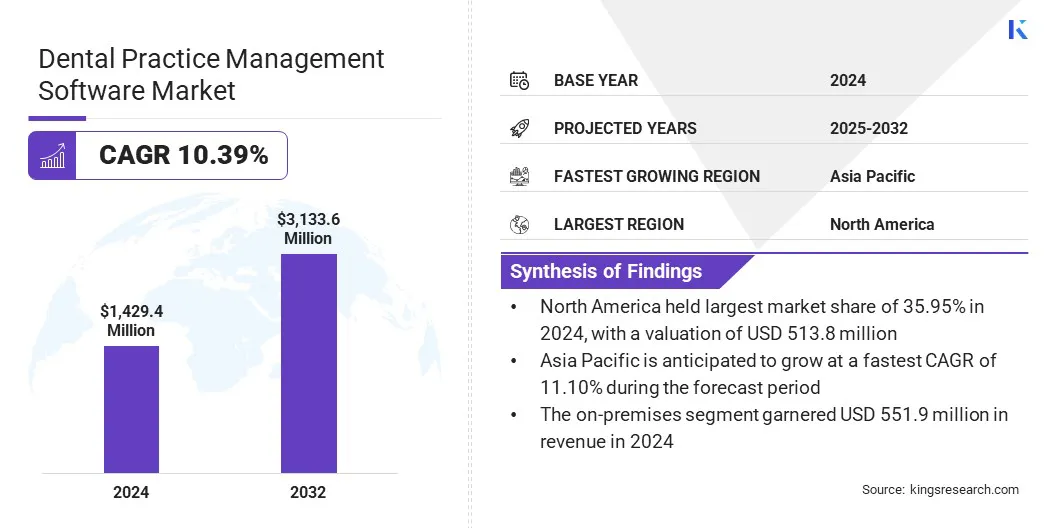
The global dental practice management software market size was valued at USD 1,429.4 million in 2024, and is projected to grow from USD 1,568.8 million in 2025 to USD 3,133.6 million by 2032, exhibiting a CAGR of 10.39% during the forecast period.
This growth is mainly driven by the rising adoption of digital tools that replace manual documentation to streamline practice operations. Increased focus on operational accuracy and compliance further strengthens the transition to paperless workflows across dental practices.
Key Market Highlights:
The dental practice management software industry was recorded at USD 1,429.4 million in 2024.
The market is projected to grow at a CAGR of 10.39% from 2025 to 2032.
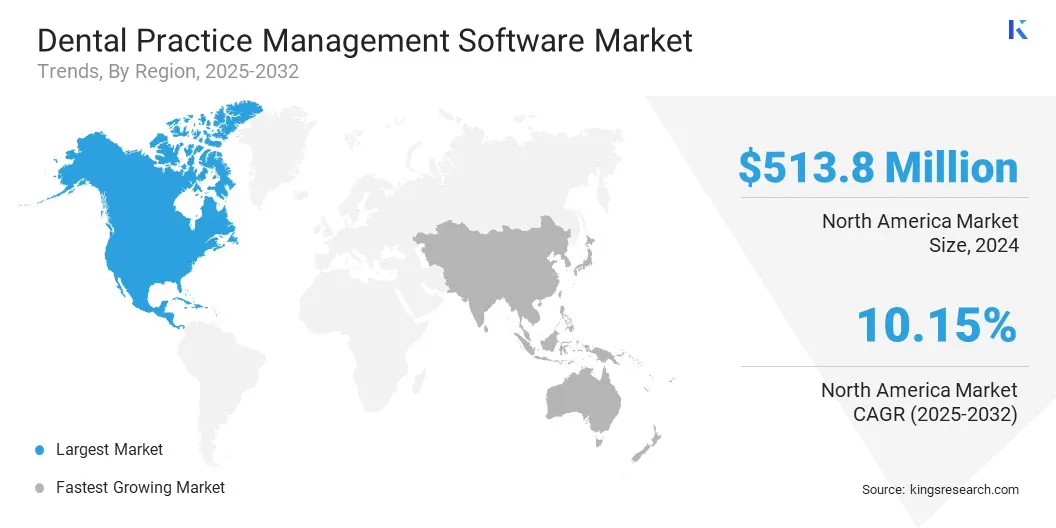
North America held a share of 35.95% in 2024, valued at USD 513.8 million.
The on-premises segment garnered USD 551.9 million in revenue in 2024.
The patient communication segment is expected to reach USD 823.0 million by 2032.
The hospitals segment is anticipated to witness the fastest CAGR of 10.33% over the forecast period.
Asia Pacific is anticipated to grow at a CAGR of 11.10% through the projection period.
Major companies operating in the dental practice management software market are Carestream Dental LLC, CD Newco, LLC, Dentally, Good Methods Global Inc., Henry Schein One, LLC, NXGN Management, LLC, Open Dental Software, Practice-Web Inc., ACE Dental, CompuGroup Medical, Dentiflow, Planet DDS, Datacon Dental Systems, Oryx Dental Software, and PEARL, INC.
The increased adoption of cloud-based multi-clinic management platforms reflects the shift toward centralized oversight where dental groups manage records, billing, scheduling, and reporting across multiple locations. This adoption strengthens market growth as demand rises for secure cloud architecture that enables remote access and coordinated operations.
Multi-clinic structures require unified data systems that maintain consistency in administrative and clinical workflows, while cloud-based dental tools support scalability, operational visibility, and streamlined collaboration, establishing a clear pathway for efficient practice management across expanding dental networks.
In November 2025, Curve Dental partnered with DentalHQ to expand its connected cloud ecosystem and strengthen its position in digital dentistry. The integration enables practices to implement and manage in-house membership programs efficiently, streamlining administrative workflows and supporting predictable recurring revenue models.
What role do technological advancements play in fueling market growth?
Technological advancements in dental practices highlights the expansion of digital capabilities in modern clinics. Growing use of automated administrative tools improves operational accuracy through reduced manual handling and fewer documentation errors.
Advancements in clinical and operational systems prompt software upgrades that streamline workflow coordination. Integrated platforms that combine imaging, diagnostics, and administration create more cohesive practice environments. Advanced technological capabilities further support sustained alignment between digital processes and evolving practice requirements, thereby boosting market expansion.
In April 2025, XDENT introduced updated dental practice management software featuring advanced 3D charting and enhanced patient engagement tools. The platform now includes AI-powered AutoScriber for hands-free clinical note transcription and WhatsApp-enabled patient communication. The overall setup establishes a higher standard for operational efficiency, diagnostic precision, and streamlined patient interaction within dental practices.
What challenge arises from cybersecurity exposure?
Concerns pertaining to cybersecurity risks in the dental practice management software market highlight the vulnerabilities associated with data breaches, unauthorized access, and system disruptions affecting digital dental operations. This challenge intensifies as practices rely on cloud platforms for administrative and clinical functions, increasing exposure to cyber threats. Providers require secure frameworks that protect sensitive patient information and ensure operational continuity.
To address this challenge, organizations deploy stronger encryption protocols, implement real-time threat monitoring, adopt advanced authentication systems, enhance compliance practices, and maintain structured governance frameworks to safeguard connected dental software environments.
How does the integration of AI-enabled tools influence market expansion?
The dental practice management software market is influenced by the integration of AI-enabled clinical decision support tools that enhance diagnostic accuracy, treatment planning, and patient management. Integrating the tools drive the market expansion through systems that support data-driven assessments, strengthen diagnostic precision, and enhance operational decision-making across dental practices.
These tools also support daily tasks and mundane processes such as automated reminders, risk assessments, and workflow optimization. Dental providers benefit from platforms that combine administrative functionality and intelligent insights, ensuring stronger outcomes supported through AI-enabled tools within practice management environments.
In October 2025, Carestream Dental, a digital imaging software, and practice management solutions provider, launched CS 3D Imaging Premium, an AI-powered software solution designed to streamline implant planning and simplify case sharing. The platform uses advanced artificial intelligence to automate routine tasks, enabling dental professionals to accelerate implant planning workflows and support more efficient clinical decision-making.
Dental Practice Management Software Market Report Snapshot
Europe: France, UK, Spain, Germany, Italy, Russia, Rest of Europe
Asia-Pacific: China, Japan, India, Australia, ASEAN, South Korea, Rest of Asia-Pacific
Middle East & Africa: Turkey, U.A.E., Saudi Arabia, South Africa, Rest of Middle East & Africa
South America: Brazil, Argentina, Rest of South America
Market Segmentation
By Deployment (Cloud-based, On-premises, and Hybrid): The on-premises segment generated USD 551.9 million in 2024, due to demand for localized data control, dedicated security environments, and facility-specific customization supporting administrative and clinical workflows.
By Application (Patient Communication, Invoice/Billing, Electronic Patient Records, Document Management, and Others): The invoice/billing segment is poised to record a CAGR of 10.75%, propelled by rising adoption of automated financial workflows, integrated claims processing, and structured revenue cycle tools, improving administrative accuracy in dental practices.
By End User (Dental Clinics, Hospitals, and Others): The dental clinics segment is estimated to hold a 41.72% share by 2032, fueled by growing clinic networks, software adoption for workflow coordination, and dependence on digital tools for operational efficiency.
Based on region, the market has been classified into North America, Europe, Asia Pacific, Middle East & Africa, and South America.
What is the market scenario in North America and Asia Pacific region?
North America dental practice management software market share stood at 35.95% in 2024, valued at USD 513.8 million. This dominance is reinforced by rising adoption of patient engagement tools that support digital communication, remote scheduling, and automated reminders across dental service providers.
Expansion is further propelled by advanced administrative tools, automated billing capabilities, and integrated clinical modules that streamline operations across larger dental groups operating multiple locations.
Large practice groups continue to invest in scalable platforms that consolidate scheduling, patient management, and revenue functions under unified systems. Rising integration of AI-powered call management tools further enhances communication workflows and strengthens coordination across diagnostic, clinical, and administrative environments, fueling regional market progress.
In February 2025, Curve Dental integrated Mango Voice into its platform to provide AI-powered call documentation capabilities. The integration automates patient call summaries, reduces manual data entry, and streamlines workflow management. Mango Voice’s AI technology enables dental practices to capture and store call information directly within the Curve Dental system, strengthening operational efficiency and record accuracy.
The Asia Pacific dental practice management software industry is set to grow at a CAGR of 11.10% over the forecast period. This rapid growth is attributed to the rising adoption of cloud-based platforms and the expanding digital infrastructure across regional dental networks.
The demand for cloud-based platforms continues to rise for workflow automation, electronic patient records, and integrated imaging modules, strengthening the shift toward structured digital processes. Regional dental service providers are prioritizing scalable systems capable of handling larger patient volumes and supporting operational efficiency across evolving dental service environments.
Furthermore, regional market growth is reinforced by partnerships with local players requiring centralized data systems to improve administrative coordination and ensure consistent workflow management across expanding dental service networks.
In January 2025, Pearl announced a strategic partnership with Centaur and its Mediasuite platform. The collaboration extends access to Pearl’s Second Opinion AI software, enabling broader integration of advanced disease-detection capabilities. The partnership strengthens Pearl’s global footprint and supports wider adoption of AI-driven diagnostic tools across dental practices in key international markets.
Regulatory Frameworks
In the U.S., the Health Insurance Portability and Accountability Act (HIPAA) governs protection of patient health information. It establishes requirements for data privacy, security controls, and audit mechanisms relevant to dental practice management software.
In the European Union, the General Data Protection Regulation (GDPR) regulates handling of personal data. It enforces strict rules on data processing, consent management, cross-border transfers, and security obligations affecting dental software platforms.
In Canada, the Personal Information Protection and Electronic Documents Act (PIPEDA) oversees management of patient information. It mandates accountability, transparency, and secure data practices across digital dental systems.
In Australia, the Privacy Act regulates use and disclosure of patient data. It outlines compliance obligations for software handling sensitive information, ensuring structured governance within dental practice management environments.
Competitive Landscape
Key players operating in the dental practice management software industry are focusing on product innovation to strengthen their competitive position. They are expanding cloud-based capabilities to improve interoperability across imaging and diagnostic modules while strengthening automation features that support revenue cycle management.
Growing investment in AI-driven functionalities enhances decision support, workflow accuracy, and clinical documentation. Reinforcement of cybersecurity infrastructure further advances compliance readiness and system reliability, enabling sustained market relevance and long-term competition. Strategic partnerships and platform integrations remain central to portfolio expansion, enabling broader coverage across administrative and clinical functions.
In February 2024, Good Methods Global Inc. partnered with Alcan Dental Cooperative, a dental partnership organization focused on pediatric care. The collaboration integrates Alcan’s operational services with Good Methods Global Inc.’s practice management technology to enhance workflow efficiency and patient experience. The partnership aims to advance operational performance across pediatric practices while supporting clinical and administrative teams.
Key Companies in Dental Practice Management Software Market:
In August 2025, Curve Dental introduced Curve FLO AI, an embedded suite of artificial intelligence capabilities designed to enhance productivity across dental practices. Integrated directly into the Curve platform, FLO AI removes reliance on external AI tools by delivering intelligence at the point of care. The launch strengthens Curve Dental’s leadership in AI-driven dental technology and supports more efficient, accurate, and streamlined practice management workflows.
In July 2024, Good Methods Global Inc. announced its integration with Overjet’s FDA-cleared AI technology, enabling users to access advanced capabilities for detecting, outlining, and quantifying oral diseases. The integration enhances diagnostic precision within the Good Methods Global Inc. platform and supports more informed clinical decision-making across dental practices.
freqAskQues
What is the current size and projected growth of the global dental practice management software market?
What are the key factors driving the dental practice management software market?
What challenges are hindering the market?
Who are the major players operating in the market?
Which technological advancements are shaping the market?
Which regions are leading in dental practice management software adoption?
What are the primary end-use segments for dental practice management software?
What trends are influencing the future of the market?
How can this report help me identify the most promising technological shifts in dental practice management software?
How can I use this report to evaluate investment opportunities in the market?
How does this report help me understand operational and cost challenges in dental practice management software?
How can this report help me make the case for investing in advanced technologies for dental practice management operations?
Author
Antriksh is an experienced analyst specializing in cross-domain research across diverse industries. With a strong foundation in data analysis and statistical interpretation, he delivers insightful market reports that guide strategic decision-making. Antriksh excels in conducting primary research, with a focus on identifying trends and understanding consumer behavior.
Thriving in dynamic and high-pressure environments, he combines analytical expertise with a commitment to delivering impactful outcomes. Beyond his professional pursuits, Antriksh's passion for travel fuels his curiosity and broadens his perspectives, enriching his ability to uncover unique insights that enhance his research capabilities.
With over a decade of research leadership across global markets, Ganapathy brings sharp judgment, strategic clarity, and deep industry expertise. Known for precision and an unwavering commitment to quality, he guides teams and clients with insights that consistently drive impactful business outcomes.



 Dental Practice Management Software Market